


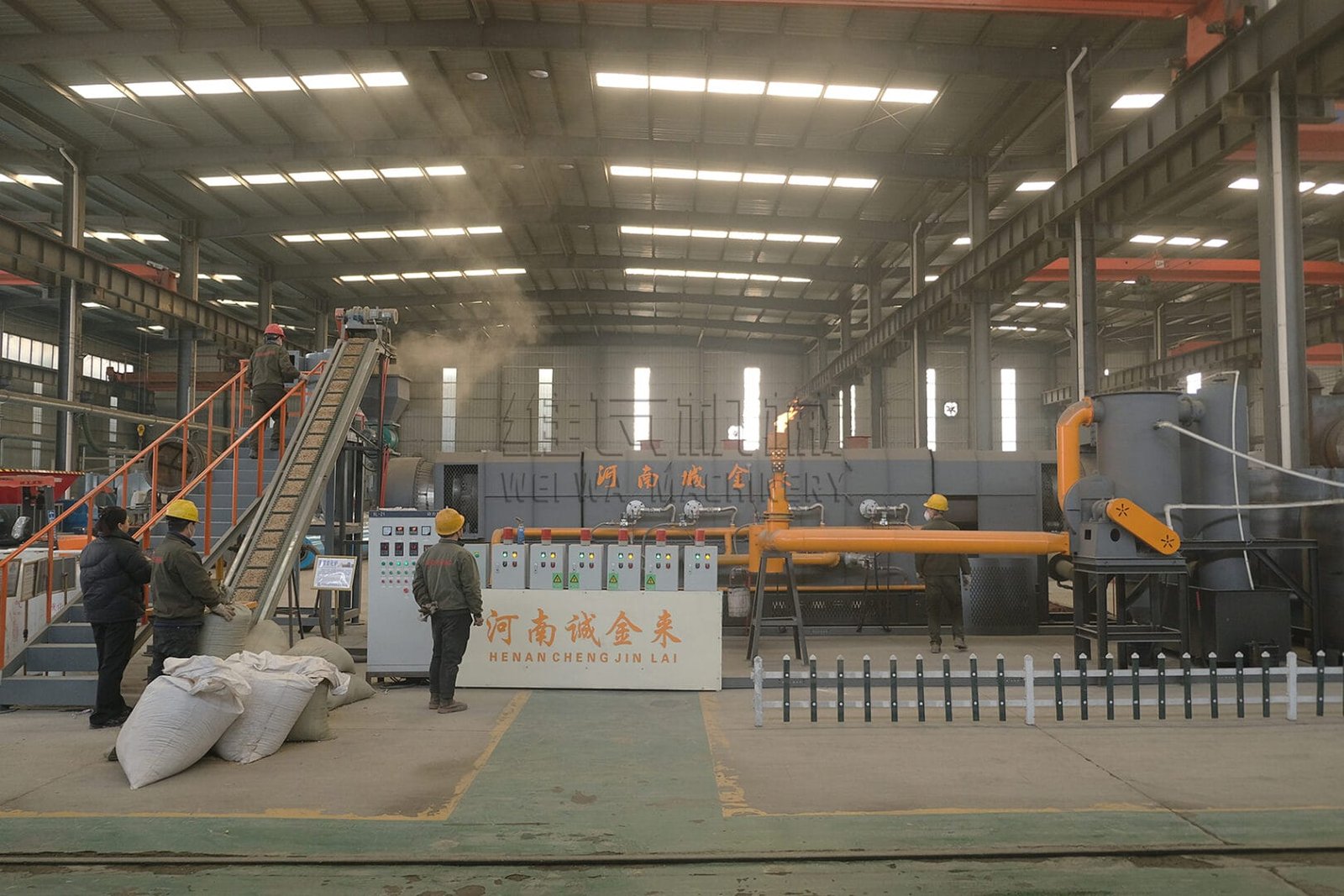
最近几年, 全球对可持续、高效生物炭生产的需求一直在上升. 作为一家致力于为可再生能源解决方案提供高品质机械的公司, Weiwa Machinery is proud to have recently conducted a successful trial of our 连续碳化炉在印度尼西亚. 这次, we used 棒子 as the raw material, 该地区资源丰富, to produce high-quality 生物炭.
The test not only demonstrated the performance of our continuous carbonization furnace for corncob, 同时也强调了这项技术在印度尼西亚市场的潜力.
什么是连续式炭化炉?
一个 连续碳化炉 is an advanced piece of equipment designed to convert biomass into charcoal or biochar through a non-stop process. 与传统的间歇式碳化方法不同, a continuous system allows for constant feeding of raw materials and simultaneous discharge of finished products. This design significantly increases production efficiency and reduces labor costs.
The key components of a continuous carbonization furnace include:
- A feeding system that ensures a steady flow of raw material.
- A heating zone where pyrolysis takes place under controlled temperature.
- A gas collection and recycling system to improve energy efficiency.
- A cooling and discharging unit to ensure the final product is ready for storage or use.
The result is a highly automated, 节能, and environmentally friendly method of producing charcoal or biochar.
Why Use Corncob for Biochar?
Corncob is one of the most widely available agricultural by-products in Indonesia. It is lightweight, porous, and rich in cellulose, making it an ideal feedstock for carbonization. When processed in a continuous carbonization furnace for corncob, the material transforms into biochar, which can be used for soil improvement, 水过滤, and even as a component in animal feed.
Using corncob in a 印度尼西亚连续式炭化炉 makes sense for several reasons:
- Abundant supply from local farming activities.
- Low cost compared to other biomass sources.
- High carbon content suitable for quality biochar.
- Reduces waste and provides added value to farmers.
The Field Test in Indonesia
Weiwa Machinery’s team arrived in Indonesia with a state-of-the-art 连续碳化炉 specifically configured for corncob processing. The test was set up in a rural area with easy access to fresh corncobs, allowing us to evaluate the entire production cycle from start to finish.
准备原料
Before starting the test, the corncobs were collected, cleaned, and cut into uniform sizes to ensure smooth feeding into the furnace. Proper preparation is essential to maintain a consistent flow in a 连续碳化炉 and to prevent blockages.
Starting the Furnace
The furnace was gradually heated to the target temperature range of 500–600°C. This temperature range is optimal for converting corncob into biochar while preserving its porous structure. The heating process was powered by part of the combustible gases produced during pyrolysis, demonstrating the self-sustaining nature of the system.
Monitoring the Process
Throughout the operation, our engineers monitored key parameters such as temperature, feed rate, 和气体成分. 这 连续碳化炉 maintained stable conditions, ensuring that each batch of biochar met our quality standards. The automated control system allowed adjustments without interrupting the workflow.
Collecting the Biochar
Once the biochar exited the cooling zone, samples were taken for analysis. The product had a uniform texture, high carbon content, and excellent adsorption properties. Local partners present at the test were impressed by the consistency and quality of the output.
Results and Observations
The trial confirmed that our 连续碳化炉 can efficiently process corncob into biochar with minimal supervision. 包括的关键观察结果:
- Steady production rate without downtime.
- Low emissions due to the closed-loop gas recycling system.
- 热效率高, 减少燃油消耗.
- Easy maintenance and robust construction suitable for tropical climates.
These factors make the 连续式炭化炉价格 competitive when considering long-term operational savings. For Indonesian customers, the ability to turn agricultural waste into valuable biochar offers both economic and environmental benefits.
印度尼西亚的市场潜力
Indonesia is an agricultural country with vast amounts of crop residues, 包括稻壳, 椰子壳, and corncobs. The government’s push toward renewable energy and sustainable agriculture creates a favorable environment for adopting 印度尼西亚的木炭制造机.
介绍了一个 印度尼西亚连续式炭化炉 could revolutionize the way biochar is produced. Benefits for the local market include:
- Creation of new income streams for farmers.
- Reduction of open burning of agricultural waste.
- Improvement of soil health and crop yields through biochar application.
- Support for Indonesia’s carbon neutrality goals.
With the right support and infrastructure, we believe that 连续碳化炉 will become a common sight in Indonesia’s rural and industrial areas.
Understanding the Technology Behind Continuous Carbonization
To fully appreciate the advantages of this equipment, it is important to understand the science of carbonization. Pyrolysis is the thermal decomposition of organic material in the absence of oxygen. In a 连续碳化炉, this process occurs in a controlled environment, allowing for precise management of temperature, 停留时间, and heating rate.
The result is a product with specific characteristics tailored to different applications. 例如, biochar intended for agricultural use requires a certain pore structure to enhance water retention and nutrient availability. Our furnace’s adjustable parameters make it possible to produce biochar optimized for various uses.
环境和经济影响
One of the main drivers for adopting continuous carbonization furnace for corncob is its positive impact on the environment. By converting waste into biochar, we reduce greenhouse gas emissions associated with decomposition or burning. 此外, the biochar itself acts as a carbon sink, storing carbon in the soil for decades.
经济上, the system offers:
- 自动化降低了劳动力成本.
- Lower energy expenses thanks to gas recycling.
- Scalability to match production needs.
- Versatility to process multiple types of biomass.
For Indonesian entrepreneurs, 投资于 连续碳化炉 means tapping into both local biomass resources and international markets for biochar.
Customizing Solutions for Local Needs
在Weiwa机械, 我们了解每个市场都有独特的要求. During our test in Indonesia, we gathered feedback from local operators to further refine our design. Adjustments such as enhanced corrosion resistance for humid environments and simplified control interfaces are being considered for future models.
This customer-focused approach ensures that our 连续碳化炉 remains reliable and easy to operate in diverse conditions.
展望未来
The success of our trial in Indonesia marks the beginning of a promising partnership between Weiwa Machinery and local stakeholders. We are confident that our technology will contribute to Indonesia’s sustainable development goals and provide practical solutions for biomass utilization.
As more clients experience the benefits of a 连续碳化炉, we expect demand to grow steadily. The combination of high efficiency, 运营成本低, and environmental friendliness makes this equipment a smart choice for modern biochar production.
关于 WEIWA机械
威瓦机械是一家领先的工业设备制造商,专注于可再生能源解决方案. With years of experience in designing and producing 印度尼西亚的木炭制造机 and other regions, we are committed to delivering reliable, 高效的, and innovative machinery. Our team works closely with customers to ensure that each solution meets their specific needs.
如果您有兴趣了解更多关于我们的信息 连续碳化炉 or would like to discuss a project, 请联系我们:
- 手机/Whatsapp: +8613838093177
- 电子邮件: info@cjlmachinegroup.com
We look forward to helping you transform biomass into valuable resources with our advanced technology.


 微信
微信

 +8615937143060
