


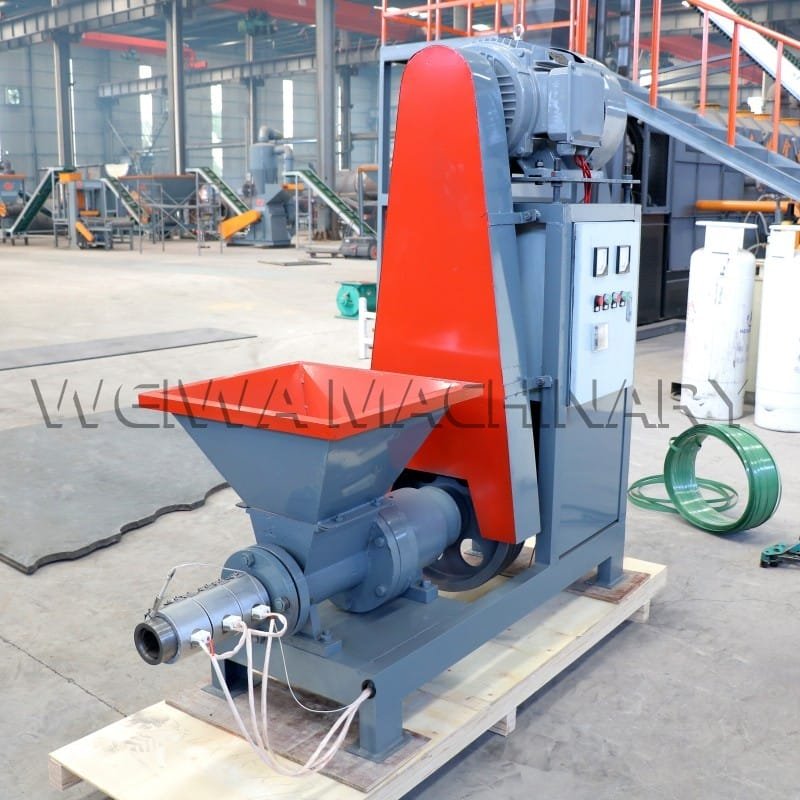
穿越南部非洲, 对可持续烹饪和取暖燃料的需求持续增长,而传统木炭生产给天然林带来巨大压力. 在津巴布韦, 木材加工厂产生大量锯末,这些锯末通常被作为废物丢弃. 展示如何将这些废物转化为高价值的清洁燃料, Weiwa Machinery recently arranged a full on site trial of a sawdust extrude production line and charcoal briquette machine in Zimbabwe.
Why Zimbabwe Needs Sawdust Charcoal Making Machines?
津巴布韦, 像许多非洲国家一样, relies heavily on wood derived charcoal for domestic cooking and small scale industrial heating. Conventional earth kiln charcoal production involves felling live trees and burning them in pits with low carbonization efficiency and high smoke emission. The resulting product is irregular in size, has variable calorific value, and contributes to progressive deforestation around major urban centers such as Harare, Bulawayo, and Mutare.
A sawdust charcoal making machine offers an alternative that uses waste biomass — primarily sawdust from local timber mills, but also rice husk, 咖啡壳, 棉茎, 甘蔗甘蔗渣, 竹尘, and sunflower stalk — to produce uniform high density briquettes that can be carbonized into premium charcoal. For Zimbabwean sawmill owners, this means converting a disposal cost into a revenue stream. For charcoal traders, it means offering a cleaner burning product with longer burn time and consistent sizing. The sawdust extruder in Zimbabwe therefore addresses both environmental concerns and economic opportunity.
The Ministry of Environment, Climate, Tourism and Hospitality Industry in Zimbabwe has repeatedly encouraged adoption of cleaner energy technologies. Although regulations vary by province, the shift toward briquetted charcoal aligns with national goals to reduce forest loss and greenhouse gas emissions. International buyers and development agencies operating in Africa increasingly prefer sourcing charcoal produced from agricultural or forestry residues rather than from whole trees. 在此背景下, the charcoal briquette machine in Zimbabwe supplied by Weiwa Machinery provides a timely and field proven solution.
Raw Material Preparation for Zimbabwean Sawmills
In most Zimbabwean timber yards, sawdust accumulates as a mixture of hardwood (mkusi, teak, msasa) and softwood particles with moisture content ranging from 30% to over 50% depending on season and open air storage conditions. Before the material can enter a sawdust extrude machine, two preparation steps are essential: size reduction and moisture control. Particle size should be uniform and generally below 5 毫米. Oversized chips or bark pieces can block the screw propeller or cause uneven extrusion. A hammer mill or wood crusher is used to achieve this granularity.
Moisture must be reduced to 8%–12% for the extrusion process to work correctly. Above 12% 水分, steam generated inside the barrel can cause the so-called cannon effect where material is ejected violently from the die. Below 6%–8%, the lignin plasticization may be insufficient and the briquette may crack after cooling. A rotary drum dryer or pipe dryer heated by a biomass burner or electric furnace adjusts the moisture to the optimal range. Our Zimbabwe trial used a rotary dryer fired by waste sawdust, achieving outlet moisture of 10% ± 1% consistently.
The Complete Sawdust Extrude Production Line Configuration
A functional sawdust to charcoal plant is more than a single machine. The sawdust extrude production line we deployed for the Zimbabwe customer consisted of the following interconnected units, each sized to match the rated capacity of the core extruder:
1. Hammer Mill / 木破碎机 — Reduces coarse wood chips, 茎, or oversized sawdust clumps to 3–5 mm. Equipped with replaceable screen meshes and a cyclone separator to minimize dust escape. For the Zimbabwe trial the crusher processed approximately 800–1000 kg of mixed sawdust per hour.
2. Rotary Drum Dryer (or Airflow Dryer) — Uses hot air to evaporate surface and bound moisture. Temperature at the inlet is controlled between 250°C and 350°C with automatic dampers. The outlet temperature is kept low enough to avoid scorching the sawdust. Screw conveyors transfer dried material to an intermediate hopper.
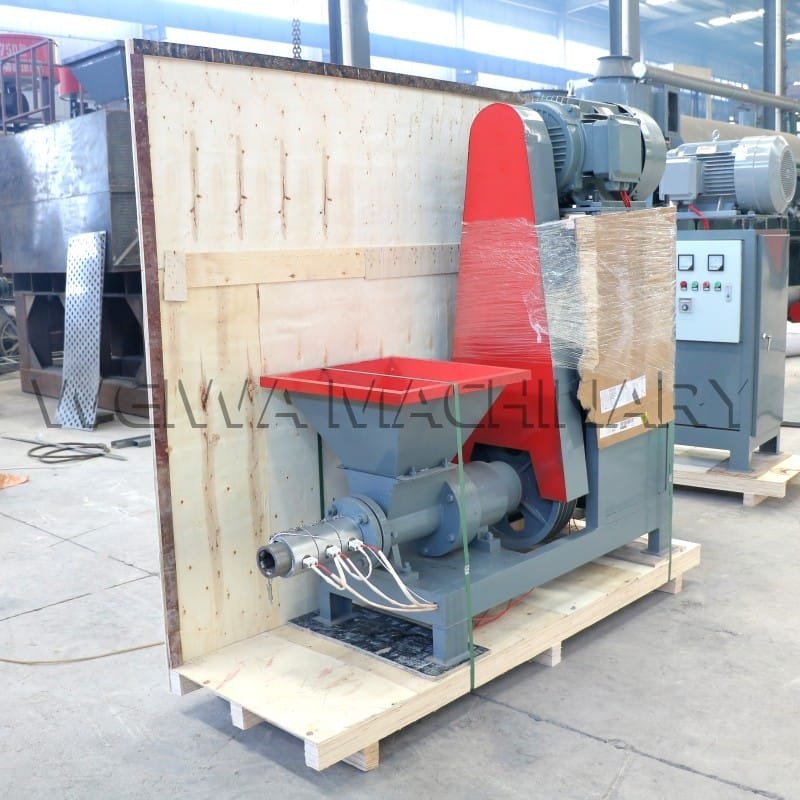
3. 木屑挤出机 (Screw Type Biomass Briquette Extruder) — The heart of the line. A large alloy steel screw compresses dried sawdust through a heated barrel and forming die. Friction and compression raise the temperature to 260°C–320°C, softening the natural lignin which then acts as a binder. The extruded rod emerges as a continuous hollow or solid stick, typically hexagonal or quadrangular, 45–80 mm in diameter depending on die selection. Weiwa models feature an adjustable temperature indicator, heavy duty bearings, and a wear resistant screw tip treated by hard facing. The trial unit was a 22 kW model producing 220–280 kg/h of green briquettes.
4. Automatic Cutter / Breaker — Severs the extruded rod into 300–500 mm lengths as it exits the die. The cut length can be adjusted to suit the dimensions of the carbonization furnace or customer preference.
5. 碳化炉 (Batch or Continuous Type) — The green briquettes are loaded into a sealed kiln or continuous carbonizer where, in the absence of sufficient oxygen, they undergo pyrolysis at 400°C–600°C. Volatile matter is driven off and the lignocellulosic structure converts to fixed carbon. A well designed furnace recovers part of the syngas to reheat the chamber, improving thermal efficiency. The Zimbabwe client used a movable brick lined batch kiln for the initial trial followed by a Weiwa continuous carbonization furnace for scaled production.
6. Cooling and Packaging Section — Fresh charcoal is fragile and hot. A horizontal cooling conveyor brings temperature down below 40°C before screening and bagging. Proper cooling prevents spontaneous ignition and breakage during handling.
This integrated approach ensures that every stage — from raw sawdust to finished charcoal — is optimized for the local conditions found in Zimbabwe. The charcoal briquette machine in Zimbabwe is thus supported by upstream and downstream equipment that guarantees stable operation and repeatable product quality.
Key Specs of Weiwa Sawdust Extrude Machine
The sawdust extruder in Zimbabwe supplied by Weiwa Machinery is available in several models covering 180 kg/h到 1200 kg/h throughput. Core specifications relevant to the African market include:
– Raw material requirement: biomass particles ≤5 mm, moisture 8%–12%
– Heating ring power: 3–5 kW (keeps barrel at preset extrusion temperature)
– Main motor power: 18.5 千瓦 / 22 千瓦 / 30 千瓦 / 37 kW depending on model
– Forming die options: 50 毫米, 60 毫米, 70 毫米, 80 直径毫米; shapes include hollow hexagonal, hollow square, solid rod
– Density of extruded briquette: 1.0–1.3 g/cm³
– Lignin auto binding: no chemical binders required
– Wear parts: screw propeller and inner sleeve made of high manganese or tungsten carbide coated alloy, replaceable
– Control panel: ammeter, temperature controller, 紧急停止, optional PLC touchscreen
The machine is designed for ease of maintenance which is critical in locations where specialized technicians may not be readily available. Access panels allow quick inspection of the screw and sleeve. Spare parts kits containing extra propellers, heaters, and sensors are shipped with every export order. 津巴布韦项目, we also provided a Chinese English operation manual and a series of setup videos shared via WhatsApp prior to arrival of the equipment.
How the Sawdust Extruder Works in the African Context?
Understanding the working principle of a sawdust charcoal making machine helps operators appreciate why certain parameters — especially moisture and temperature — must be controlled carefully. The screw type extruder operates on the principle of thermoplastic lignin binding under high pressure.
Dried sawdust is fed into the inlet hopper and conveyed forward by a rotating screw shaft. As material moves along the tapered compression chamber, the available cross sectional area decreases, causing pressure to rise dramatically — often exceeding 30–40 MPa near the die entrance. 同时地, the electric heating ring wrapped around the barrel maintains the outer wall at 280°C–320°C. Frictional heat from the compacted biomass adds another 20°C–40°C. At this temperature the lignin present in woody biomass (typically 18%–28% by weight in hardwoods) undergoes glass transition and becomes viscoelastic, functioning as a natural adhesive.
When the material is forced through the shaped die opening, it emerges as a dense continuous rod. The central hole (in hollow dies) is created by a mandrel and serves two purposes: it increases surface area for subsequent carbonization and allows volatiles to escape more evenly during pyrolysis. Once the rod leaves the die and cools in ambient air, the lignin solidifies, locking the cellulose fibers into a rigid high density briquette.
No starch, 黏土, or chemical binders are added at any stage. This is an important selling point for the African market where customers are increasingly aware of indoor air quality. Briquettes made without additives burn cleaner and produce less ash than those containing fillers. 而且, the calorific value of the extruded green briquette before carbonization already exceeds that of raw wood by 15%–20% due to compaction. After carbonization the resulting charcoal has a fixed carbon content of 75%–88% and a calorific value commonly above 29 兆焦/公斤, outperforming traditional lump charcoal in both metrics.
在津巴布韦, where power supply can be intermittent, we offer sawdust extrude machines coupled with diesel generators or direct diesel drive upon request. The frame is reinforced to absorb vibration on uneven concrete floors typical of small workshops. All contact parts are corrosion resistant and the paint finish is suited for humid or dusty environments.
On-Site Trial of Charcoal Briquette Machine in Zimbabwe
The trial was conducted at a timber processing yard on the outskirts of Harare. The client had previously been discarding approximately 1.5 tons of mixed hardwood and softwood sawdust per day. Their objective was to evaluate whether a sawdust extruder in Zimbabwe could convert this waste into marketable charcoal briquettes with acceptable capital payback.
天 1 — Site Inspection and Machine Positioning. Our engineer assessed the available space, three phase power supply (415 V / 50 Hz in this case), and raw material stockpile. The production line was laid out in a linear flow: crusher → bucket elevator → dryer → intermediate silo → sawdust extrude machine → cutter → temporary rack for green briquettes. The carbonization kiln was placed in a separate open area with fire safety clearance as per local regulations.
天 2 — Crushing and Drying Tests. Raw sawdust was passed through the hammer mill. Initial particle size distribution was measured: 68% passed a 4 mm sieve, the remainder required a second pass. 干燥后, moisture samples were taken with a portable moisture meter at three points in the batch. Results ranged from 9.2% 到 10.8%, within specification. The dryer temperature was tuned to avoid overheating which can caramelize sugars in the sawdust and lead to excessive screw wear.
天 3 — Extruder Commissioning and Trial Runs. The sawdust extrude machine was preheated to 290°C. Once stable, dried sawdust was introduced at a moderate feed rate. The first extruded rods came out slightly soft due to residual internal heat imbalance but normalized within 8–10 minutes. Thereafter the machine produced uniform hexagonal hollow rods 50 mm in outer diameter with a 15 mm central hole. Surface was smooth, color golden brown indicating proper lignin melt, and transverse break strength was good — a sample rod supported a 5 kg weight without snapping.
Throughout a four hour continuous run the extruder processed an average of 245 kg/h of dried sawdust with current draw stable at 34–38 A on the main motor. No jamming occurred. The heating ring cycled normally to maintain barrel temperature ±5°C of the setpoint. The automatic cutter produced even 400 mm sticks which were stacked on pallets for overnight cooling prior to carbonization.
天 4 — Carbonization Trial. 大约 600 kg of cooled green briquettes were loaded into the batch kiln in shallow layers to ensure even heat penetration. The kiln was sealed and firing commenced. Over a 5.5 hour cycle the temperature inside the chamber rose to 520°C and was held for 90 分钟. Flue gas was observed to diminish, indicating completion of the main devolatilization phase. After controlled cooling, the charcoal yield was calculated at 28.5% by weight of the green briquettes, corresponding to roughly 22% yield from original bone dry sawdust — figures consistent with literature for screw extruded briquettes carbonized in well sealed kilns.
天 5 — Quality Assessment and Client Training. The finished charcoal was deep black, sonorous when struck, with closed cell structure and minimal fines. Random samples were broken open; the cross section showed uniform carbonization throughout the cross section, not just at the surface — a sign that the hollow core design and proper drying had allowed heat to penetrate fully. Water boiling test (standard simmer test) showed the briquettes maintained boiling for 48 minutes per 500 g charge versus 32 minutes for locally sourced lump charcoal of similar weight. Ash content was 3.1% (dry basis). The client’s team was trained on daily lubrication points, 螺杆磨损检查, die change procedure, and safe kiln operation including CO monitoring and fire watch.
Trial Data and Output Analysis
Key quantitative outcomes from the Zimbabwe sawdust extruder trial:
– Extruder throughput: 220–270 kg/h of green briquette (varies with raw material bulk density)
– Specific energy consumption: 大约. 0.10–0.12 kWh/kg of green briquette
– Drying energy: sawdust from 35% 到 10% moisture consumed ~900 kcal/kg evaporated water using biomass burner
– Green briquette density: 1.12 g/cm³
– Carbonization yield: 28%–30% (green to charcoal)
– Charcoal fixed carbon: 80%–84% (dependent on peak carbonization temperature)
– Breakage rate after carbonization and cooling: <4%
– Estimated daily capacity (8 h extrusion + 2 batch carbonizations): 1.8–2.2 tons finished charcoal
Based on local market prices discussed with the client, the projected payback period for the complete sawdust extrude production line — including crusher, 干衣机, 挤出机, 刀具, and carbonization furnace — fell between 7 和 11 months assuming 22 working days per month and full offtake of produced charcoal. This estimate did not factor in potential additional revenue from selling green briquettes to other carbonizers or from processing other biomass such as cotton stalks and maize cobs which are abundant in Zimbabwe’s rural areas.
Carbonization Results of the Sawdust Charcoal Making Machine
Carbonization is the defining step that differentiates a biomass briquette from true charcoal. The sawdust charcoal making machine — in this context the complete system culminating in the carbonization furnace — must deliver consistent temperature control, adequate residence time, and safe containment of syngas.
During the Zimbabwe trial the batch kiln achieved a peak internal temperature of 540°C as read by a type K thermocouple inserted into the chamber wall. The volatile evolution profile matched typical curves for lignocellulosic briquettes: initial moisture drive off below 150°C, hemicellulose decomposition between 200°C and 280°C, cellulose peak around 320°C–370°C, and lignin slow degradation continuing up to 600°C. Holding the charge at 500°C–540°C for 60–90 minutes ensured thorough conversion without over firing which would embrittle the charcoal and increase fines.
The charcoal produced from the Weiwa sawdust extruder in Zimbabwe had the following characteristics measured in our field test kit:
– Apparent density: 0.42–0.48 g/cm³ (木炭)
– Moisture (as received): 2.3%
– Ash content (dry basis): 2.8%–3.5% for hardwood sawdust; slightly higher for mixed softwood
– Fixed carbon (by difference): 81%–85%
– Higher heating value (estimated from fixed carbon): 29–31 MJ/kg
– Ignition time: comparable to premium lump charcoal; sustained glowing combustion with minimal sparking
– Smoke: negligible after initial surface volatiles burned off; significantly less than un carbonized briquette or low quality lump charcoal
These results confirm that a properly configured sawdust extrude production line can deliver export grade charcoal suitable for both domestic resale in Zimbabwean townships and higher margin niche markets such as barbecue or hotel supply in the region. The uniformity of the extruded shape also allows neat stacking in bags which improves shelf appeal compared to irregular lump charcoal.
For clients requiring even higher throughput and reduced labor, Weiwa supplies a continuous carbonization furnace with gas recirculation. This system accepts pre dried green briquettes on a moving hearth, carbonizes them in a multi zone chamber under controlled oxygen deficit, and discharges cooled charcoal at the far end. Typical retention time is 30–50 minutes depending on desired degree of carbonization. The recovered syngas is partially combusted in a burner to preheat the furnace, cutting external fuel needs by up to 60% compared to a simple batch kiln.
Why Choose Weiwa Machinery Sawdust Extruder in Zimbabwe?
WEIWA机械 (河南维瓦机械制造公司, 有限公司) has been dedicated to the research, 生产, and export of biomass briquetting and charcoal making equipment for more than 15 年. Our machines have been installed in over 130 包括印度尼西亚在内的国家, 印度, 马来西亚, 泰国, 越南, 菲律宾, 巴基斯坦, 火鸡, 波兰, 埃及, 埃塞俄比亚, 坦桑尼亚, 南非, and extensively across West and Southern Africa. The sawdust extruder in Zimbabwe is one of many successful field deployments that validate our engineering for tropical and subtropical operating conditions.
Choosing Weiwa for your charcoal briquette machine in Zimbabwe means you benefit from:
Customized Production Planning — We analyze your available raw materials (木屑, 稻壳, 棉茎, 渣, 竹尘), target hourly or daily capacity, local power supply (three phase / single phase / 柴油机), and factory footprint. Based on this we propose a tailored sawdust extrude production line layout complete with equipment sizing, 基础图, and electrical schematic.
Durability for African Conditions — Our sawdust extrude machine uses thickened alloy steel sleeves and tungsten carbide coated screws to resist abrasion from silica rich biomass such as rice husk or sugarcane bagasse. Bearings are shielded against dust ingress. The frame is phosphatized and powder coated. Spare parts availability is ensured through our stock program with air shipment in 3–5 working days.
Installation and Commissioning Support — We provide detailed video guides, multilingual manuals (英语 / Spanish / French / Russian / Arabic), and remote assistance via WhatsApp, 微信, Zoom, or phone. For large orders we can dispatch engineers to site (subject to visa and cost agreement) to supervise installation, carry out the first trial run, and train your operators — exactly as we did for the Zimbabwe client described in this article.
Certifications and Quality Assurance — Weiwa Machinery holds ISO 9001 quality management certification and selected models carry CE marks. Each sawdust charcoal making machine undergoes no load test and load test before leaving the factory. Running video and inspection report are shared with the buyer prior to shipment.
Flexible Commercial Terms — We support TT, LC, and negotiated deposit + balance against BL copy. Equipment is packed in fumigated wooden cases or nude in containers with protective film as appropriate for the destination port. For Zimbabwe imports via Beira or Durban we can advise on documentation and typical clearance procedures.
More than two million end users worldwide rely on fuel produced by Weiwa equipment. Whether you plan to start a small workshop processing sawdust from a single timber mill or a commercial plant supplying charcoal across provinces, our team will help you design the right solution.
关于 WEIWA机械
河南维瓦机械制造公司, 有限公司. (维瓦机械) is a professional manufacturer of biomass briquette machines, 锯末挤出机, 木炭制造机, 碳化炉, and complete sawdust to charcoal production lines. 总部位于巩义, 河南省, 中国, we integrate R&D, 生产, 质量控制, and after sales service to deliver reliable equipment for the global renewable energy market.
我们的产品范围涵盖锯末挤出机 (screw type biomass briquette extruders), 木炭煤石机, continuous and batch carbonization furnaces, 旋转式干燥机, 锤式粉碎机, 压碎机, and ancillary conveyors. 我们出口到超过 130 countries and regions across Asia, 非洲, 欧洲, 和美洲. Every machine is built to withstand demanding field conditions and is backed by responsive technical support.
If you are looking for a sawdust extruder in Zimbabwe, a complete sawdust extrude production line, a charcoal briquette machine in Zimbabwe, a sawdust charcoal making machine, or a charcoal making machine in Zimbabwe, contact Weiwa Machinery today for a free customized proposal.
联系我们:
暴民 / WhatsApp: +86 13838093177
电子邮件: info@cjlmachinegroup.com


 微信
微信

 +8615937143060
