


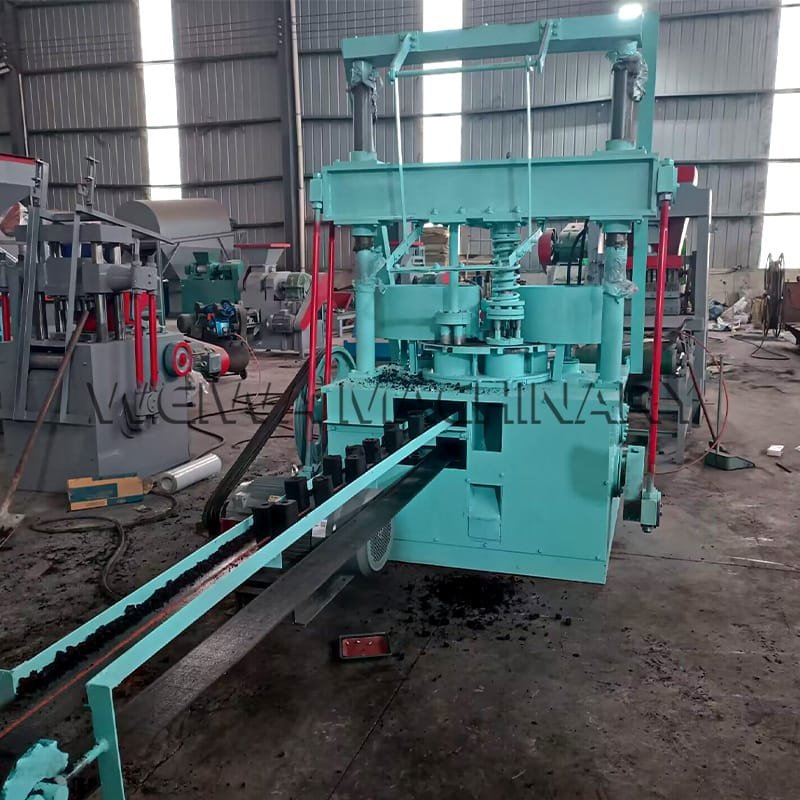
最近, 威瓦机械为乌干达客户完成蜂窝煤机现场调试及试运行. 该项目让我们有机会展示我们的型煤制造机如何使用当地采购的木炭粉和煤粉进行生产, 并展示测试期间生产的成品蜂窝煤样品.
什么是 蜂窝煤成型机?
蜂窝煤成型机, sometimes referred to as a honeycomb punching machine, is a mechanical press that compresses powdered raw materials such as charcoal powder, 煤尘, 木屑炭, or biomass residues into round disc-shaped briquettes with evenly spaced holes punched through the body. The holes create a honeycomb pattern that allows air to pass freely through the fuel during ignition and burning. Unlike simple extrusion equipment, a honeycomb charcoal coal briquette forming machine uses a stamping punch and rotating mold table to achieve high compaction pressure, which gives the final product high density, 均匀的形状, and excellent resistance to breakage in transport and storage.
Raw Materials Suitable for the Coal Briquettes Making Machine
The coal briquettes making machine we supplied to the Uganda client accepts a wide range of fine powders including hardwood charcoal dust, 稻壳木炭, 椰子炮粉, anthracite coal fines, and blended mixtures with a small proportion of natural binder such as cassava starch or molasses. For optimal briquette formation the moisture content of the feed material should typically be controlled between eight percent and twelve percent, and particle size should be uniform after passing through a crusher and screened before entering the hopper.
蜂窝冲孔机的工作原理
这 蜂窝冲孔机 is composed of five main assemblies: the machine frame, transmission system driven by an electric motor and reduction gear, feeding hopper with agitator to ensure even material distribution, stamping unit with punch head and spring-loaded bottom plate, and a discharge conveyor belt. When the motor starts, power is transmitted through pulleys and gears to rotate the indexing turntable which carries multiple mold cavities. Material drops from the hopper into each mold cavity as it indexes under the punch station. The upper punch then descends under crank or eccentric drive, exerting several tons of pressure to compress the loose powder into a dense cake. A second light punch stroke assists demolding, pushing the formed briquette upward where it is ejected onto the conveyor for collection. The entire cycle repeats automatically at a rate depending on model specification, commonly between thirty-five and forty-eight strokes per minute.
Why the Honeycomb Structure Improves Combustion
The characteristic holes in a honeycomb briquette are not merely decorative. They increase the surface area exposed to oxygen and create channels for air to flow through the center of the fuel block. This results in faster and more reliable ignition, a steady flame front, and more complete combustion with reduced smoke and lower residual ash. In Uganda where honeycomb briquettes are widely used for household cooking and small commercial heating, this combustion efficiency translates directly into fuel savings and improved indoor air quality compared with irregularly shaped lump charcoal or unformed powder.
Uganda Client Background and Project Requirements
Our Ugandan customer operates a growing clean-fuel supply business in East Africa and sought a reliable honeycomb briquette charcoal machine in uganda that could convert locally available charcoal dust—often considered waste—into standardized, marketable briquettes. Key requirements included consistent output shape compatible with common stoves, ability to handle mixed charcoal and coal blends, ease of operation for local staff, 和备件供应情况. After reviewing production volume needs and raw material characteristics, we recommended our medium-capacity coal briquettes making machine equipped with interchangeable molds sized for the popular one-hundred-millimeter diameter by seventy-millimeter height honeycomb disc.
On-Site Trial Procedure in Uganda
Before formal handover, Weiwa Machinery technicians supervised a full trial run at the client’s premises. The process involved raw material preparation, machine calibration, 样品制作, and visual plus physical evaluation of the finished briquettes.
Raw Material Preparation and Binder Mixing
Charcoal dust was first passed through a hammer mill and sieved to remove oversized particles. Moisture was checked using a portable meter and adjusted by brief sun drying when necessary. The powder was then blended with a measured amount of binder solution in a wheel mixer until the mass reached a slightly cohesive but non-sticky feel. Proper mixing is critical because uneven binder distribution can cause edge cracking or low green strength in the pressed briquette.
Machine Setup and Calibration
The honeycomb charcoal coal briquette forming machine was leveled, 润滑的, and connected to the local three-phase power supply. We set the punch stroke depth and turntable indexing timing according to the target briquette thickness. Mold alignment was verified to ensure the punch head centers precisely in the mold cavity—misalignment beyond a few millimeters can cause flash or incomplete filling. The hopper gate opening was adjusted to regulate fill volume so that each cavity received a consistent amount of material.
Sample Production Run
After a short warm-up run to stabilize pressure, the machine began continuous production. Within minutes the conveyor carried out neatly formed honeycomb discs with clearly defined holes, 光滑的表面, 和锋利的边缘. Our team collected samples from the first ten minutes and again after thirty minutes to confirm repeatability. Throughout the run the honeycomb punching machine maintained stable pressing force and showed no abnormal vibration or overheating.
Finished Briquette Sample Showcase and Quality Analysis
The samples produced during the Uganda trial were evaluated for geometry, 密度, drop resistance, and burn behavior. Below we detail the observed characteristics which met both our factory standards and the client’s commercial expectations.

Geometric Accuracy and Surface Finish
Each sample measured within plus or minus one millimeter of the nominal one-hundred-millimeter diameter and seventy-millimeter height. The honeycomb holes were concentric and free of burrs. A clean surface finish minimizes dust shedding during packaging and handling, an important factor for retail presentation in the Ugandan market.
Density and Mechanical Strength
By water displacement measurement the average bulk density of the samples exceeded 1.2 grams per cubic centimeter, which is typical of well-compressed briquettes made on a 蜂窝煤木炭机. A drop test from one-meter height onto a concrete floor resulted in negligible chipping, confirming that the green strength after pressing was sufficient for stacking and local distribution without special protective packaging.
Burn Performance of the Honeycomb Briquettes
Ignition time was recorded from first flame contact to full glowing of the briquette. Thanks to the through-holes, the samples caught fire in approximately three to four minutes when lit with a small amount of kindling. Once alight they burned with a steady orange glow, minimal visible smoke, and uniform progression from outer rim inward. Total burn time for a single disc under controlled conditions exceeded sixty minutes, delivering a calorific performance competitive with premium lump charcoal while using recycled powder material.
Customization Options for the Honeycomb Charcoal Coal Briquette Forming Machine
Weiwa Machinery offers customizable mold inserts for the 蜂窝木炭型煤成型机 allowing different diameters, 厚度, number of holes, and even non-circular shapes such as square or hexagonal upon request. Punching pressure can be fine-tuned on most models to accommodate softer biomass blends or harder anthracite-coal mixes. Motor power options and output speeds are selected based on projected daily throughput so that the 型煤成型机 matches your business scale whether you are a startup micro-enterprise or an established fuel processor.
Why Choose Weiwa Machinery for Your Honeycomb Briquette Project?
With years of experience exporting briquette and carbonization equipment worldwide, Weiwa Machinery provides not only robust honeycomb briquette charcoal machine in uganda solutions but also pre-shipment testing, 备件支持, and remote technical guidance. Each honeycomb punching machine undergoes a load trial in our workshop before crating. We help customers calculate binder ratios, choose appropriate mesh sizes for raw material preparation, and train operators on safe startup, shutdown, and routine maintenance procedures. Our goal is to ensure that every coal briquettes making machine we deliver keeps running efficiently in the real conditions of your local market.
If you are planning to start or upgrade honeycomb briquette production in Uganda or elsewhere in Africa, contact Weiwa Machinery today for a tailored proposal and factory video of the honeycomb briquette charcoal machine in operation.
关于 WEIWA机械
WEIWA机械 (WEI WA机械) is a professional manufacturer of biomass briquette machines, charcoal briquetting equipment, 碳化炉, 及相关生产线. 我们的产品远销多个国家和地区, serving more than two million customers worldwide who trust Weiwa Machinery as their first choice for reliable, cost-effective fuel processing machinery. We offer factory-direct pricing, 定制工程, 和完善的售后服务.
联系我们:
暴民 / WhatsApp: +86 138 3809 3177
电子邮件: info@cjlmachinegroup.com


 微信
微信

 +8615937143060
