


Why Making Charcoal Balls in Democratic Republic of the Congo Is Becoming a Real Business?
The Democratic Republic of the Congo holds a large part of the Congo Basin rainforest and simultaneously carries one of the heaviest urban charcoal consumptions in sub-Saharan Africa. Reports from Kinshasa estimate daily charcoal use in the capital alone at thousands of tonnes, while national reliance on wood-based cooking fuel stays above ninety percent in many provinces. Traditional lump charcoal is still dominant, but its chain is unstable: tree cutting, inefficient earth kilns, long transport from rural areas, breakage into fines, and price volatility in the wet season.
同时, every stage of the traditional chain produces charcoal dust. Markets, transshipment yards, bagging points and household braziers generate huge volumes of fine powder that is currently swept away, burned dirty, or sold at almost zero price. A charcoal ball press machine converts that waste into uniform, 高密度燃料. This is what the industry calls making charcoal balls: collecting charcoal fines, conditioning them with moisture and binder, and compressing them in roller pockets into oval, 圆形的, pillow or square shapes.
For Congolese buyers, the economics are straightforward. Raw material cost is extremely low because charcoal fines are often treated as refuse. Final briquettes burn longer than loose powder, emit less fugitive dust, stack neatly in sacks, and fit modern improved cookstoves. Retail prices for ecological briquettes in Goma and Kinshasa have already been reported at almost half the cost per cooking-day of lump charcoal. When a family switches from one sack of embers to two months of briquettes at a lower ticket, the local producer gains repeat customers. That is why inquiries for the Ball Charcoal Briquettes Machine from DRC buyers rose sharply in our export pipeline during the last two years.
Urban Cooking Demand in Kinshasa and Lubumbashi
Kinshasa concentrates over ten million people and a dense network of street food vendors, 面包店, breweries and households that cook twice a day. Lubumbashi and Kolwezi add industrial heating demand from artisanal metallurgy and small foundries. Both segments need predictable solid fuel. Imported LPG remains expensive and cylinder distribution is uneven outside the capital. Loose charcoal powder is unpopular with urban vendors because it blows away and burns poorly. Uniform charcoal balls made by a Charcoal Briquette Machine solve handling, ignition and burn-time problems at once.
Agricultural and Forestry Residues as Backup Feedstock
Beyond charcoal dust, DRC produces cassava stalks, maize cob, sawmill offcuts, 棕榈仁壳, coconut shell in western corridors, and sugarcane bagasse in plantation zones. Any of these can be carbonized in a simple mound kiln or a batch carbonizer, crushed under five millimeters, blended with charcoal fines, and fed into the same charcoal ball press machine. This diversifies supply during the rainy season when charcoal kiln output drops.
什么是 球木炭煤球机?
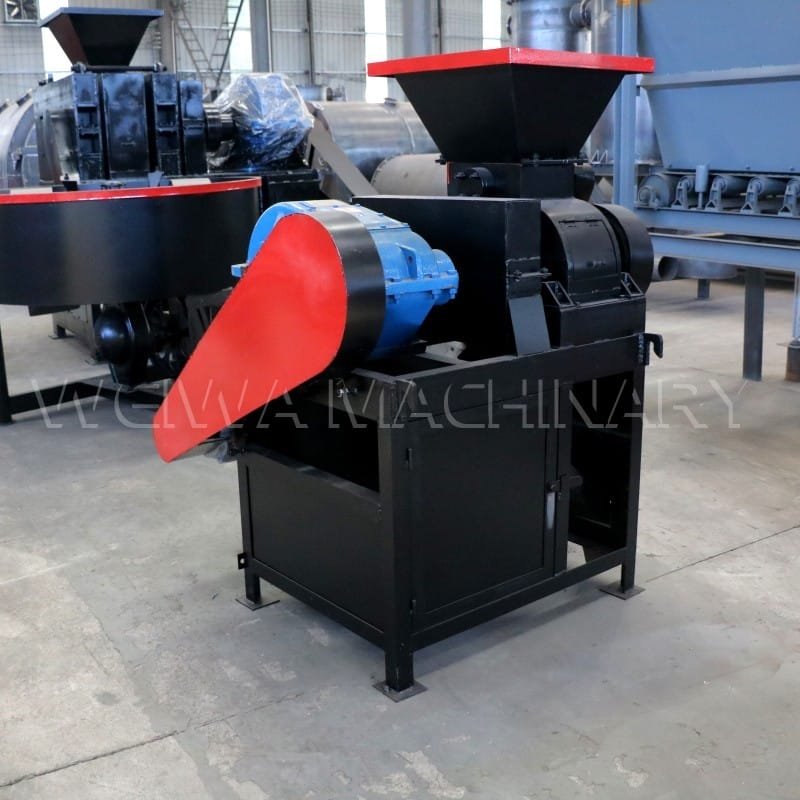
A Ball Charcoal Briquettes Machine is a roller pressing type briquette press. It is not a screw extruder and not a hydraulic block press. The core principle is mechanical: two horizontal rollers rotate in opposite directions, each roller carrying matched mold pockets. Conditioned powder falls into the roller nip. As the pockets close, pressure rises to several tons per cavity, particles deform, trapped air escapes, and intermolecular and binder bonds form a dense ball. When the rollers pass the widest separation point, the ball drops onto a discharge conveyor.
This roller method is preferred for BBQ charcoal and metallurgical powder because it gives high hourly capacity with relatively low motor power. A single charcoal ball press machine from Weiwa can form one to ten tonnes per hour depending on roller diameter, pocket size and material nature. Density normally exceeds 1.1 grams per cubic centimeter, which is the threshold for slow-combustion briquettes that survive transport on rough rural roads.
Main Components of the Charcoal Ball Press Machine
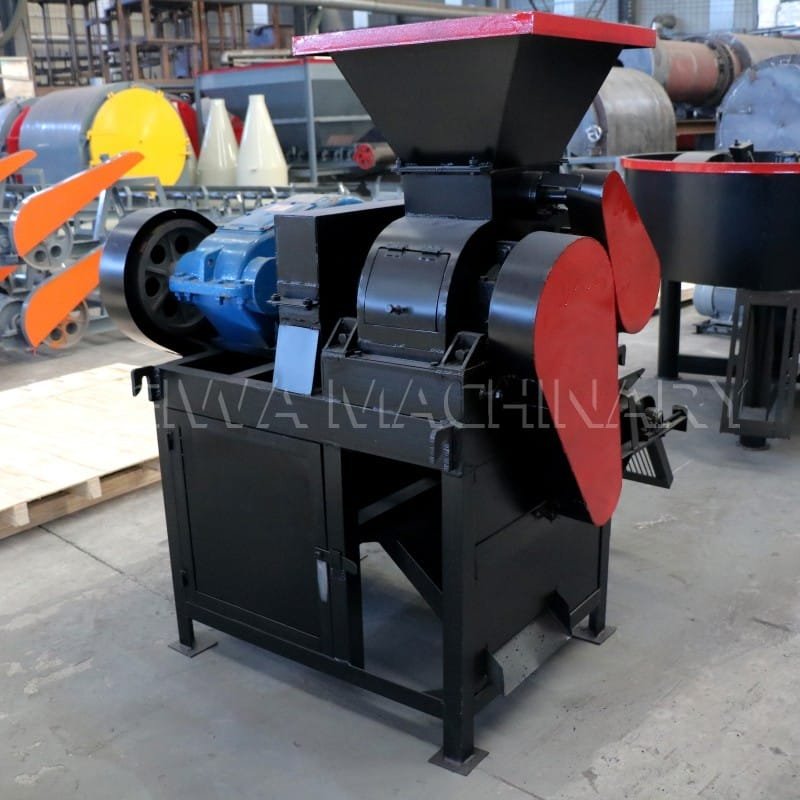
The rollers are the heart of the press. Weiwa machines use forged alloy steel sleeves, surface hardened and interchangeable. Pocket geometry decides the product: 椭圆形, 蛋, 枕头, 圆球, square tablet, bread shape or custom logo shape for branded BBQ fuel. The main frame absorbs reaction force. The reducer and gearbox transfer torque from the electric motor or diesel engine. The feeding screw pre-compacts material before the nip to avoid roller slipping. Pressure adjustment is done by mechanical spring assembly or hydraulic cylinder, allowing the same frame to accept different roller sets.
For making charcoal balls in Democratic Republic of the Congo, power stability matters. We therefore offer electric motor versions for clients with three-phase supply in industrial zones, and diesel drive versions for rural plants in Equateur, Bandundu or North Kivu where grid power is intermittent. Both share the same roller cassette, so a client can retrofit later.
Charcoal Briquette Machine Versus Generic Coal Press
Many African buyers ask whether a coal ball press can simply replace a Charcoal Briquette Machine. The answer is partial. Roller physics is similar, but charcoal powder is softer, more porous and more sensitive to moisture. A press tuned for anthracite may crack charcoal balls or overload the feeder. Weiwa calibrates roller surface finish, pocket draft angle, screw speed and binder dosage specifically for biomass char. That is why we always send a material questionnaire before confirming a Ball Charcoal Briquettes Machine configuration for Congo.
Full Production Line for Making Charcoal Balls in Congo
A single press is rarely enough for commercial output. The recent DRC order shipped by Weiwa included six functional stations. The first station is a hammer crusher or charcoal grinder that reduces lump charcoal and carbonized biomass to under three millimeters. Uniform particle size is the hidden key to briquette strength; oversized grains create surface pits and broken balls.
The second station is a twin-shaft paddle mixer. 木炭粉, water and binder enter in controlled ratio. Common binders are cassava starch, corn starch, 糖蜜, bentonite or guar gum. The mixer coats every particle, develops plastic behavior, and discharges at a moisture window usually between eight and fourteen percent depending on char origin. A poorly mixed batch will clog the screw feeder or produce brittle balls regardless of how good the charcoal ball press machine is.
The third station is a batching silo with level sensor that buffers mixed material and feeds the press continuously. The fourth station is the Ball Charcoal Briquettes Machine itself, mounted on vibration dampers with a local control cabinet showing amperage, roller temperature and emergency stop status. The fifth station is a mesh belt dryer. Fresh balls leave the press at high moisture and low mechanical strength; a tunnel or mesh dryer brings final humidity down to five or eight percent. The sixth station is a weighting and bagging unit, manual for small lines or semi-automatic for plants above three tonnes per hour.
Capacity Planning for DRC Buyers
We classify Congo-bound lines into three tiers. A micro line with a 290 millimeter roller and five point five kilowatt motor delivers around one tonne per hour and fits a twenty-foot workshop in a suburb of Kinshasa. A standard line with 360 到 450 millimeter rollers delivers two to five tonnes per hour and suits a cooperative supplying several neighborhoods. A commercial line with 650 millimeter rollers and thirty kilowatt drive delivers eight to ten tonnes per hour for regional distribution to wholesalers and supermarkets. All tiers share the same training procedure and spare-part philosophy.
Customization for Workshop Space and Climate
Congolese factories rarely look like European plants. Ceiling height may be limited, floor may be uneven, humidity may exceed eighty percent in Bas-Congo, and dust control may be requested by provincial environment officers. Our engineering team issues a CAD layout drawing showing equipment footprint, dryer direction, maintenance aisle, binder tank position and fire safety clearance. The client reviews the drawing, confirms civil works, then we produce the line to the agreed footprint. This design-first approach prevents the classic mistake of buying a Charcoal Briquette Machine and discovering it does not fit the door.
Raw Material Handbook for Congolese Producers
Successful making charcoal balls in Democratic Republic of the Congo starts with raw material discipline. Charcoal fines from hardwood such as musamba, mukula or terminalia work best. Sawdust char from furniture clusters around Kinshasa and Lubumbashi is excellent if carbonized separately and not mixed with treated plywood waste. Coconut shell char imported from coastal neighbors or grown in small western plantations gives premium BBQ balls with low ash.
Mineral extenders are possible but need caution. Some DRC clients ask about adding laterite, red soil or iron ore fines to increase weight. We advise against heavy mineral loading above fifteen percent because it lowers combustion quality and may breach clean cooking norms promoted by UNCDF and GIZ projects in Maniema. A charcoal ball press machine will press almost anything powdery, but market acceptance depends on smoke, ash and burn curve.
Binder Selection Under Local Supply
Starch binder is the safest entry point. Cassava starch is widely available in DRC agriculture and dissolves in boiling water to form paste. Molasses from sugar zones gives higher calorific value but attracts moisture if overdosed. Bentonite is inert and improves green strength but dilutes combustion. Our technicians normally recommend a hybrid: seventy percent cassava starch and thirty percent molasses for BBQ balls, or pure starch at two percent dry weight for household cooking balls. The exact recipe is validated during a free material test in our Chinese workshop before shipment.
Market Entry Model for DRC Entrepreneurs
There are three viable business models around the Ball Charcoal Briquettes Machine in Congo. The first is the collection model: a small operator signs agreements with ten charcoal markets to collect fines daily, presses them near the city edge, and sells sacks to nearby vendors. The second is the cooperative model: a women’s group or parish cooperative runs a carbonizer plus press line, sells under a brand name, and accesses NGO clean-cooking grants. The third is the industrial model: a registered company near a sawmill or plantation runs a full Charcoal Briquette Machine line, supplies supermarkets, mines and hotels, and exports surplus to Brazzaville or Bangui.
Payback periods quoted by existing African clients of Weiwa range from six to eighteen months. The spread depends on three variables: how close the raw material source is, how disciplined the binder cost control is, and whether the founder secures recurring contracts with institutions rather than only spot market sales.
Regulatory and Environment Narrative
DRC loses hundreds of thousands of hectares of forest yearly. Provincial environment bureaus in Goma and Kindu already praise briquette cooperatives for cutting deforestation pressure. A charcoal ball press machine does not magically reforest the Congo Basin, but it monetizes waste that would otherwise be burned openly. For aid-funded clean cooking programs, a documented briquette line with dryer and dust collection is far easier to defend than another lump charcoal kiln. Weiwa supports this narrative by supplying optional cyclone dust collectors and improved kiln drawings on request.
Why the Client Chose Weiwa Machinery?
Our Congolese client evaluated three suppliers. One offered a cheaper screw extruder, but screw wear on abrasive charcoal fines is notorious and shape flexibility is poor. Another offered a hydraulic press, but hourly output was too low for the client’s wholesale ambition. Weiwa presented a roller press line with high-chromium alloy rollers, a double-shaft mixer with stainless paddle option, a mesh belt dryer sized for rainy-season humidity, and a factory layout adapted to a twelve-meter span shed.
During the factory acceptance test, we ran the Ball Charcoal Briquettes Machine with simulated Congo charcoal powder mixed from imported lump charcoal and sawdust char. Roller pressure was set to produce thirty millimeter oval balls. Compression density, ball ejection rate and surface finish were recorded on video and shared with the client via WhatsApp. Rollers were then coated with anti-rust oil, wrapped in film, and the whole line was loaded into a forty-foot high-cube container with wooden case reinforcement for the mixer and dryer motors.
After-Sales Structure for Overseas Clients
Weiwa Machinery runs a dedicated English and French-friendly export service desk. 备用滚筒, 刮刀, reducer oil seals and electrical contacts are listed as a recommended first-order spare kit. Installation is supported by remote video call with a senior mechanical engineer. For lines above five tonnes per hour, we can dispatch a technician to Kinshasa or Lubumbashi for on-site commissioning if the client handles visa, accommodation and local transport. All charcoal ball press machine models ship with multilingual manuals, wiring diagrams and roller pocket drawings so a local welder can fabricate simple guards.
Common Mistakes When Starting Charcoal Ball Production
The first mistake is buying only a press without a crusher and mixer. The second is ignoring moisture; charcoal powder that is too dry will not bond, powder that is too wet will smear on rollers. The third is copying Asian binder recipes exactly; Congolese cassava starch has different gel temperature than Thai tapioca starch. The fourth is overestimating workshop height and forgetting dryer length. The fifth is treating the Charcoal Briquette Machine as a magic box that fixes bad raw material. 现实中, briquette quality is manufactured upstream, then only shaped by the press.
How to Test Your Material Before Buying?
We strongly suggest DRC buyers send two kilograms of representative charcoal powder to our address before paying deposit. We run sieve analysis, moisture test, compaction trial and roller pressing on a laboratory bench charcoal ball press machine. The client receives pressed samples by courier and a one-page report recommending roller size, binder percentage and dryer residence time. This five-day procedure saves months of frustration after container arrival.
Keyword Glossary for New Buyers
Throughout this article we used several related terms deliberately. Ball Charcoal Briquettes Machine is the full product phrase for roller-type charcoal ball plants. Charcoal ball press machine refers specifically to the press unit. Charcoal Briquette Machine is the broader category including screw and punch presses. Making charcoal balls is the process phrase Congolese startups search for. Making charcoal balls in Democratic Republic of the Congo is the localized long-tail query that combines process and country intent. Using these phrases in natural sentences, headings and image attributes helps Google match the page to buyer searches without keyword stuffing.
关于 WEIWA机械
Weiwa Machinery is a Chinese manufacturer with more than thirty years of working experience in briquette presses, 碳化炉, 压碎机, mixers and drying systems. Our equipment runs in over one hundred and thirty countries across Africa, 东南亚, the Middle East and Latin America. We are not a trading company reselling unknown brands; we build the rollers, machine the frames, wire the cabinets and load the containers ourselves.
Our advantage for Congo-bound clients is integration. You do not buy a press from one factory, a dryer from another, and a mixer from a third, then struggle with incompatible heights. Weiwa delivers a coordinated line, a single layout drawing, one guarantee boundary, and a professional after-sales team that answers on WhatsApp within one business day. 我们提供定制服务, design factory layout drawings, calculate foundation loads, and help plan raw material flow so your charcoal ball venture in Kinshasa, Goma or Lubumbashi starts with engineering certainty rather than guesswork.
If you are evaluating making charcoal balls in Democratic Republic of the Congo as a business, or you already collect charcoal fines and want to upgrade to a proper Ball Charcoal Briquettes Machine line, contact our export office for a free material test and quotation.
联系Weiwa机械
移动的 / WhatsApp: +8613838093177
电子邮件: info@cjlmachinegroup.com
Send your raw material sample, tell us your workshop size and target hourly capacity, and we will reply with a roller specification, line layout and container packing plan tailored to the Congolese market.


 微信
微信

 +8615937143060
