


Korea Charcoal Market and Why Horizontal Carbonization Furnace Fits
Korean charcoal demand is not only about traditional barbecue culture. Bé nhỏ- and medium-scale farms, biomass recyclers, and industrial heating suppliers are looking for a charcoal making machine for Korea that can process localized feedstock such as fruit-tree prunings, imported hardwood offcuts, rice husk briquettes, and coconut shell resold from Southeast Asia. The horizontal carbonization furnace fits this mix because its barrel chamber accepts irregular shapes, its rail-and-cart system reduces labor, and its indirect heating path keeps the charcoal from touching flame directly. When a Korean client asked us for a horizontal carbonization furnace in Korea compliant setup, the priority was not the largest batch size but the most predictable batch cycle: load, seal, pyrolyze, cool, discharge.
In Korea, environmental ordinances in several provinces already discourage open pit kilns. A modern carbonization furnace with tar condensation and gas return is easier to permit because the visible smoke drops sharply once the purification tower reaches operating temperature. That regulatory angle is why many Korean inquiries now start with the phrase charcoal making machine for Korea rather than a generic charcoal kiln, because the machine must satisfy local emission expectations, not only produce charcoal.
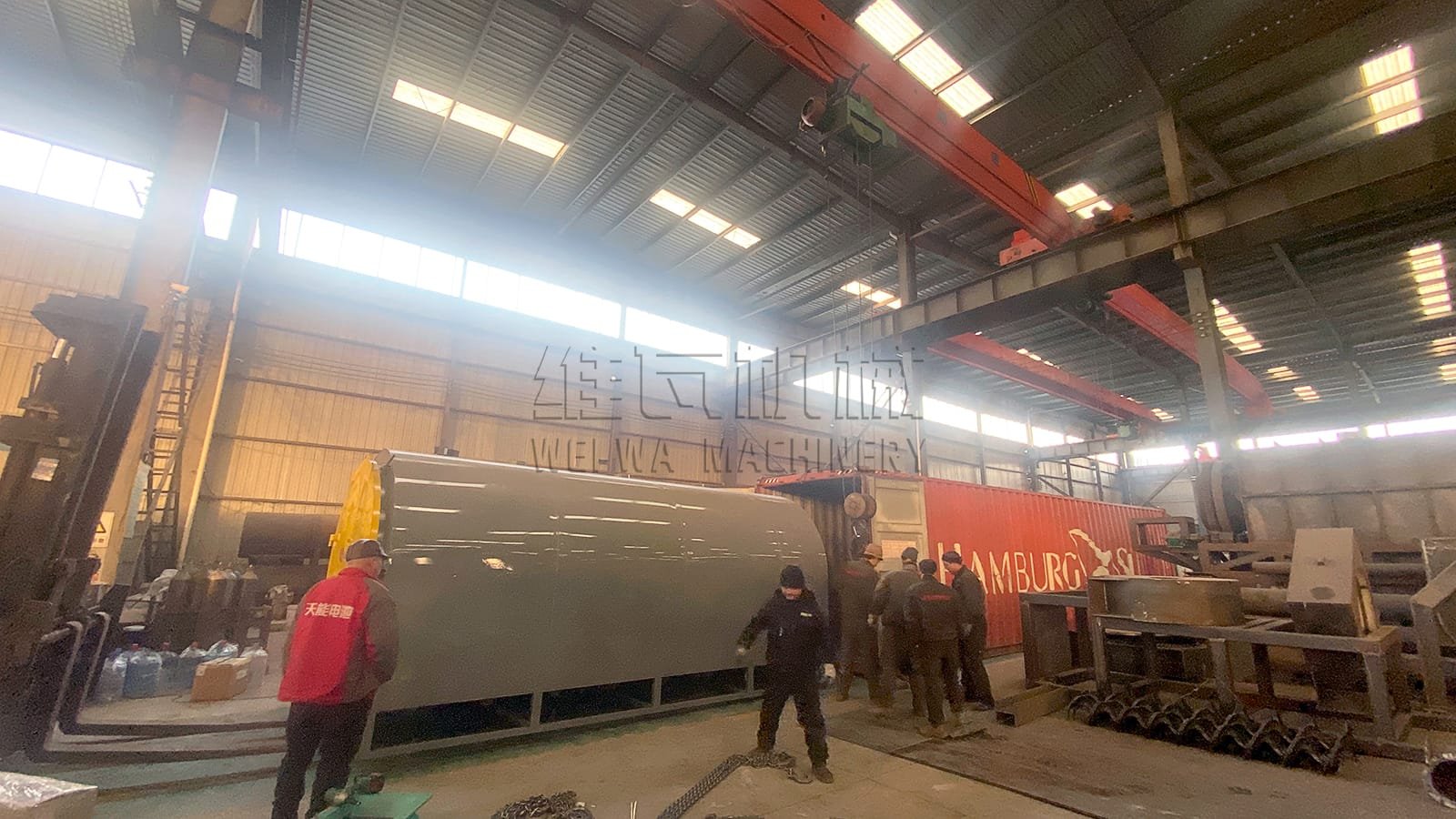
Shipment Scene from Weiwa Machinery Workshop
The shipment began in our welding bay where the barrel, rail frame, combustion chamber, and three-stage purification tower were torque-checked. Our engineer ran a dry-fire test on the burner for ten minutes, then charged a 200 kg sample of mixed hardwood and sawdust briquette into the cart. The horizontal carbonization furnace reached 320 °C in 48 minutes and crossed 580 °C at the thermocouple near the barrel center within two hours. After the Korean client reviewed the video call and the data log, we painted the skid, wrapped the PLC panel, and loaded the unit onto the container with the spare seal gasket, the rail clips, and the English manual.
Weiwa Machinery treats every export unit as a commissioning job, not only a sale. The charcoal making machine for Korea order included a 380 V three-phase control box with English labels, LPG-compatible burner fittings, and a modified chimney height for the client’s concrete pad. Before the container closed, our team re-tightened the gas return flange because the recycled syngas line is the part most sensitive to vibration during ocean freight. That detail matters for a horizontal carbonization furnace in Korea arrival scenario where the buyer expects to ignite on day three, not day thirty.

Horizontal Carbonization Furnace Technical Recap
The horizontal carbonization furnace is a barrel-style retort mounted on rails. The cart carries the raw material into the barrel, the door seals with ceramic packing, and indirect heat from the external burner wraps the barrel. Pyrolysis gas escapes through the top manifold, passes the condensation stage where tar and wood vinegar separate, and the cleaned combustible fraction returns to the burner as supplemental fuel. Internal temperature stabilizes near 600 °C, which is the band where lignin-rich biomass releases volatile matter without burning the fixed carbon.
Indirect Heating and Gas Recycling
Indirect heating means the charcoal never sees open flame. For a Korean buyer using a charcoal making machine for Korea in a semi-urban workshop, this design reduces spark risk and keeps the fixed carbon above 68 percent in our repeated tests. Gas recycling is not a marketing label. The burner duty drops roughly 30 percent once the returned syngas joins the LPG line, and the stack plume turns from grey to nearly invisible after the first hour. A carbonization furnace without this loop can still make charcoal, but it will burn more fuel and fail the smoke check that Korean district offices increasingly ask for.
Rail Mounted Barrel and Cart Loading
The rail system is the reason operators choose a horizontal carbonization furnace over a vertical pit. One cart cools outside while the second cart carbonizes inside. Throughput rises without raising peak burner power. During the Korea-bound unit’s factory trial, our worker loaded the cart with a forklift in nine minutes, pushed it into the barrel, closed the door, and walked to the PLC. No night shift, no pit opening at 3 a.m., no guesswork about color. For a charcoal making machine for Korea run by a family workshop, that ergonomic gap is the real productivity gain.
Trial Run Results in Korea with Local Raw Materials
After customs clearance and pad installation, the Korean client ran three batches in the first week. Batch one was 220 kg of dried oak log cuts at 12 percent moisture. Batch two was 200 kg of sawdust briquette. Batch three mixed 120 kg coconut shell with 100 kg pine offcut. The horizontal carbonization furnace in Korea held 590–610 °C in the middle stage for all three runs. Yield on oak was 34.2 percent, on sawdust briquette 31.8 percent, and on the coconut shell mix 36.1 percent. Fixed carbon measured 71–74 percent with a laboratory spot check.
Wood Log and Sawdust Briquette Carbonization
Korean hardwood logs carbonize slowly but give premium BBQ charcoal with tight cracks and high density. The charcoal making machine for Korea trial showed oak logs needed six hours and forty minutes from cold close to sealed cooling. Sawdust briquettes finished faster at five hours and twenty minutes because the uniform shape conducts heat better. Both batches lit cleanly in a chimney starter and held glow for 95 minutes in a windshield test, which matched our Gongyi data within a five-minute margin.
Temperature Curve and Yield Observation
The thermocouple graph from the Korean site showed the typical three steps. Dehydration ran 80–180 °C, devolatilization accelerated at 280 °C, and deep carbonization stabilized at 560–600 °C. When the client tried a 19 percent moisture batch, runtime extended to seven hours and syngas dilution dropped the burner return pressure, confirming our manual warning. A horizontal carbonization furnace rewards dry feedstock. A carbonization furnace is not broken when wet shell slows it down; the raw material is simply not ready.
Charcoal Making Machine for Korea Buying Considerations
Buyers searching charcoal making machine for Korea often compare price first, but the variables that decide payback are batch size, moisture tolerance, voltage, and purification tier. Của chúng tôi 1000 kg dual-cart barrel suits a starter line. Các 500 kg single cart validates the market. Các 1500 kg version fits a copra or coconut shell importer who already has a drying yard. For Korea, we recommend 380 V three-phase, English PLC, LPG or diesel burner, and the three-stage tower rather than the single scrubber, because provincial inspectors ask for tar separation proof.
A horizontal carbonization furnace in Korea also needs spare seals and a trained loader. The machine is not complex, but the first week mistakes are always the same across countries: charging wet material, opening the door early, blocking the tar drain. Weiwa ships a 22-page English manual and a walkthrough video so the Korean buyer does not repeat the learning curve we already paid for in earlier markets.
Why Weiwa Machinery for Horizontal Carbonization Furnace Projects?
Weiwa Machinery is based in Gongyi, Trịnh Châu, HENAN, and has supplied charcoal making machine systems to more than 50 quốc gia. Our horizontal carbonization furnace line covers 500 kg to 2000 kg batch sizes, with rail carts, gas recycling, and PLC control as standard, not paid add-ons. We do not sell a carbonization furnace and disappear. We join the first ignition by video, review the thermocouple curve, and ship parts within 48 hours if a gasket or sensor fails. For the Korean client, that meant the first charcoal came out on schedule, the fixed carbon number satisfied their buyer, and the smoke test passed without a second attempt.
A charcoal making machine for Korea is only as good as the commissioning behind it. The horizontal carbonization furnace in Korea we shipped is now in its fourth week of daily batches, averaging 920 kg finished charcoal every two days from mixed feedstock, with LPG consumption 28 percent lower than the client’s old vertical kiln. That is the kind of field result we publish because it is repeatable, not theatrical.
Contact Máy móc Weiwa
If you are evaluating a horizontal carbonization furnace, a charcoal making machine for Korea, or any carbonization furnace upgrade, our team can share the Korea trial sheet, the layout drawing, and the voltage option that matches your pad. We respond in English and Korean-friendly business hours.
Đám đông / WhatsApp: +8613838093177
E-mail: info@cjlmachinegroup.com
Weiwa Machinery designs, welds, and tests every horizontal carbonization furnace in our own workshop before it sails. The unit in Korea is not a prototype. It is the same steel, the same rail, and the same gas loop we build for clients in Southeast Asia, South America, and East Africa, adjusted only for voltage, fuel, and language. That is why our charcoal making machine line has become a default choice for more than two million equipment buyers worldwide who need a carbonization furnace that works on arrival, not after three service visits.


 WeChat

 +8615937143060
