


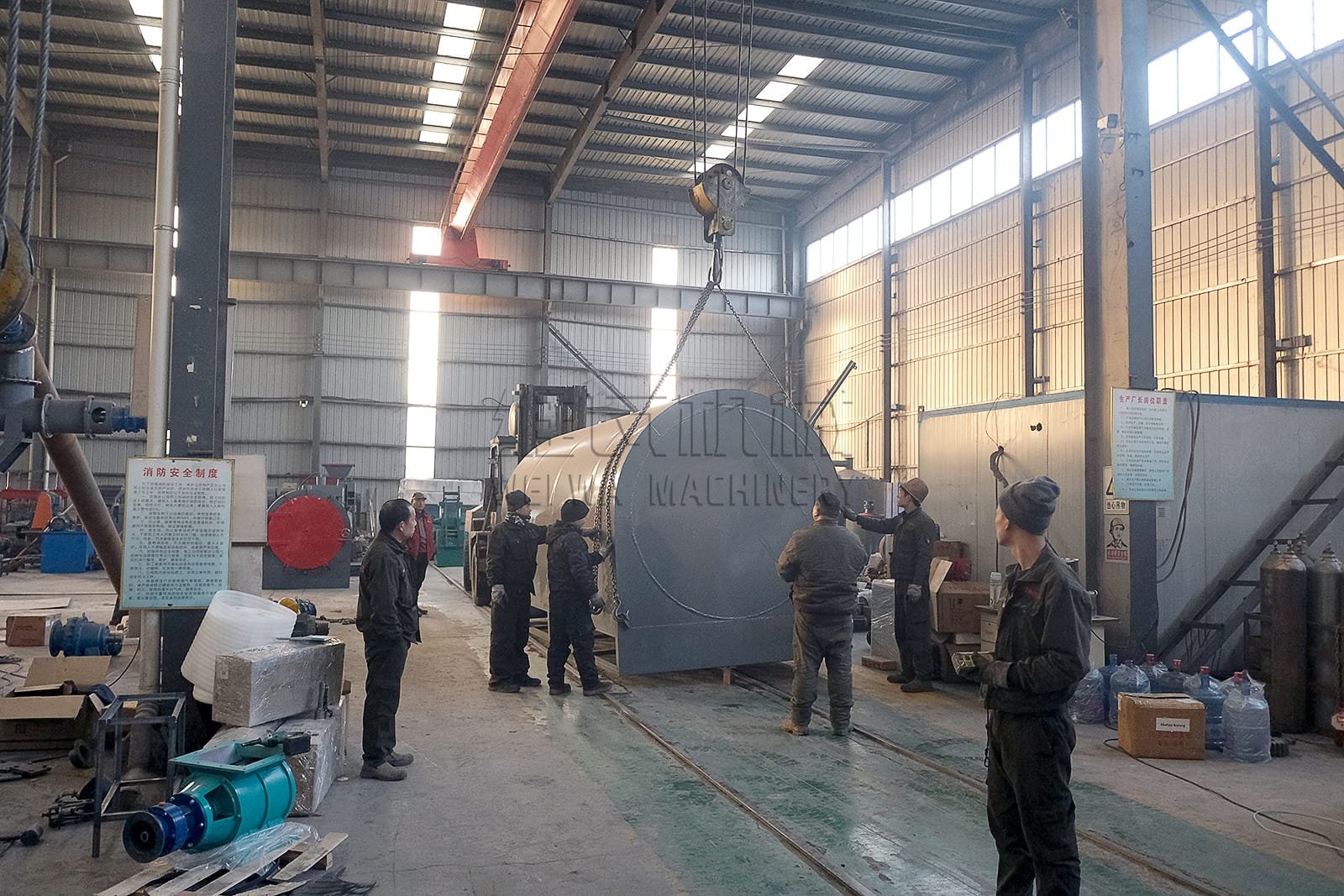
Container Loading the Lò cacbon hóa ngang for Ghana
The export process for a horizontal carbonization furnace heading to Ghana starts long before the container arrives. Our production team completed weld inspection, gas circuit pressure testing, rail alignment, burner nozzle calibration and electric control panel check. The barrel-style chamber was treated with anti-rust oil, wrapped in waterproof industrial film, and cushioned for ocean transit. The gas-purification tower, condenser pipes, thermometer, sealing caps and spare gaskets were packed separately in shock-proof wooden crates with bilingual labels for reassembly on site.
Because a horizontal carbonization furnace for Ghana often arrives at a workshop without heavy crane access, we design the rail and cart system to allow manual or forklift-assisted positioning. The client receiving this unit runs a charcoal yard outside Kumasi and previously used an earthen charcoal kiln. Their main complaints were uneven charcoal, high wood consumption, long cooling time and smoke complaints from neighboring farms. The horizontal carbonization furnace in Ghana scenario is becoming common: an operator wants smokeless batch carbonization, predictable cycle time and charcoal that meets urban barbecue and export specifications.
Before the container was sealed, our engineers ran a complete trial using tropical hardwood logs and coconut shells, because those two materials represent the most realistic feedstock mix for the buyer. The trial was documented with temperature charts, weight records and photographic evidence so the Ghana team could see expected performance before installation.
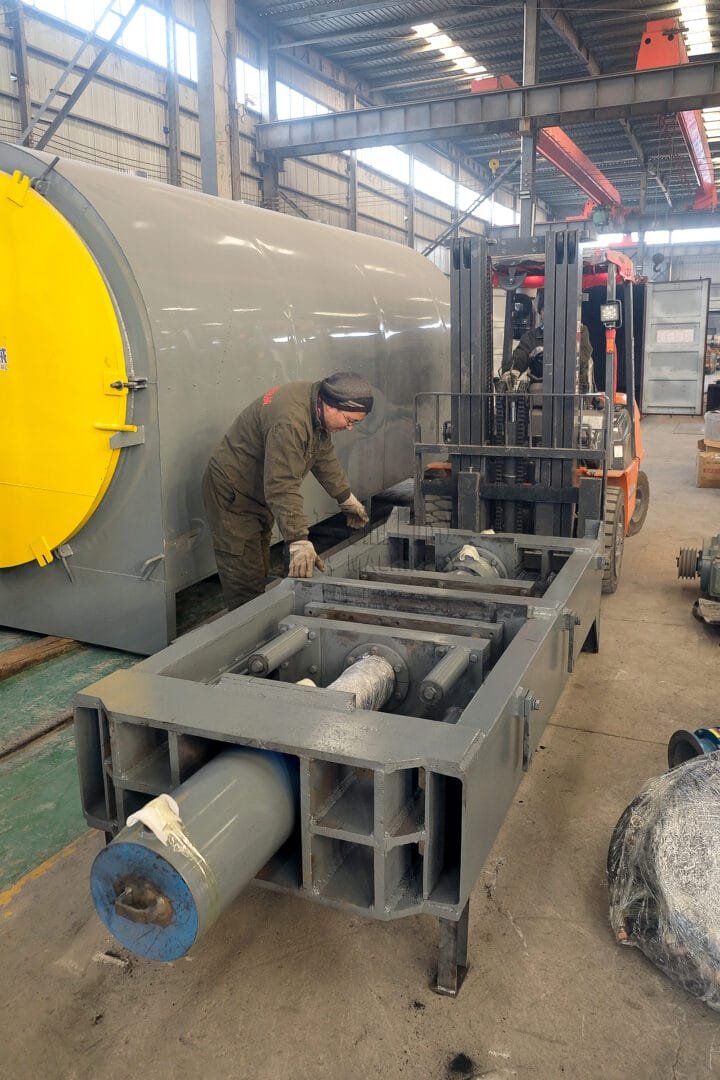
What a Horizontal Carbonization Furnace Actually Does?
A horizontal carbonization furnace is a batch pyrolysis unit built around a horizontally oriented steel chamber mounted on rails. Raw material is loaded on a cart, pushed into the chamber, sealed, and heated indirectly. Unlike an open charcoal kiln, the chamber works in an oxygen-limited environment. Biomass does not burn freely. It thermally decomposes, releasing volatile gases that are captured, condensed, purified and returned to the burner as clean combustible gas.
This self-sustaining cycle is the core reason why a horizontal carbonization furnace outperforms traditional charcoal kiln setups in fuel economy. External firewood or LPG is only needed during startup. Once pyrolysis gas volume is sufficient, the furnace sustains internal temperature near 600 °C using its own off-gas.
Indirect Heating and Gas Recycling
Indirect heating means the flame never touches the raw material directly. A firebox or burner heats the chamber wall, and the chamber radiates heat inward. Volatile compounds released from wood, cây tre , coconut shell or sawdust briquettes travel through a condensation tower. Tar and wood vinegar drop out. The remaining gas—mainly methane, hydrogen and carbon monoxide—returns to the burner.
In our trial for the Ghana-bound horizontal carbonization furnace, the external burner was switched to low fire after roughly two hours. From that point, recycled gas supplied most of the thermal energy. Fuel wood consumption dropped by an estimated 30 ĐẾN 40 percent compared with a conventional kiln of similar batch size.
Rail Chamber and Batch Loading
The rail-mounted chamber is a defining feature of the horizontal carbonization furnace. Operators load carts in a shaded prep area, push them into the furnace, seal the door, and begin the cycle. After carbonization and cooling, the cart is pulled out and emptied. This reduces back strain, avoids shoveling inside a hot chamber, and keeps batch weights consistent.
For Ghana workshops where labor cost is not the only issue but labor reliability and safety are, the cart system matters. A traditional charcoal kiln needs workers to stack wood in a mound, cover it with soil, monitor cracks, and quench with water or sand. The horizontal carbonization furnace replaces that workflow with a repeatable mechanical routine.
Pre-Shipment Trial Run With Ghana Feedstock
We did not test the furnace with generic pine pallets. We deliberately used a hardwood mix similar to what grows around Ashanti and Bono regions, plus imported coconut shells that coastal Ghana buyers often blend into their feedstock. Moisture of the hardwood was around 15 percent after two days of sun drying. Coconut shells were below 12 percent. The combined batch weighed 1200 kilograms.
Hardwood and Coconut Shell Mix
Hardwood logs were cut into 40 ĐẾN 60 centimeter sections. Coconut shells were loaded whole. The cart was arranged so airflow gaps remained between pieces. Our engineers avoided overpacking because dense packing slows pyrolysis and creates under-carbonized cores. The door was sealed with high-temperature gasket tape, and the purification tower water circulation was started ten minutes before ignition.
Temperature, Yield and Smoke Check
Ignition began with firewood in the startup burner. Internal chamber temperature reached 300 °C in 78 phút. Between 300 Và 500 °C, gas evolution accelerated. By minute 135, chamber temperature stabilized at 590 °C. Peak observed temperature was 612 °C. The automatic gas return valve opened, and flame appearance at the burner changed from yellow to sharp blue, indicating recycled syngas combustion.
Total active carbonization time was seven hours and twenty minutes. Cooling took nine hours with the door cracked under controlled venting. Final charcoal weight was 368 kilograms from 1200 kilograms of feedstock, a yield of 30.6 percent. Fixed carbon tested at 72 percent. Ash content was 3.1 percent. No continuous smoke column was visible from the stack during steady-state operation. A faint vapor plume appeared only during initial moisture release, which is normal and not the black smoke associated with a charcoal kiln.
The Ghana client reviewed the trial video and weight sheet. For them, the decisive numbers were yield consistency and smoke reduction. A traditional charcoal kiln on the same feedstock typically returns 22 ĐẾN 26 percent charcoal with high batch variance. The horizontal carbonization furnace in Ghana trial produced 30.6 percent with uniform black luster and low breakage.
Why a Horizontal Carbonization Furnace in Ghana Makes Sense?
Ghana has abundant biomass. Offcuts from lumber yards, branches from cocoa farm pruning, palm kernel shells from oil mills, coconut shells from coastal trading, rice husk from northern farms, and sawdust from furniture workshops are all potential feedstock. Yet charcoal supply still depends heavily on informal pit burning and rudimentary kilns. That gap is exactly where a horizontal carbonization furnace for Ghana creates value.
Replacing Traditional Charcoal Kiln Methods
A traditional charcoal kiln can be built cheaply, but it punishes the operator with low yield, weather dependence, fire risk and smoke disputes. During rainy season, earthen kilns take longer to dry and may fail entirely. During dry season, uncontrolled burning wastes wood. The horizontal carbonization furnace removes most of that uncertainty. Cycle time is fixed. Yield is predictable. Charcoal density is higher. And because the unit is enclosed, nearby crops and housing are not exposed to embers.
For a Ghana entrepreneur selling to Accra barbecue distributors or exporting to neighboring Sahel markets, charcoal grade decides margin. Uniform pieces, low ash and high fixed carbon command premium price. The horizontal carbonization furnace delivers that grade repeatedly.
Biomass Waste From Cocoa, Palm and Sawdust
Cocoa farmers prune trees twice a year. Palm oil processors discard empty fruit bunches. Furniture factories pile sawdust. All of these are marginal waste streams until a charcoal making machine converts them into storable, transportable, sellable carbon. The horizontal carbonization furnace accepts wood logs, cây tre , Vỏ dừa, sawdust briquettes and agricultural residues provided moisture stays under 20 percent.
We advise Ghana clients to pair the furnace with a simple hoop dryer or solar shed when processing fresh biomass. Drying is not part of the furnace itself, but it protects cycle time and charcoal quality.
Charcoal Making Machine vs Charcoal Kiln in West Africa
The phrase charcoal making machine covers many designs: vertical retorts, rotary carbonizers, continuous pyrolysis plants and horizontal batch furnaces. The charcoal kiln is the oldest method and still dominant in rural Ghana. Choosing between them is not only about price. It is about throughput stability, emission rules, labor safety and product consistency.
A charcoal kiln wins on low capital cost. It loses on yield, smoke, weather sensitivity and resale value. A horizontal carbonization furnace costs more upfront but recovers the gap through fuel savings, higher yield, reusable byproduct gas and cleaner working conditions. For a producer targeting 10 ĐẾN 20 tonnes of charcoal per month, the furnace usually pays back within two to three seasons.
We do not claim the horizontal carbonization furnace replaces every kiln in Ghana. Very small seasonal burners may still prefer earthen pits. But for any operator receiving regular orders, hiring staff, or facing community smoke complaints, the charcoal making machine path is more durable.
The unit shipped to Ghana this month sits in the 900 ĐẾN 3000 kilogram per batch range depending on feedstock density. That capacity fits medium yards without requiring continuous plant staffing. It is also compact enough to fit beside an existing sawmill or coconut processing shed.
Về Máy móc Weiwa
Weiwa Machinery is a manufacturer of biomass processing equipment including the horizontal carbonization furnace, charcoal making machine lines, briquette presses, crushers, dryers and supporting conveyors. Our machines are exported to many countries and regions, and we have served more than 2 million customers across agriculture, charcoal trade, woodworking and renewable energy sectors. Every horizontal carbonization furnace leaving our workshop passes weld inspection, pressure check, electric control test and a live carbonization trial when requested by the client.
For the Ghana market, we provide English operation manuals, spare part kits, WhatsApp video support and optional on-site commissioning. We help buyers choose chamber size, configure the gas-purification tower for local emission expectations, and plan feedstock drying based on humidity in Accra, Kumasi, Tamale or Takoradi.
If you are evaluating a horizontal carbonization furnace in Ghana, comparing a horizontal carbonization furnace for Ghana against your current charcoal kiln, or simply want trial-run data for hardwood and coconut shell, contact our team directly.
Contact: Đám đông / WhatsApp +8613838093177
E-mail: info@cjlmachinegroup.com
The horizontal carbonization furnace shipped this month is now on the ocean. When it lands, the Ghana team will repeat the same seven-hour cycle we ran in our workshop. Based on trial data, they should see around 30 percent yield, stable 600 °C carbonization, recyclable syngas combustion, and charcoal that competes on quality with imported briquettes. That is the practical difference between a charcoal kiln and a modern charcoal making machine built for West African biomass.


 WeChat

 +8615937143060
