


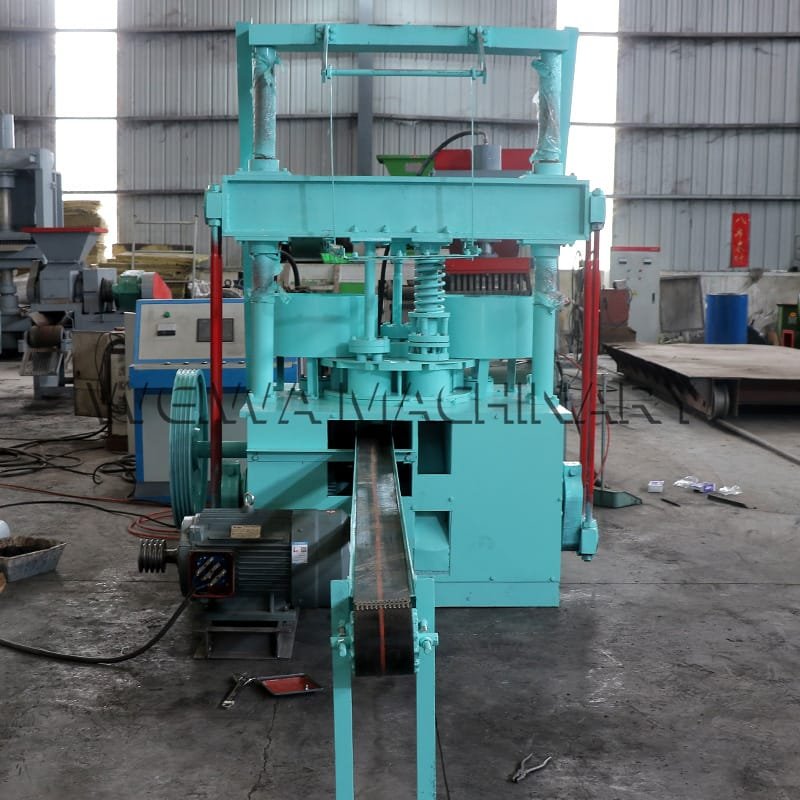
When a charcoal producer in Lusaka reached out to Weiwa Machinery with a straightforward request — “show us what your honeycomb briquette charcoal machine can do with our local coal powder” — the response was not a brochure or a video link. It was an invitation to run the machine with their own material, at their own facility, under conditions that mirrored what a real production shift would look like. Two weeks later, a Weiwa technical engineer was on the ground in Zambia, commissioning a Model 220 honeycomb punching machine and feeding it with locally sourced anthracite fines that the customer had been stockpiling for months without a viable processing route.
What Is a Honeycomb Briquette Charcoal Machine?
A honeycomb briquette charcoal machine — also called a honeycomb charcoal coal briquette forming machine or a honeycomb punching machine — is a mechanical press that compresses powdered carbonaceous material into uniformly shaped briquettes perforated with a characteristic pattern of round holes. Those holes are not cosmetic. They serve a combustion function: the vertical channels running through each briquette create a chimney effect that draws air upward through the fuel body during burning, promoting more complete combustion and a steadier heat release than a solid puck of the same material would achieve.
The honeycomb briquette is a familiar sight across much of Asia and parts of Africa. In China, it powered household cooking stoves for decades before natural gas pipelines displaced it in urban areas. In Vietnam and Indonesia, it remains a staple fuel for street food vendors, small restaurants, and rural households. And increasingly, across sub-Saharan Africa — Zambia included — the honeycomb format is gaining recognition as a practical bridge between the low cost of raw charcoal or coal powder and the performance expectations of consumers who want a fuel that lights easily, burns predictably, and does not crumble during transport from producer to retailer.
How the Punch Press Mechanism Works?
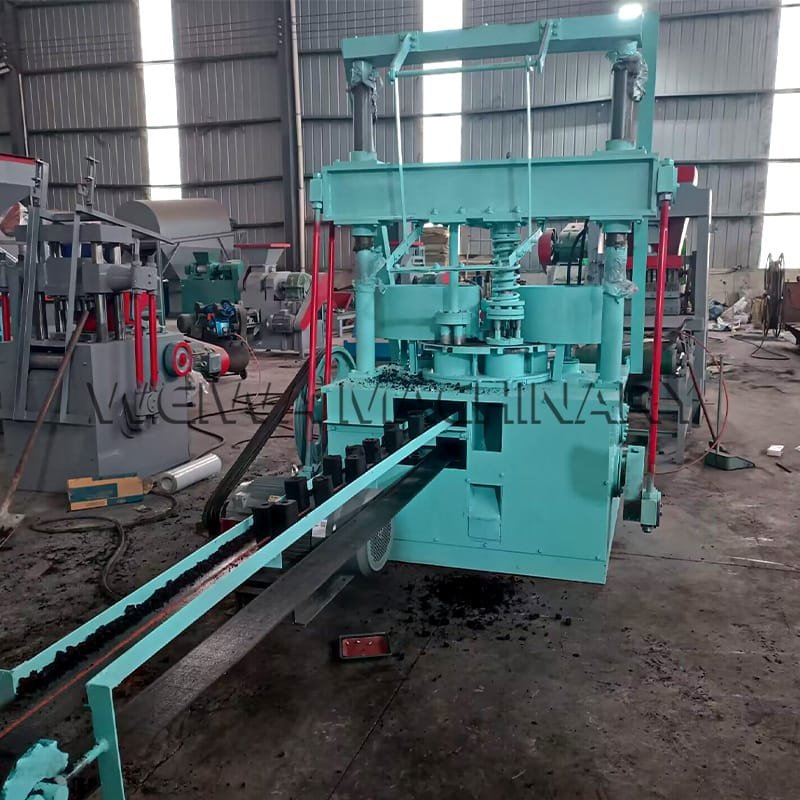
The core operating principle of a Weiwa honeycomb briquette charcoal machine is mechanical punching, not screw extrusion and not roller compaction. The machine is built around a rotating mould table — a circular steel disc into which multiple mould cavities are machined, each corresponding to one finished briquette. As the table indexes from station to station, each cavity passes under a series of stations: a filling station where powdered feedstock drops into the cavity from an overhead hopper, a compression station where a hydraulic or mechanical punch descends into the cavity and compacts the material at pressures typically in the range of 20 ĐẾN 30 megapascals, and an ejection station where a lower piston pushes the finished briquette upward and out of the mould.
The punch itself carries an array of steel pins arranged in the pattern of the honeycomb holes. As the punch drives into the powder-filled cavity, those pins displace material and create the through-holes while the punch face simultaneously compacts the remaining material into a dense, cohesive briquette. The pins retract as the punch lifts, leaving clean holes that run the full height of the briquette. This simultaneous forming and perforating action is what distinguishes the honeycomb briquette charcoal machine from other briquetting technologies: it produces a finished, hole-punched briquette in a single stroke, with no secondary drilling or piercing step required.
The Weiwa models are driven by an electric motor coupled through a reduction gearbox to a crank-and-connecting-rod assembly that converts rotary motion into the reciprocating vertical motion of the punch. The mould table rotation is synchronised with the punch stroke through a Geneva mechanism or cam indexing drive, ensuring that each cavity arrives at the compression station exactly as the punch descends. This mechanical synchronisation is critical — if the timing drifts by even a fraction of a second, the punch can strike the edge of the mould cavity rather than entering it cleanly, causing damage to both the mould and the punch tooling. Weiwa’s gear-driven timing system, enclosed in an oil bath, maintains alignment across hundreds of thousands of cycles without requiring field adjustment.
From Raw Material to Finished Honeycomb Briquette
While the honeycomb briquette charcoal machine is the centrepiece of the production line, it does not operate in isolation. The Zambia trial ran a complete process chain that illustrates how the machine fits into a working production environment.
The first step is size reduction. The customer’s feedstock — locally sourced anthracite coal from Zambia’s Southern Province — arrived in lumps ranging from 20 ĐẾN 80 millimetres. A hammer crusher reduced this to a powder passing through a 3-millimetre screen, creating a feed material with consistent particle size distribution. Particle size matters because the mould filling stage relies on the powder flowing freely from the hopper into the cavity under gravity; if the powder contains oversized particles or irregular chunks, cavities fill unevenly, and briquette weight and density vary from piece to piece.
The second step is binder addition and mixing. Pure coal powder, even when finely ground, does not bind into a durable briquette under pressure alone — the particles lack the natural plasticity that biomass materials like sawdust possess. The Zambia trial used a starch-based binder, pre-gelatinised in hot water and mixed into the coal powder at approximately 5 percent by weight using a horizontal paddle mixer. The binder coats each coal particle with a thin adhesive film. Under the 25-megapascal compression force delivered by the honeycomb briquette charcoal machine, those coated particles lock together into a rigid matrix that holds its shape through handling, chuyên chở, and the early stages of burning.
The third step is the pressing operation itself, performed by the honeycomb briquette charcoal machine. The Zambia trial used a Weiwa Model 220 with an 11-kilowatt main motor, running at 20 ĐẾN 28 strokes per minute. At that rate, the machine produced between 2 Và 3 tonnes of finished honeycomb briquettes per eight-hour shift — a throughput that, as the trial demonstrated, could comfortably supply several hundred households with a week’s worth of cooking fuel from a single day’s production.
The fourth and final step is drying. Freshly pressed briquettes contain moisture from the binder solution — typically 18 ĐẾN 22 percent — and must be dried to below 8 percent moisture before they can be packaged, sold, or burned efficiently. The Zambia trial used open-air drying on raised racks under a simple polythene canopy, taking advantage of Zambia’s warm, dry-season climate to bring briquettes to target moisture within 48 giờ. For larger-scale or wet-season operation, a belt dryer or rotary dryer can accelerate this step to under two hours.
The Zambia Trial — Testing a Honeycomb Briquette Charcoal Machine at a Customer Site
The customer operated from a small industrial compound on the outskirts of Lusaka, with a covered production shed, a hammer mill already on site for agricultural processing, and a growing network of retail outlets selling bagged charcoal to households in the city’s densely populated townships. Their business challenge was straightforward: lump charcoal sourced from rural charcoal burners was becoming more expensive and less reliable as Zambia’s deforestation crisis tightened supply, and customers were increasingly receptive to manufactured briquettes if the price and burn quality were competitive.
Feedstock Preparation and Recipe Development
The trial began not with the honeycomb briquette charcoal machine itself but with the feedstock bench. The customer had accumulated approximately 15 tonnes of anthracite fines — a by-product of the local coal mining and grading industry — and wanted to validate that this material could be turned into saleable cooking fuel. Anthracite is the highest-rank coal, with fixed carbon content typically above 85 percent, low volatile matter, and very low ash. Its combustion characteristics — high heat output, long burn duration, minimal smoke — make it an excellent candidate for household cooking briquettes, provided it can be formed into a shape that allows sufficient airflow for clean ignition and sustained burning.
The Weiwa engineer conducted a series of bench-scale tests before starting the main production run. Moisture content of the as-received anthracite fines was measured at 4.2 percent, well within the acceptable range. Particle size distribution was checked using a sieve stack, and approximately 8 percent of the material was retained on a 5-millimetre screen — acceptable for the hammer mill but requiring a second pass through the crusher to bring oversized material into spec. The binder formulation was tested at three concentrations — 3 percent, 5 percent, Và 7 percent starch by weight — with the 5 percent formulation delivering the best balance of green strength (the briquette’s ability to hold together immediately after pressing, before drying) and economy.
A small test batch of 50 briquettes was pressed first to verify mould fill, compression pressure, and ejection behaviour. All 50 briquettes emerged from the mould table intact, with cleanly defined honeycomb holes and no cracking around the hole perimeters — a sign that the binder was performing as expected and that the compression ratio was appropriate for the anthracite material.
Trial Production Run and Sample Analysis
With the recipe validated, the full trial production run commenced. The honeycomb briquette charcoal machine was fed continuously from the overhead hopper, which was topped up every 15 minutes by a worker shovelling prepared coal powder from the mixer discharge bin. The machine settled into a steady rhythm: the mould table rotating smoothly, the punch descending and retracting with a consistent mechanical cadence, finished briquettes ejecting onto the discharge chute and sliding into a collection bin.
Over the course of a single eight-hour shift, the Model 220 honeycomb briquette charcoal machine produced approximately 2,400 kilograms of finished briquettes — well within its rated capacity of 2 ĐẾN 3 tonnes per shift. The actual stroke rate averaged 24 strokes per minute, slightly below the machine’s maximum of 28, as the operator found that this pace produced the most consistent briquette weight and avoided occasional bridging of powder in the hopper throat.
Briquette dimensions matched the mould specification precisely: 220 millimetres in diameter, 90 millimetres in height, with 16 honeycomb holes each 14 millimetres in diameter arranged in concentric rings. Individual briquette weight averaged 1,250 grams immediately after pressing, dropping to approximately 1,080 grams after drying — a moisture loss of roughly 14 percent, consistent with the binder water content.
Density testing was performed on dried briquettes using the water displacement method. The average apparent density was 0.92 grams per cubic centimetre, which places Weiwa’s honeycomb briquette charcoal machine output firmly in the high-density category for formed coal briquettes. High density correlates directly with burn duration — a denser briquette contains more combustible material per unit volume and burns for longer — and also with mechanical durability during transport, which is a non-trivial consideration in Zambia where briquettes may travel over unpaved roads from producer to retailer.
The burn test was the moment the customer cared about most. Three dried briquettes were ignited in a standard Zambian mbaula — the portable metal charcoal stove used in the vast majority of urban and peri-urban households — and timed against a control batch of traditional lump charcoal of equivalent weight. The honeycomb briquettes ignited within 8 minutes using a small amount of kindling, reached cooking temperature in approximately 17 phút, and sustained usable heat output for 2 giờ và 45 minutes before needing replenishment. The lump charcoal control ignited faster but burned out in under 2 giờ, and its heat output was noticeably less steady, with periodic flare-ups and drop-offs as irregularly sized lumps combusted at different rates.
The customer’s observation, recorded in the trial log, was that the honeycomb briquettes “burn like a clock” — a comment that captures the fundamental consumer appeal of the honeycomb format. The regular geometry and consistent density produce a predictable burn curve, which matters enormously to a household cook who needs to time a meal and cannot afford to have the fire die halfway through.
Customer Feedback and Market Reception
The trial did not end at the factory gate. The customer took 200 dried briquettes — roughly 215 kilograms of product — and distributed them in 10-kilogram sample bags to 20 households in Lusaka’s Matero and Chawama townships, along with simple usage instructions and a feedback form. A further 100 briquettes went to two small restaurants for trial use in their commercial cooking operations.
The household feedback, collected over a two-week period, was instructive. Sixteen of the twenty households reported that the honeycomb briquettes lasted longer per cooking session than the lump charcoal they normally used. Fourteen noted that the briquettes produced noticeably less smoke, which was cited as a health benefit particularly valued by households where cooking is done indoors or in semi-enclosed kitchen areas. Twelve households expressed a willingness to switch to honeycomb briquettes permanently if the price per kilogram was no higher than their current charcoal expenditure. Two of the restaurant users placed tentative orders for regular supply, citing the predictability of burn time as a factor that simplified their kitchen operations.
The customer’s own economic analysis, based on trial data, suggested a production cost of approximately 1,800 Zambian kwacha per tonne of finished briquettes — covering raw material, binder, điện, labour, and a modest allocation for equipment depreciation. At Lusaka retail prices for bagged charcoal, which at the time of the trial ranged between 3,500 Và 5,000 kwacha per tonne depending on quality and season, the margin was compelling. Even at the lower end of the retail price range, the operation would generate gross margins above 45 percent, with the honeycomb briquette charcoal machine representing the single largest capital investment in the production line.
Why Zambia Needs Honeycomb Briquette Charcoal Machines?
The trial results demonstrated that a honeycomb briquette charcoal machine can produce saleable cooking fuel from Zambian coal fines. But the broader question — why Zambia, and why now — deserves a deeper look, because the machine’s commercial viability is inseparable from the structural dynamics of Zambia’s energy landscape.
The Charcoal-Deforestation Crisis and Clean Cooking Imperative
Zambia’s dependence on traditional charcoal is among the highest in sub-Saharan Africa. Over 80 percent of the population relies on charcoal or firewood as their primary cooking fuel, a figure that has remained stubbornly high despite decades of electrification programmes and liquefied petroleum gas promotion campaigns. The reason is not simply poverty — though poverty is certainly a factor — but a combination of unreliable electricity supply, limited LPG distribution infrastructure outside major cities, and deeply ingrained cooking practices that favour solid fuel stoves for the staple maize meal dish nshima, which requires sustained heat over a period of 30 ĐẾN 45 phút.
The environmental cost is severe. Zambia loses an estimated 250,000 ĐẾN 300,000 hectares of forest cover annually, with charcoal production for urban markets identified as the single largest driver. The FAO’s Alternatives to Charcoal Project in Zambia, running from 2021 through 2026, has explicitly targeted the development of manufactured fuel briquettes as a deforestation reduction strategy, providing technical assistance and market development support to briquette producers.
A honeycomb briquette charcoal machine addresses this crisis by enabling production of cooking fuel from materials that do not require cutting trees. Coal fines — the material used in the Zambia trial — are a mining and grading by-product that currently has limited commercial value and in many cases accumulates as a disposal liability. Charcoal powder and dust — the fines generated when lump charcoal is handled, bagged, and transported — represent another underutilised feedstock stream. By converting these waste-derived powders into formed briquettes, a honeycomb briquette charcoal machine creates cooking fuel from materials that were previously discarded, reducing the pressure on Zambia’s forests without asking households to change their cooking equipment or practices.
The health dimension is equally significant. Sản xuất than truyền thống, particularly when carried out in inefficient earth-mound kilns, exposes charcoal burners to extremely high concentrations of carbon monoxide and particulate matter. Household use of lump charcoal in poorly ventilated cooking spaces contributes to respiratory illness, particularly among women and children who spend the most time near the cooking fire. Manufactured honeycomb briquettes, by burning more completely and producing less smoke than irregular lump charcoal, reduce both occupational and household exposure to combustion pollutants — a public health benefit that the Zambia trial household feedback bore out in practice.
Economic Opportunity for Small and Medium Producers
Beyond the environmental and health arguments, a honeycomb briquette charcoal machine represents an accessible entry point into manufacturing for Zambian entrepreneurs. The capital requirement for a complete production line — crusher, máy trộn, honeycomb briquette charcoal machine, and drying racks — is modest compared to many other industrial processing investments, and the technical skills required to operate and maintain the equipment can be learned within a matter of days.
The Zambia trial demonstrated this accessibility in practice. The customer’s workforce consisted of four people: one machine operator who had previously worked as a diesel mechanic, two general labourers handling material movement and briquette stacking, and a supervisor who managed quality control and customer relations. The machine operator was trained by the Weiwa engineer over two days and was running the honeycomb briquette charcoal machine independently by day three of the trial. Maintenance tasks — greasing bearings, checking belt tension, inspecting punch pins for wear — are straightforward and were documented in a laminated quick-reference card translated into both English and Nyanja, ensuring that the customer’s team could perform routine upkeep without calling for external support.
The market opportunity scales with Zambia’s urbanisation rate. Lusaka’s population has grown from approximately 1.7 million in 2010 to an estimated 3.3 million in 2025, and the city’s charcoal consumption has grown in parallel. A single honeycomb briquette charcoal machine producing 2.5 tonnes per day — the demonstrated output of the Model 220 — can supply roughly 5,000 households with a week’s cooking fuel each month. At Lusaka’s scale, there is room for dozens of such machines before the market approaches saturation, and the customer’s experience distributing sample briquettes suggests that demand is limited not by consumer resistance but by supply — people want the product; they simply have not had access to it before.
Honeycomb Briquette Charcoal Machine Price and Investment Logic
The honeycomb briquette charcoal machine price varies by model and configuration, and Weiwa Machinery provides detailed quotations based on the customer’s specific throughput requirements, feedstock characteristics, and auxiliary equipment needs. For a Zambian entrepreneur evaluating the investment, the relevant comparison is not against other machinery manufacturers but against the alternative: continuing to buy lump charcoal from an unreliable and increasingly expensive supply chain.
Using the Zambia trial data as a reference point, a complete production line built around a Model 220 honeycomb briquette charcoal machine — including hammer crusher, horizontal paddle mixer, the press itself, and a set of drying racks — can pay back its capital cost within approximately 8 ĐẾN 14 months of operation at the production volumes and market prices recorded during the trial. This payback calculation assumes single-shift operation, no carbon credit revenue (which may become applicable if charcoal dust rather than coal fines is used as feedstock, opening eligibility under certain biomass fuel standards), and no value assigned to the avoided cost of waste disposal for coal fines that would otherwise require management.
Operating costs are dominated by raw material and binder, which together account for roughly 60 ĐẾN 65 percent of the per-tonne production cost. Electricity is a minor line item — the 11-kilowatt main motor on the Model 220 draws approximately 88 kilowatt-hours over an eight-hour shift, which at Zambia’s industrial electricity tariff translates to a cost of under 200 kwacha per day. Labour for a four-person team operating one honeycomb briquette charcoal machine adds a further cost that varies with local wage rates but typically represents 15 ĐẾN 20 percent of total production cost.
The key variable that determines whether the investment works is not the machine price but the spread between feedstock cost and briquette selling price. In Lusaka, where the trial took place, that spread is wide enough to support profitable operation. In more remote areas where both feedstock and market access are less favourable, the economics tighten. Weiwa’s approach is to work with prospective buyers to model the specific economics of their location before they commit to a purchase, using locally verified input costs and market prices rather than generic assumptions.
What Sets Weiwa’s Honeycomb Punching Machine Apart?
The honeycomb punching machine market includes manufacturers from China, Ấn Độ, and a handful of African fabricators producing simpler, lower-throughput designs. Several design features of the Weiwa honeycomb briquette charcoal machine are worth highlighting because they directly affect machine longevity, output quality, and the operator’s daily experience.
The mould table and punch assembly are the highest-wear components in any honeycomb briquette charcoal machine, and Weiwa addresses this with material selection. Mould cavities are machined from chromium-alloy steel and heat-treated to a surface hardness of HRC 58 ĐẾN 62, providing resistance to the abrasive wear that coal powder inflicts on mould walls over hundreds of thousands of cycles. The punch pins — the steel rods that create the honeycomb holes — are made from high-speed tool steel and are individually replaceable, so a worn or bent pin can be swapped out in minutes without removing the entire punch assembly. This modularity keeps maintenance costs low and production downtime minimal.
The drive system uses a helical gear reducer rather than a worm gear, which improves transmission efficiency and reduces heat generation during extended operation. The main bearings are grease-lubricated through easily accessible nipples, and the machine frame is a welded steel box section designed to absorb the cyclic impact loads of the punching cycle without transmitting excessive vibration to the foundation. During the Zambia trial, the machine was bolted directly to a concrete floor without any special vibration isolation, and the operator reported no perceptible shaking beyond the immediate vicinity of the machine — a practical advantage in facilities where multiple pieces of equipment share a common floor.
The hopper and feed system include a mechanical agitator that prevents powder bridging, a common problem when processing fine coal powder that can compact under its own weight and stop flowing into the mould cavities. The agitator is driven by a small independent motor and can be switched on or off as needed, consuming negligible power when running and eliminating the need for an operator to prod the hopper manually — a safety improvement that reduces the risk of hand injuries near the rotating mould table.
For the Zambia customer, one of the most appreciated features was the quick-change mould system. The Model 220 honeycomb briquette charcoal machine can be converted between different briquette diameters and hole patterns by swapping the mould table and punch assembly, a job that two people can complete in under two hours. This flexibility means that a producer serving both household and commercial customers can switch between, for example, a 220-millimetre household briquette and a 260-millimetre commercial briquette on the same machine, avoiding the need to purchase and maintain separate machines for different product formats.
The Road Ahead for Honeycomb Briquettes in Zambia
The Zambia trial confirmed what the customer suspected: a honeycomb briquette charcoal machine can manufacture cooking fuel that Zambian households accept, at a production cost that supports a viable business. But the implications extend beyond one customer’s operation.
Zambia’s energy policy environment is evolving in directions that favour manufactured solid fuels. The government’s Integrated Resource Plan acknowledges the role of clean cooking fuels in reducing deforestation and indoor air pollution. Development finance institutions, including the African Development Bank and the World Bank’s Energy Sector Management Assistance Programme, have committed funding to briquette value chain development in Southern Africa. And the growing frequency of load-shedding events — driven by Zambia’s heavy reliance on hydroelectric generation in an era of increasingly variable rainfall — is pushing more households toward charcoal as a backup cooking fuel, expanding the addressable market for any producer who can supply a consistent, affordable product.
The honeycomb format itself has advantages that position it well for the Zambian context. Unlike pillow-shaped or cylindrical briquettes that require specially designed stoves for optimal performance, honeycomb briquettes fit directly into the mbaula stoves that Zambian households already own. This compatibility removes a major adoption barrier: the customer does not need to convince households to buy new cooking equipment before they can use the fuel. The honeycomb holes provide the airflow that makes the briquette burn properly in a simple metal stove without forced air or complex grate geometry.
There are challenges, to be sure. Coal fines are not available in every region of Zambia, and producers in areas distant from coal mining activity will need to identify alternative feedstocks — charcoal dust from charcoal wholesale markets, agricultural residues like groundnut shells or maize cobs, or a blend of biomass char and mineral coal. The binder supply chain requires attention: starch must be sourced reliably and at predictable cost, and alternative binders like molasses or cassava flour may offer cost advantages that vary by season and location. And the market development work — building consumer trust, establishing retail distribution channels, and differentiating the product from lower-quality briquettes that may enter the market — is an ongoing investment that extends well beyond the machine purchase.
Weiwa Machinery’s role in addressing these challenges is not limited to supplying the honeycomb briquette charcoal machine. The company’s technical support team provides recipe development assistance, helping customers formulate briquette mixes that work with their locally available feedstocks and binders. Training covers not only machine operation but also production planning, quality control sampling, and basic financial modelling. And the company’s growing network of customers across more than 130 countries provides a peer community where Zambian producers can learn from operators in Kenya, Tanzania, Nigeria, and other African markets where honeycomb briquette charcoal machines have already established commercial production.
The Zambia trial was a single machine, a single customer, and a single week of production. But the sample briquettes that left the customer’s compound and entered Lusaka’s households represented something larger: a proof point that manufactured cooking fuel, produced locally from locally available material, can compete with traditional charcoal on price, outperform it on burn quality, and earn the acceptance of the Zambian cooks who are the ultimate arbiters of whether a fuel belongs in their kitchen.
Về Máy móc Weiwa
Công ty sản xuất máy móc Henan Weiwa, Ltd. has spent more than three decades designing, building, and supporting the machinery that converts raw biomass and mineral materials into formed fuels. From its manufacturing base in Gongyi City, Henan Province — a 112,000-square-metre facility with over 200 machine tools and a dedicated research and development team of more than 100 engineers — the company supplies honeycomb briquette charcoal machines, ball charcoal briquette presses, charcoal extruders, continuous and horizontal carbonization furnaces, crushers, dryers, máy trộn, and complete turnkey production lines to customers in over 100 quốc gia.
The company’s Zambia trial reflects a broader philosophy: Weiwa does not simply sell machines and ship them. Every honeycomb briquette charcoal machine order includes the technical support needed to get production running — recipe testing with the customer’s own feedstock, on-site commissioning and operator training, and ongoing remote support. The five overseas branch offices provide regional points of contact, and the company’s spare parts inventory ensures that wear components like punch pins and mould inserts are available when customers need them.
Whether a customer in Zambia, Tanzania, Kenya, or any other market is launching a honeycomb briquette production business from scratch or expanding an existing charcoal operation into manufactured briquettes, Weiwa Machinery’s engineering team provides customised equipment configuration, plant layout planning, and the production know-how that turns a machine into a business.
Đám đông / WhatsApp: +8613838093177 E-mail: info@cjlmachinegroup.com Website: https://cjljx.com Product Page: https://cjljx.com/product/honeycomb-charcoal-briquettes-machine


 WeChat

 +8615937143060
