


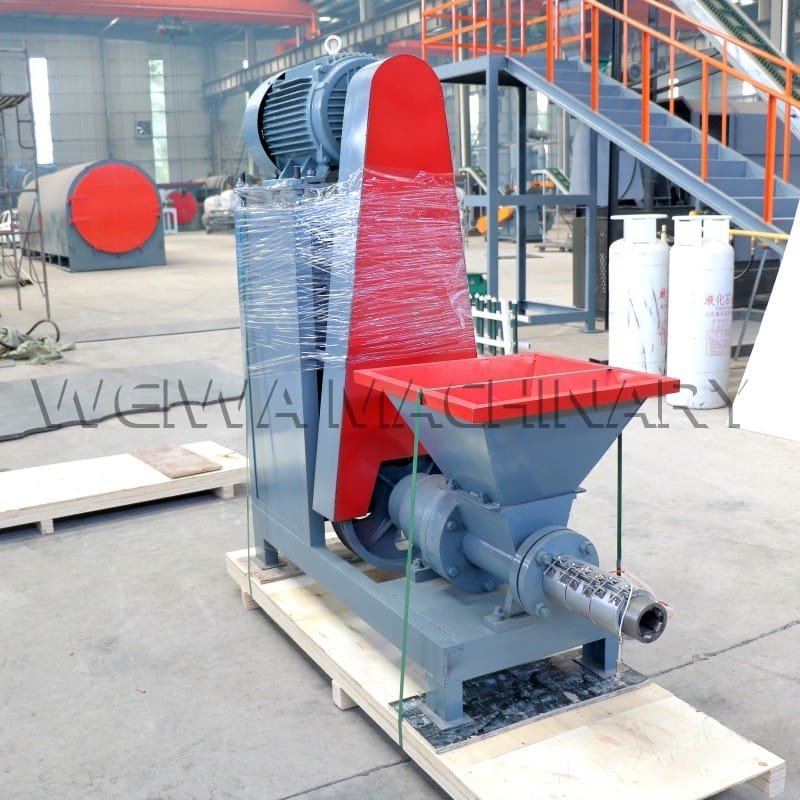
In the heart of Central Africa, where lush forests meet growing energy demands, a transformative moment unfolded recently: Weiwa Machinery loaded and dispatched a full set of charcoal production line equipment, including our advanced sawdust extrude machine in Congo, to support local biomass utilization. For us at Weiwa Machinery—a company dedicated to turning agricultural residues into renewable energy solutions—this shipment is more than a business transaction; it’s a bridge between innovative engineering and the urgent need for sustainable fuel in regions like Congo. Trong blog này, we invite you to step into the bustling shipping site, then dive deep into the science of charcoal making with sawdust extruders, Máy nướng máy, and how these technologies are reshaping Congo’s energy landscape.
Shipping Our Charcoal Production Line to Congo
The early morning sun cast long shadows over the port as our team finalized the last checks on the container housing the charcoal production line. Crates labeled “Sawdust Extruder,” “Sawdust Briquette Machine,” and “Auxiliary Equipment” stood ready, each piece a testament to months of R&D aimed at adapting to tropical climates and local raw material characteristics. For Congo, where sawdust—generated from timber processing and woodcraft industries—is often discarded or burned inefficiently, this line represents a shift from waste to wealth.
Our logistics coordinator, Mr. Li, explained, “We customized the packaging to withstand Congo’s humidity and rough transit conditions. Cácsawdust extruder alone weighs 2.5 tấn, so securing its alignment was critical to prevent damage to its precision screw and heating components.” Watching the crane lift the first crate onto the vessel, we felt a mix of pride and responsibility: this equipment would soon empower Congolese entrepreneurs to produce high-quality charcoal, reducing reliance on deforestation for traditional wood charcoal.
Why Congo? The Urgent Need for Sustainable Charcoal Solutions
To understand the impact of our shipment, we must first contextualize Congo’s energy reality. Với hơn 60% of its population relying on biomass for cooking—primarily wood charcoal—the country faces dual challenges: deforestation and indoor air pollution from inefficient combustion. Traditional charcoal production involves carbonizing wood in earthen kilns, a process that emits significant CO₂ and consumes 6–10 times more wood than modern methods. Trong khi đó, Sawdust, a byproduct of Congo’s thriving timber sector, is often dumped or burned, contributing to air pollution without economic benefit.
Đây là nơisawdust extrude machines and briquetting technology come in. By converting loose, low-density sawdust into dense, slow-burning briquettes, these machines turn waste into a clean, cost-effective alternative to wood charcoal. For Congo, adopting such technology isn’t just an environmental imperative—it’s an economic opportunity for small-scale producers and a public health win for households.
How Sawdust Extruders and Briquette Machines Work?
At the core of our charcoal production line lies two key technologies: cácsawdust extruder and the sawdust briquette machine (often used interchangeably with “sawdust briquetting machine”). Let’s break down their roles in simple terms, tailored for those new to biomass processing.
What Is a Người đùn cưa?

Asawdust extruder is a mechanical device designed to compress loose sawdust into a continuous, dense strand or pellet under high pressure. Unlike simple compactors, extruders use a rotating screw mechanism that generates both pressure and friction—key to initiating partial lignin softening in the sawdust. Lignin, a natural polymer in plant cell walls, acts as a “binder” when heated and compressed, allowing particles to fuse without additives.
In Congo, where sawdust moisture levels can vary (typically 10–20%), our extruder features an adjustable heating system (up to 300°C) to optimize lignin activation. As sawdust enters the extruder barrel, the screw forces it through a die with specific dimensions, shaping it into uniform strands. These strands are then cut to length, forming “extrudates” that are denser and easier to handle than raw sawdust.
The Role of the Sawdust Briquette Machine
While extrusion densifies sawdust, cácsawdust briquette machine takes it further by shaping the material into compact, stackable blocks. After extrusion, the strands are fed into the briquette machine, which applies even higher pressure (via hydraulic or mechanical systems) to eliminate residual air pockets. This step is crucial: air gaps reduce calorific value and cause briquettes to crumble during transport or storage.
Modern briquette machines, like ours, also integrate temperature control to ensure consistent binding. The result is a briquette with 1.5–2 times the density of raw sawdust, burning longer and cleaner than traditional wood charcoal. In Congo, where storage space is often limited, this density translates to fewer trips for fuel collection and less spoilage.
Turning Biomass into Charcoal
Extrusion and briquetting prepare the feedstock, but the final step—carbonization—transforms it into charcoal. Our production line includes a batch carbonizer or continuous kiln, where briquettes are heated in a low-oxygen environment (250–500°C). This process drives off volatile gases (like methane and tar), leaving behind fixed carbon—the combustible component of charcoal.
Notably, carbonization of sawdust briquettes is more efficient than wood carbonization: sawdust has a higher surface area, allowing faster heat transfer and lower energy consumption. For Congo, this means smaller carbonizers, reduced operational costs, and less time to produce market-ready charcoal.
Tailoring Technology for Congo: Key Adaptations in Our Charcoal Line
One size does not fit all in biomass processing, especially in a region as diverse as Congo. Before shipping, our engineers worked closely with local partners to adapt the line to three critical factors: raw material variability, climate, and user skill levels.
Handling Congo’s Sawdust Diversity
Congo’s timber industry processes hardwoods (VÍ DỤ., okoumé, sapele) and softwoods, producing sawdust with varying lignin content and particle sizes. Hardwood sawdust, richer in lignin, binds more easily, while softwood sawdust may require slight moisture adjustment. Của chúng tôisawdust extruder includes a variable-speed feeder and moisture sensor to auto-adjust input rates, ensuring consistent extrusion regardless of sawdust type.
Climate-Resilient Design
High humidity (averaging 70–80% in Congo’s rainy season) poses risks to machinery, such as rust and electrical short circuits. We equipped the line with stainless steel components, waterproof enclosures for motors, and desiccant filters to protect sensitive parts. Ngoài ra, the control panel uses intuitive icons (not just text) to accommodate multilingual operators.
Training for Local Empowerment
Technology is only as good as its users. As part of the shipment, Weiwa Machinery will conduct on-site training for Congolese technicians, covering operation, BẢO TRÌ, and troubleshooting. “We don’t just sell machines—we build capacity,” said our project manager, Ms. Zhang. “By teaching locals to maintain the sawdust briquetting machine, we ensure long-term viability beyond our initial support.”
The Bigger Picture: Environmental and Economic Impact in Congo
Beyond the technical details, our charcoal production line holds promise for Congo’s sustainable development. Environmentally, replacing 1 ton of wood charcoal with sawdust briquettes saves approximately 6 cubic meters of timber, curbing deforestation. Economically, small-scale producers can slash production costs by 30–40% (since sawdust is cheaper than wood) and tap into urban markets hungry for affordable, clean fuel.
Socially, the line creates jobs—from raw material collection to machine operation—and reduces women’s and children’s exposure to indoor smoke, a leading cause of respiratory illness in Congo. For us at Weiwa Machinery, seeing our sawdust extrude machine in Congo become a tool for community resilience is the ultimate reward.
Về Máy móc Weiwa
Founded in 2010, Weiwa Machinery has grown from a small workshop to a global leader in biomass processing equipment. Nhiệm vụ của chúng tôi rất đơn giản: turn agricultural and forestry waste into renewable energy, empowering communities while protecting the planet. Specializing in sawdust extruders, sawdust briquette machines, and complete charcoal production lines, we combine German-engineered precision with localized innovation to serve clients in over 50 quốc gia.
What sets us apart is our commitment to customization and after-sales support. Whether adapting to Congo’s humid climate or training local teams, we believe technology should be accessible, đáng tin cậy, and transformative. As we watch our latest shipment sail toward Congo, we’re reminded that every machine we build is a step toward a greener, more equitable world.
As the vessel disappeared over the horizon, we knew this was just the beginning. In Congo, của chúng tôiSawdust Extrude Machine and briquette equipment will soon hum to life, turning sawdust into hope—one briquette at a time. Stay tuned for updates from the field, and join us in celebrating the power of engineering to drive change.


 WeChat

 +8615937143060
