


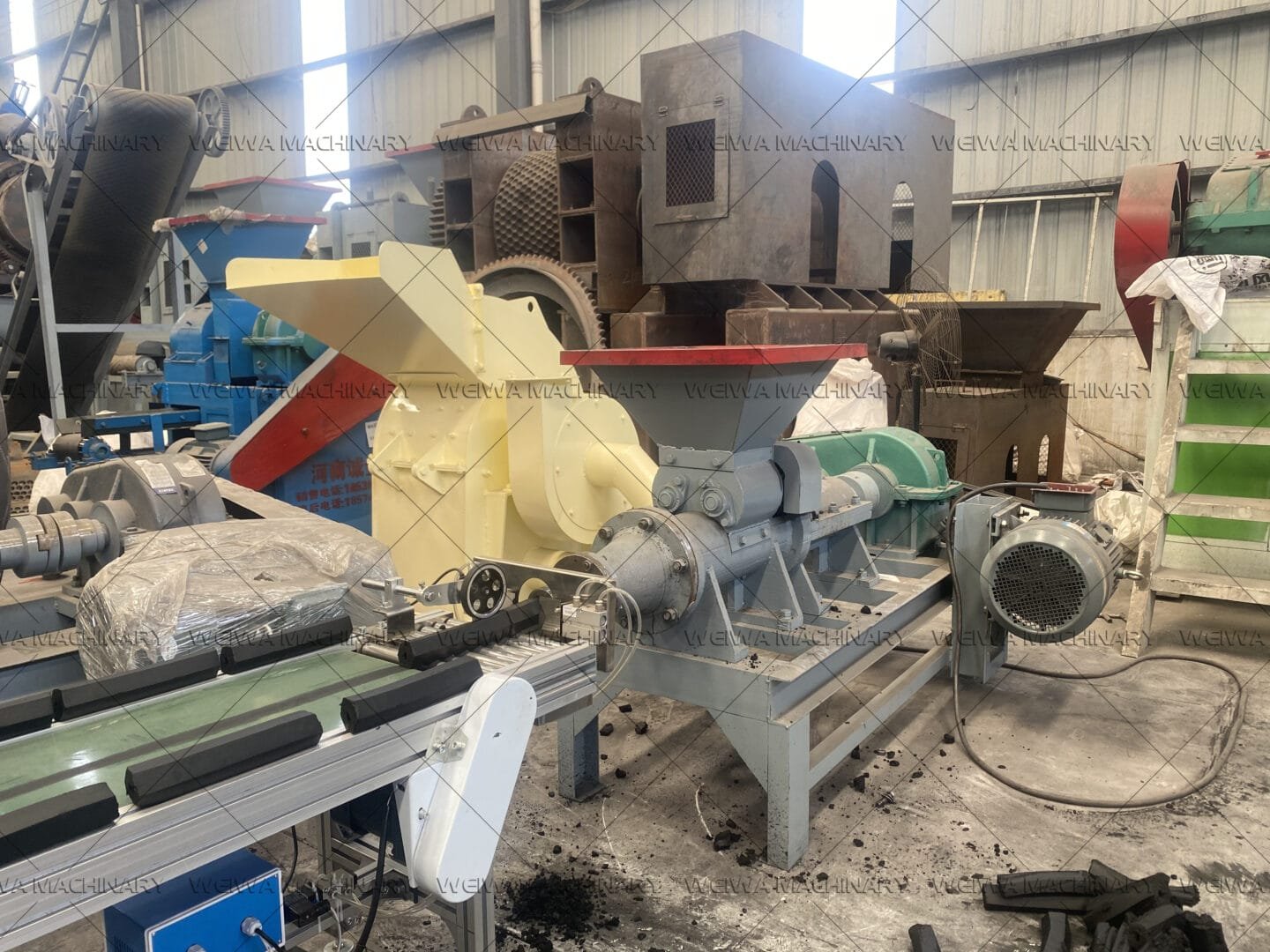
Why a Pakistan Client Came to Test the Máy đùn than?
The barbecue charcoal business in Pakistan is shifting. Traditional lump charcoal is expensive, inconsistent in size, and hard to pack. Many distributors in Lahore, Faisalabad, Karachi, and Quetta now prefer machine-made shapes because they stack better, burn longer, and look more professional in retail bags. Among all shapes, the hexagonal rod is gaining ground quickly.
Our visitor already owned a small screw press from another supplier, but it could not hold die geometry after a few weeks. He wanted a Charcoal Extrude Machine for Hexagonal Rod Charcoal that could run two shifts a day in summer ambient temperatures above 40°C, use local coconut shell and wood charcoal powder, and keep the hexagon edges sharp. That is why he asked for a factory acceptance trial instead of buying blind.
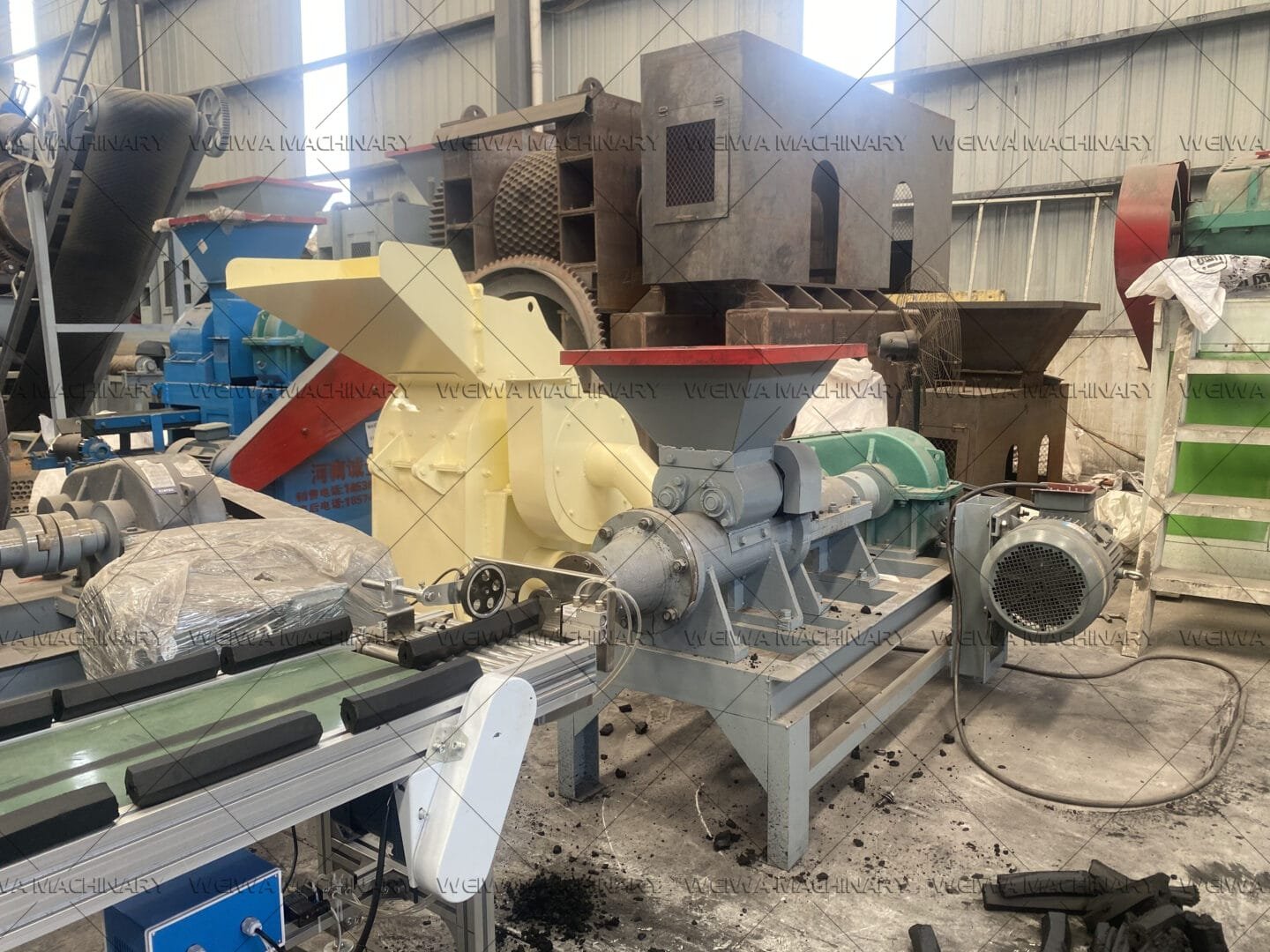
What the Client Brought and What He Wanted to See?
He shipped two samples of Pakistani raw material: a coconut shell charcoal powder with 27 percent moisture after pre-wetting, and a wood-coal blend at 31 percent moisture. He also brought a competitor’s hexagonal sample so we could compare edge definition and ringing sound when tapped. His acceptance criteria were practical. The rod had to be hollow or solid hexagonal, 33 millimeters flat-to-flat, 220 millimeters long, with no longitudinal crack, no tail bloom, and a green strength high enough that a rod would not bend under its own weight at the cutter.
Understanding the Charcoal Extrude Machine Before the Trial
A Charcoal Extrude Machine is not a punch press. It does not compress a pre-measured puck into a cavity. Instead, it uses a rotating screw propeller inside a tapered barrel to push moistened charcoal paste forward until pressure rises enough to force the material through a fixed mold head. The cross-section of that mold decides the final shape. Change the die head and the same machine can make cylindrical, quảng trường, oval, or hexagonal rods.
This screw-extrusion principle is the reason a Hexagonal coal briquette machine stays productive even when raw material particle size varies. The screw does three jobs at once: it conveys powder forward, it kneads the binder into the mass, and it builds pressure gradually so the paste becomes dense before it reaches the die.
Core Components of the Weiwa Charcoal Extruder
The machine we placed on the test bench was our 160-type Charcoal Extrude Machine with a 22 kilowatt 100 percent copper coil motor. Power travels from the motor through a triangle belt to a hardened gearbox. The gearbox output shaft connects to the propulsion shaft by a floating coupling, which protects the screw from shock loads when hard impurities pass through. On the propulsion shaft sits a high manganese alloy propeller. At the front of the barrel is the replaceable die head, in this case a #45 steel hexagonal mold with a central 8-millimeter hole.
The base and frame are national certified carbon steel, welded and stress-relieved before machining. In our experience, a flexible frame is the silent killer of hexagonal accuracy. Micro vibration walks the die head out of center within days. A rigid base keeps the flat-to-flat dimension stable for months.
Material Preparation for Hexagonal Coal Briquette Production
No Charcoal Extrude Machine can save bad input. The trial began not at the extruder, but at the mixer. The Pakistani coconut shell powder was already below 3 millimeters after local pre-crushing, so we skipped the crusher and moved directly to the grinding wheel mixer. We added 4 percent cassava starch binder and 6 percent water and blended for nine minutes. The target was a damp cocoa-texture mass that clumps when squeezed but breaks cleanly when pulled.
For the wood-coal blend we ran the same binder ratio but extended mixing to eleven minutes because coal dust has lower natural cohesion. Moisture stayed inside the 25 ĐẾN 35 percent window that screw extrusion with starch requires. Too dry and the rod cracks at the die. Too wet and the screw slips, producing a soft oval tail instead of a hexagon.
Starting the Hexagonal Coal Briquette Machine for Pakistan
Our engineer mounted the extruder, bolted the motor, installed the belt guard, and loaded the hopper by bucket. The client insisted on a cold start, the way his operators would run it back home. We switched on the main breaker, engaged the gearbox lubrication pump, and rotated the screw at low speed for ninety seconds to purge air from the barrel. Then we opened the feed gate.
The first thirty seconds delivered a soft oval lump because the die head was still cold. By minute two the rod exited straight. By minute five the hexagon geometry locked in. The flat faces were even, the central hole was centered, and the surface showed a matte black finish with a faint sheen. There was no smoke, which mattered to the client because he sells to restaurants that refuse smoky production lines.
First Batch on Coconut Shell Charcoal Powder
We ran the coconut shell blend for sixty minutes. The conveyor carried roughly 620 kilograms of finished rod to the pneumatic cutter, which sliced each piece to 220 millimeters. The client pulled one rod and tapped it with a wrench. The sound was a dull metallic knock. He smiled and said that single sound told him more than any specification sheet. His previous machine produced a hollow wooden tone, and those rods crumbled in transport.
We measured ten rods with his plastic caliper. Flat-to-flat variance was within 0.4 millimeter. Hexagon angle held at 120 degrees. Screw flight tip wear after the run was 0.18 millimeter, negligible for a 160-class machine.
Second Batch on Wood-Coal Blend
The wood-coal blend ran slightly slower at about 570 kilograms per hour because green strength is lower, but the hexagon edges stayed sharp. No bending, no surface check cracks. Bearing housing temperature reached 61°C, well under the 85°C alarm threshold. The client noted that the 100 percent copper coil motor did not emit the hot varnish smell he was used to from aluminum-wound units in Pakistan’s summer workshops.
Why Hexagonal Rod Charcoal Works for Pakistan Barbecue?
The hexagonal shape is not a decoration. It solves three commercial problems at once. Flat facets let rods lie parallel in a tandoor basket, so natural airflow channels form between pieces. Six contact edges spread thermal stress better than a square, so the rod resists spalling when a cook splashes marinade on hot charcoal. The central hole we added lowers ignition time; the client timed a cold start at 4 phút 20 seconds to a glowing front, compared with 6 phút 10 seconds on his old solid cylindrical rod.
Over a busy night, a grill operator saves around twenty minutes of waiting per ten kilogram batch. In a restaurant that means more seating turns. In a retail pack, the hexagon photographs better on WhatsApp catalogs, and end users read the shape as a sign of factory quality. That perception is itself a sales asset.
Key Weiwa Design Points That Passed the Trial
Several details decided whether this Charcoal Extruder for Pakistan would be accepted or rejected. The carbon steel base did not ring when kicked, unlike thin-plate frames. The copper coil motor held temperature under load. The gearbox kept a constant reduction ratio, so screw speed did not drift when belt tension changed. The triangle belt only links motor to gearbox, not gearbox to screw, which avoids the belt-slip density drop common in low-cost 22 kilowatt extruders.
The high manganese alloy propeller resisted the silica in Pakistani charcoal better than plain cast steel. Các #45 steel mold kept its angle because we temper and grind each die head after rough machining. None of these parts are visible in a product photo, but together they are why the Charcoal Extrude Machine for Hexagonal Rod Charcoal holds shape after two hours of continuous run.
How the Extruder Fits a Full Charcoal Production Line?
The Charcoal Extrude Machine is the core, but never the whole system. In the Pakistan client’s planned layout, raw lump charcoal goes to a crusher to reach below 3 millimeters. A grinding wheel mixer blends powder, starch, and water. The extruder forms the rod. A mesh belt dryer removes residual moisture so the rod survives stacking and overseas shipping. Cuối cùng, an automatic cutter and packing table close the loop.
During the trial we only ran the extruder, but we walked the client through the upstream and downstream machines and explained why skipping the dryer ruins otherwise perfect rods. A green hexagonal rod may look solid, but if moisture stays above 8 percent it will mold in a sealed PP bag during Karachi’s humid season.
Comparing Hexagonal, Cylindrical, and Square Rods
Cylindrical rods are the easiest to extrude and the cheapest to tool, but they roll in the basket and leave uneven gaps. Square rods stack tighter but crack more often at the corners under thermal shock. The hexagonal rod is the compromise: easier to extrude than a clean square, better airflow than a cylinder, and stronger under side load than either. For the Pakistan barbecue segment, we now recommend the hexagonal hollow rod as the default commercial shape unless a buyer already owns square packaging molds.
Field Notes on Binder Choice for Pakistani Raw Materials
Starch binder remains the safest choice for food-contact barbecue charcoal. Cassava starch gave us the cleanest knockout from the die during the trial. Corn starch works but needs one extra minute of mixing. Clay binder increases weight and lowers combustion quality, so we discourage it for BBQ grades even though it is cheaper. The client agreed to standardize on cassava at 4 percent and keep water between 6 Và 7 percent depending on seasonal humidity in Punjab.
Commissioning Advice for a Charcoal Extruder for Pakistan
If you install a Hexagonal coal briquette machine in Pakistan or any hot-climate market, do not skip the cold-start purge. Rotate the screw empty for sixty to ninety seconds every morning. Keep belt tension checked weekly because ambient heat expands the belt and changes slip behavior. Grease the floating coupling monthly. Keep one spare #45 steel hexagonal die head in stock so a worn die never stops a shift. These small habits extend screw life past 800 hours before flight rebuild.
Production Data from the Weiwa Trial
Across two hours and eleven minutes of running, including one planned stop to check screw temperature, the 160-type Charcoal Extrude Machine processed 1,190 kilograms of mixed Pakistani material into finished hexagonal rod at 220 millimeters length. Effective hourly output averaged 595 kilograms. Power draw stayed between 17.5 Và 19.2 kilowatts under stable feed. Reject rate, defined as cracked or tail-bloomed rods, was under 2 percent before the pneumatic cutter, and under 0.5 percent after the cutter removed the first and last 30 millimeters of each startup and shutdown sequence.
Why Buyers Ask Specifically for a Charcoal Extruder for Pakistan?
The phrase is not just geographic. Over the past three years we have standardized a sub-specification inside our 140, 160, Và 180 models aimed at South Asian conditions: Động cơ cuộn đồng, tropical-grade grease, wider belt guards for dusty workshops, and hexagon die heads with 120-degree tolerance grinding. When a buyer writes Charcoal Extruder for Pakistan in an inquiry, they are usually telling us they already burned their fingers on a generic machine that looked identical in a photo but failed in July heat. Our answer is to show the trial data, not the catalog page.
Charcoal Extrude Machine for Hexagonal Rod Charcoal in Other Markets
The same machine configuration sells well in Indonesia, Bangladesh, Ai Cập, and Nigeria, but Pakistan remains the fastest-growing hexagonal segment because of the tandoor and roadside grill culture. In each market the raw material changes: Indonesia sends coconut shell, Egypt sends wood charcoal, Nigeria sends a coal-charcoal blend. The extruder does not change. Only the mixer time, binder percentage, and die flat-to-flat dimension change. That modular logic is why we can promise a 160-type Charcoal Extrude Machine for Hexagonal Rod Charcoal to a new country without re-engineering the frame.
Common Mistakes When Starting a Hexagonal Coal Briquette Machine
The first mistake is buying the die before testing the powder. Die geometry is useless if the binder is wrong. The second mistake is chasing high horsepower instead of screw flight design; Một 22 kilowatt machine with a poor propeller will make worse rods than a 15 kilowatt machine with a correct variable-pitch screw. The third mistake is ignoring moisture and blaming the extruder when rods crack. In the Pakistan trial we spent more time adjusting mixer moisture than touching the extruder itself.
After-Sales and Spare Parts Reality
A Charcoal Extrude Machine is a wear machine. The screw will need rebuild, the die will need regrind, the coupling will need grease. We stock these parts for the 140, 160, Và 180 models and ship them with DHL or UPS to Pakistan within three to five working days. The client from this trial left our factory with one spare propeller, two hexagonal die heads, one coupling kit, and a belt set. He did not buy them because we pushed; he bought them because he watched the first die head come off in eight minutes and realized downtime cost more than the spare.
Summary of the Trial Outcome
The Hexagonal coal briquette machine for Pakistan passed every criterion the client set. The Charcoal Extrude Machine produced uniform hexagonal hollow rods from local coconut shell and wood-coal powder, with correct flat-to-flat dimension, Không có khói, stable motor temperature, and a reject rate under 2 percent. The client placed the order for one 160-type unit with two die heads and later sent a deposit for a 180-type line with crusher, máy trộn, máy sấy, and cutter. The trial was not a sales show. It was a factory acceptance test that turned into a long-term supply relationship.
Về Máy móc Weiwa
Weiwa Machinery is a Chinese manufacturer of charcoal and coal briquette equipment, carbonization furnaces, crushers, máy trộn, dryers, and full production lines. We export to more than 130 countries including Pakistan, Indonesia, Ấn Độ, Malaysia, Việt Nam, Thổ Nhĩ Kỳ, Ai Cập, Algeria, and South Africa. Our charcoal extrude machine range covers 140, 160, Và 180 screw types with customizable cylindrical, quảng trường, and hexagonal molds. Every machine is built on certified carbon steel frames, fitted with copper coil motors, and tested before shipment. We welcome factory visits, live video trials, and material acceptance tests using your own charcoal powder.
Contact Weiwa Machinery
Đám đông / WhatsApp: +8613838093177
E-mail: info@cjlmachinegroup.com
Website: https://cjljx.com/product/charcoal-extrude-machine


 WeChat

 +8615937143060
