


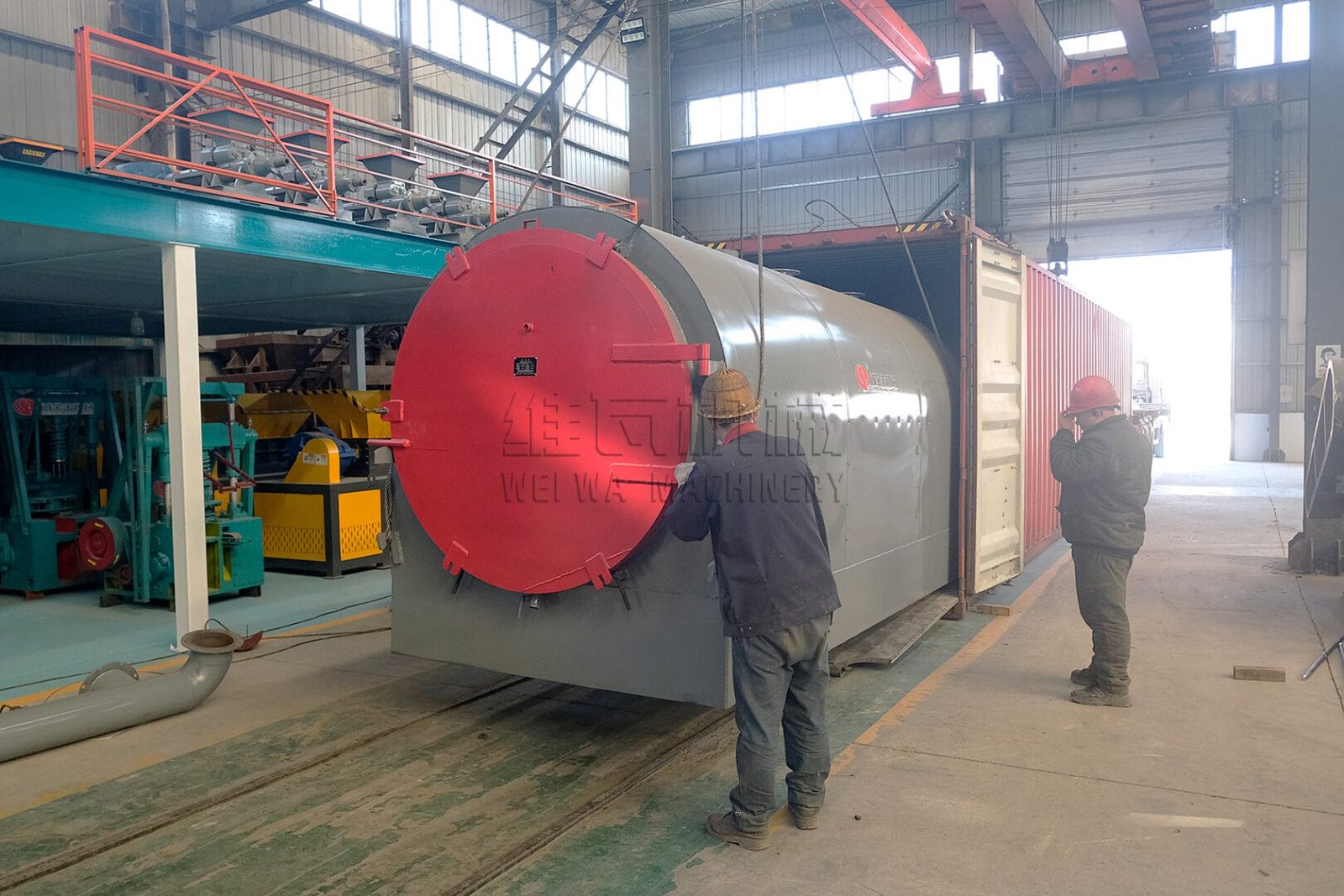
Tuần trước, Weiwa Machinery completed the container loading and sea freight arrangement of a complete horizontal carbonization furnace production line destined for Douala, Cameroon. This shipment includes our standard barrel-style horizontal carbonization furnace mounted on rails with kiln carts, a multi-stage gas purification and recovery system, a screw feeder, and auxiliary cooling equipment. The Cameroonian client plans to use this making charcoal machine to process local hardwood logs, cây tre , Vỏ dừa, and sawdust briquettes into high-quality charcoal for both domestic cooking fuel and industrial charcoal briquette production. Khi đến nơi, our technical team guided the customer through a full trial run via remote video support, and the furnace achieved stable internal temperatures near six hundred degrees Celsius with self-sustaining gas recycling after the initial ignition phase. In this article, we will explain the working principle of the horizontal carbonization furnace, how to make charcoal from wood in tropical climate conditions such as those found in Cameroon, the role of this equipment in a complete charcoal briquette production line, and why an increasing number of briquette manufacturers in Cameroon are searching for a reliable charcoal making machine for sale in Cameroon that can handle raw biomass directly without pre-crushing all large pieces.
Why Cameroon Is a Growing Market for Charcoal Making Machine and Charcoal Briquette Production?
Cameroon has abundant forestry resources and large volumes of agricultural residues such as cocoa shells, coffee husks, oil palm kernel shells, and corn stalks. Traditional earth kilns and mound charcoal methods are still widely used, but they suffer from low charcoal yield, heavy smoke pollution, and inconsistent quality. As urban demand for clean-burning barbecue charcoal and restaurant-grade briquettes rises in cities like Douala and Yaoundé, more entrepreneurs are looking for a professional making charcoal machine that can convert wood and biomass waste into uniform charcoal under controlled anaerobic conditions. A horizontal carbonization furnace is particularly suitable for this market because it accepts whole logs and large bamboo sections that continuous screw-type carbonizers cannot process without prior chipping. For briquette manufacturers in Cameroon who already own a charcoal crushing, mixing, and extrusion press, adding a horizontal furnace allows them to produce their own high-purity char from local wood rather than purchasing questionable charcoal powder from third parties. This vertically integrated approach improves final briquette quality and reduces dependency on fluctuating raw material supply chains.
Overview of Weiwa Horizontal Carbonization Furnace Structure and Features
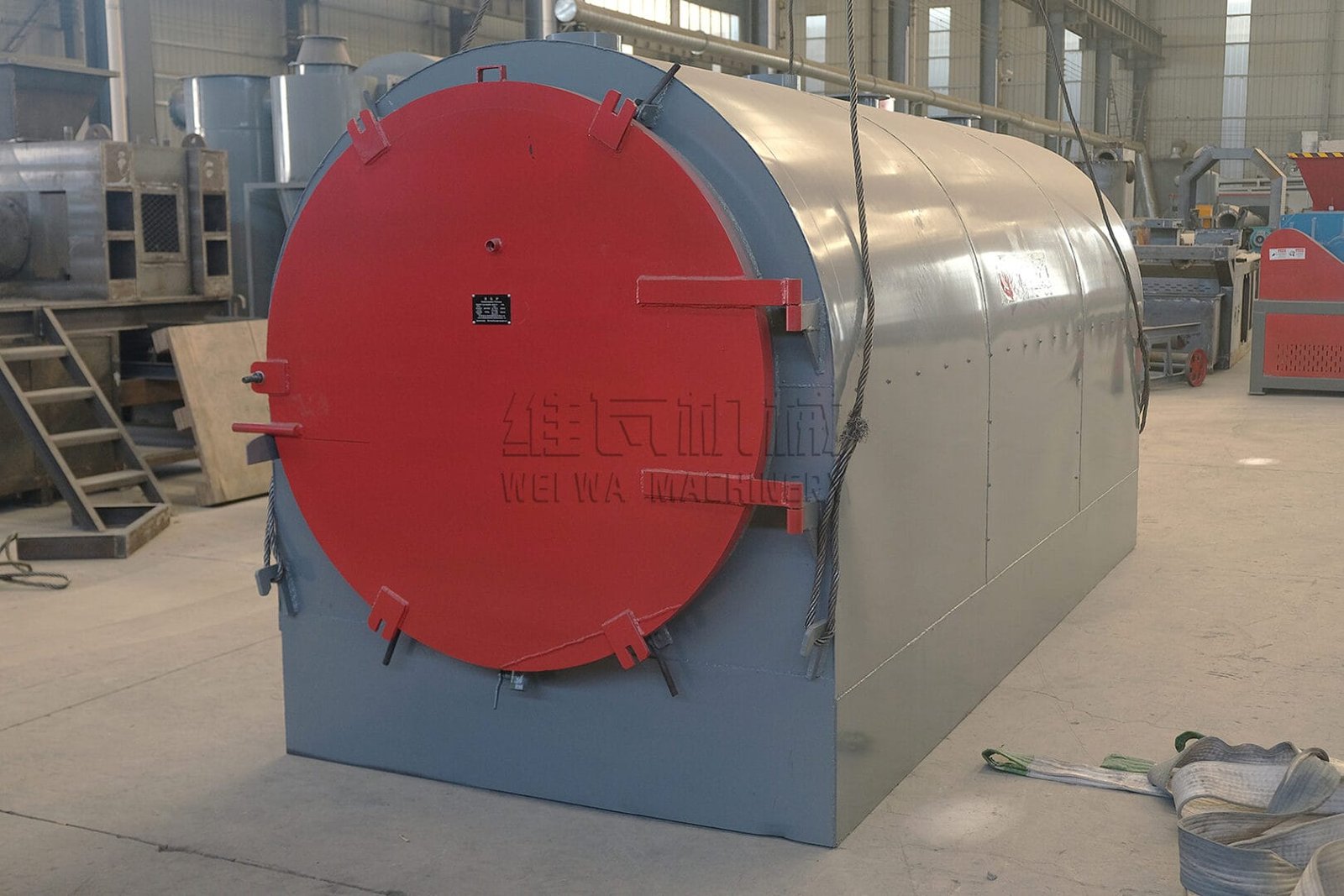
The Weiwa horizontal carbonization furnace features a horizontally oriented cylindrical chamber supported by a steel frame and equipped with heavy-duty rails. Operators load raw materials onto a kiln cart outside the furnace and push the cart into the chamber, which is then sealed with a high-temperature resistant door using rock wool gaskets to ensure an oxygen-free environment during carbonization. Indirect heating is applied initially by burning wood, than đá, or gas until the inner temperature reaches approximately one hundred fifty degrees Celsius, at which point the biomass begins to undergo thermal decomposition and releases pyrolysis gases including carbon monoxide, khí mê-tan, and hydrogen. Our gas purification system condenses and separates wood tar and wood vinegar, then routes the cleaned combustible gas back to the combustion chamber beneath the furnace. Once this recycled gas ignites, the furnace becomes self-sustaining and requires little to no external fuel for the remainder of the cycle. A typical batch processes in six to eight hours depending on moisture content and material density, with charcoal yield normally ranging between forty percent and sixty percent of the original dry weight. The furnace body is insulated with a middle layer of ceramic fiber or light refractory material to minimize heat loss, and the entire unit is painted with anti-corrosion coating suitable for humid tropical environments.
Fume Recovery and Environmental Compliance for Cameroon Operations
Smoke control is a major concern for charcoal briquette production facilities located near populated areas. The Weiwa horizontal furnace is equipped with a flue gas purification tower that cools hot gases, captures heavy tar droplets, and discharges only the cleaned portion back to the burner or safely vents through a short stack after secondary combustion. This design helps briquette manufacturers in Cameroon comply with evolving environmental expectations while also reducing the smell and visible smoke that often cause community complaints when using traditional pit kilns. By reusing the syngas as fuel, the machine also cuts overall energy cost, which is an important consideration for any investor evaluating a charcoal making machine for sale in Cameroon with long-term operating budgets in mind.
How to Make Charcoal from Wood Using a Horizontal Carbonization Furnace Step by Step?
Understanding the practical workflow helps new operators in Cameroon achieve consistent results when running the making charcoal machine for the first time. The complete process of how to make charcoal from wood with our horizontal furnace can be described in five sequential stages.
Raw Material Preparation and Moisture Control
Although the horizontal furnace can accept whole logs up to the inner diameter of the chamber, it is recommended to air-dry wood to below twenty-five percent moisture content before loading. Freshly cut tropical hardwoods in Cameroon may contain thirty to sixty percent moisture, so a simple open-air stacking period of two to four weeks significantly shortens the drying phase inside the furnace and increases daily throughput. Bamboo segments, Vỏ dừa, and pre-formed sawdust briquettes can be mixed in the same batch as long as they are arranged to allow airflow around the pieces on the kiln cart.
Loading and Sealing the Furnace Chamber
Place the dried wood or biomass evenly on the cart, close the furnace door firmly, and verify that all sealing latches are engaged. Check the manometer if installed, to confirm the chamber can hold slight positive pressure. Proper sealing prevents oxygen ingress which would otherwise cause partial combustion instead of true carbonization and reduce charcoal yield.
Ignition and Initial Heating Phase
Use the external burner to raise the furnace temperature gradually. During the first one to two hours, water vapor escapes through the exhaust port. Continue heating until the internal thermocouple reads one hundred fifty to two hundred degrees Celsius, marking the start of active pyrolysis. At this stage, you will see pale yellow smoke exiting the flue, which is the precursor to recoverable syngas.
Gas Recycling and Self-Sustaining Carbonization
When the flue gas ignites in the purification and reburn system, close the auxiliary fuel valve. The furnace now maintains its own temperature using the combustible gas generated by the decomposing biomass. The temperature typically climbs to five hundred fifty to six hundred degrees Celsius and stabilizes. Hold this temperature for three to five hours depending on batch size. Do not open the door during this period.
Cooling and Discharging Charcoal
After the carbonization hold time expires, shut off the gas supply to the burner and allow the furnace to cool naturally with the door closed for at least two hours. Then pull the kiln cart out and transfer the hot charcoal to a separate cooling bin or spread it on a non-flammable surface. Once fully cooled below forty degrees Celsius, the charcoal is ready for screening, nghiền nát, and further processing in a charcoal briquette production line if desired.
Integrating the Horizontal Carbonization Furnace into a Charcoal Briquette Production Line
Many briquette manufacturers in Cameroon do not stop at producing loose lump charcoal. They crush the output from the horizontal furnace, mix it with a small percentage of binder such as cassava starch or molasses, and feed the mixture into a charcoal extruder or roller press to form uniform briquettes. The sequence is therefore: raw wood → horizontal carbonization furnace → charcoal crushing → wheel mixing with binder → briquette extrusion → final drying. When you source a complete charcoal making machine for sale in Cameroon from Weiwa Machinery, we can configure the full line including the horizontal furnace, hammer mill, double-shaft mixer, coal rod extruder, and mesh belt dryer. This turnkey approach ensures compatible capacities across all units and avoids bottlenecks where one machine waits on another. The self-generated syngas from the furnace can even be ducted to pre-heat the drying tunnel, further improving energy efficiency across the plant.
Field Trial Results from the Cameroon Shipment
During the post-delivery remote commissioning session, the Cameroonian customer loaded a test batch consisting of local hardwood logs approximately ten to fifteen centimeters in diameter plus a smaller quantity of coconut shells. After a two-hour pre-drying phase, the furnace reached pyrolysis temperature and the gas recovery system activated as designed. The customer reported that the combustible gas reburned steadily and the external LPG auxiliary burner was closed for the majority of the carbonization hold period. Final charcoal showed a glossy black appearance, low ash content after simple visual inspection, and an estimated yield of roughly forty-eight percent based on the weight of air-dried input. The client confirmed the machine was easy to load thanks to the rail cart system and noted that the smoke treatment met their expectation for a clean-running making charcoal machine. Based on this trial, they plan to add a second horizontal furnace in the next ordering season to double weekly output for their expanding charcoal briquette production business supplying local wholesale markets.
Common Questions from Briquette Manufacturers in Cameroon Before Buying
Can the Furnace Handle Sawdust Briquettes as Well as Whole Logs
Đúng. Pre-pressed sawdust briquettes are an excellent feedstock because they have low moisture after pressing and carbonize evenly. You can load them alongside wood pieces, but avoid packing too tightly or the inner portions may carbonize slower than the outer layer.
What Voltage and Power Are Required for the Auxiliaries?
The horizontal furnace itself does not require electricity to carbonize once lit, but the exhaust fan, optional automatic temperature controller, and connected crushers or mixers typically run on three-phase power. We can customize the control panel for 380V/50Hz or other specifications matching Cameroon’s industrial power standards, and provide voltage stabilizers upon request.
Is On-Site Installation Training Available
Weiwa Machinery provides detailed English and French operation manuals, wiring diagrams, and startup videos. For large-scale projects, our engineers can travel to Cameroon subject to visa and schedule availability, or we conduct live video training until your operators are confident with the entire charcoal making machine for sale in Cameroon package.
Why Choose Weiwa Machinery as Your Charcoal Equipment Partner?
Weiwa Machinery has been manufacturing biomass carbonization and briquetting equipment for more than twenty years. Our machines are exported to over one hundred countries with a strong presence in Africa, Đông Nam Á, and South America. Each horizontal carbonization furnace is shop-tested before leaving our Zhengzhou factory, and critical wearing parts are made from high-temperature alloy steel for extended service life. We offer customized furnace sizes from five hundred kilogram per batch to three thousand kilogram per batch, stainless or carbon steel options, and additional modifications such as extra tar collection tanks or dual-language PLC touch screens. Our sales team responds promptly to inquiries about charcoal briquette production feasibility studies, factory layout planning, and spare parts logistics. For briquette manufacturers in Cameroon who want a dependable making charcoal machine backed by real technical support rather than just a transactional purchase, Weiwa Machinery aims to be your long-term production partner.
Về Máy móc Weiwa
Máy móc Weiwa (Máy móc Wei Wa) is a professional manufacturer of charcoal making machines, Lò cacbon hóa ngang, charcoal extruders, crushers, máy trộn, and complete biomass briquetting production lines. Located in Zhengzhou, Tỉnh Hà Nam, Trung Quốc, we serve global customers with factory-direct pricing, custom engineering, and professional after-sales service. Our equipment is widely used to make charcoal from wood, vỏ dừa, cây tre , trấu gạo, and other agricultural wastes. Sản phẩm được xuất khẩu sang nhiều quốc gia và khu vực, and Weiwa Machinery has become the first choice for more than 2 triệu khách hàng trên toàn thế giới.
Contact us for a free quotation on a charcoal making machine for sale in Cameroon or a complete charcoal briquette production line:
Điện thoại di động / WhatsApp: +86 138 3809 3177
E-mail: info@cjlmachinegroup.com


 WeChat

 +8615937143060
