


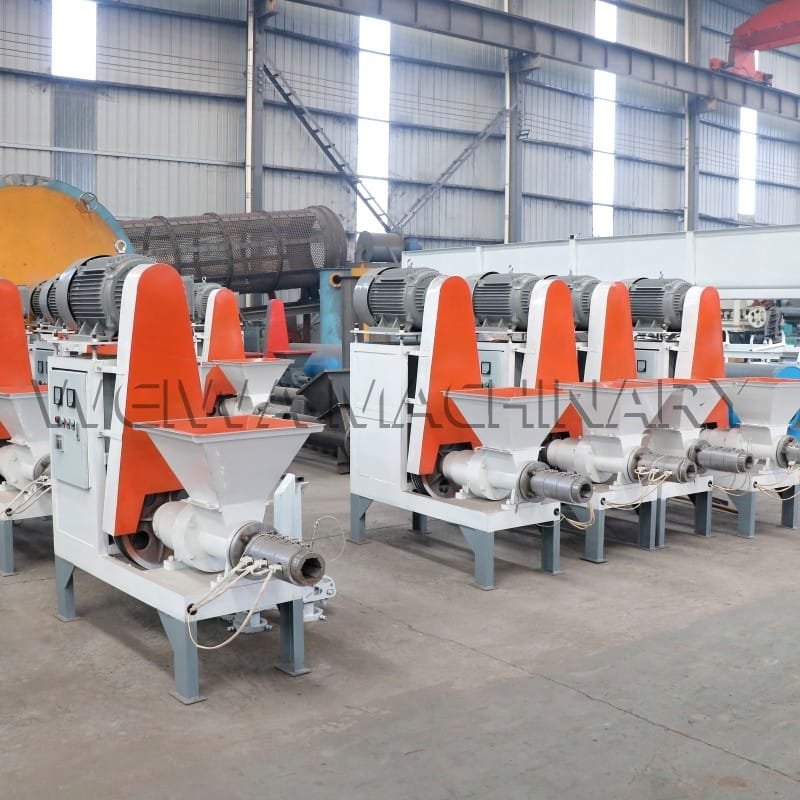
Unlocking India’s Bioenergy Potential with Weiwa Biomass Briquette Machine and Six-Row Sawdust Extrude Machine
India generates tens of millions of tons of agricultural and forestry residue every year. Trấu gạo, mía bã mía, sawdust from plywood mills, Cá bông, and coconut shells are often discarded or open-burned, causing both economic loss and environmental damage. Against this backdrop, more Indian entrepreneurs are turning to the Biomass Briquette Machine to convert such waste into high-density, eco-friendly fuel. Gần đây, an Indian client visited Weiwa Machinery via a live video factory tour to evaluate our six-row Sawdust Extrude Machine, also known in the industry as a Sawdust Briquette Machine or Charcoal Making Machine. This article explores how the six-link charcoal production line works, why it fits the Indian market, and what business opportunities it creates for biomass energy investors.
Hiểu biết về Máy làm bánh sinh khối and Sawdust Extrude Machine
A Máy làm bánh sinh khối is designed to compress loose organic waste—such as sawdust, rice hulls, trấu cà phê, Bụi tre, and chopped crop stalks—into solid fuel sticks or blocks without chemical binders. The core technology relies on a large screw shaft inside the Sawdust Extrude Machine that pushes pre-dried material through a heated barrel and a forming die. Frictional heat softens the natural lignin in biomass, which then acts as an internal adhesive once the extruded rod cools and solidifies. This self-binding mechanism is why a properly configured Sawdust Briquette Machine can produce smokeless, high-calorific-value briquettes that are ready for direct combustion or further carbonization in a Máy làm than.
The typical input specification for our screw-type Sawdust Extrude Machine requires raw material particle size under 5 mm and moisture content below 12%. When these parameters are met, the machine outputs hollow hexagonal, quảng trường, or pentagonal briquettes with diameters ranging from 45 mm to 80 mm and a central ventilation hole of 15–20 mm. Compared with ordinary firewood, the resulting biofuel has more than 20% higher calorific value, lower ash content, and significantly improved transport density, which is critical for commercial distribution in the Indian subcontinent.

Why a Six-Row (Six-Link) Charcoal Making Machine Appeals to Indian Buyers?
During the video factory tour, our Indian client showed particular interest in the six-row configuration, sometimes referred to as a six-link or six-unit parallel Máy làm bánh sinh khối hệ thống. Rather than running six disconnected standalone machines, Weiwa integrates six forming heads onto a unified frame with shared feeding, heating control, and discharge arrangement. This design reduces floor space, simplifies centralized lubrication and maintenance, and allows synchronized start–stop operation.
For Indian customers who process abundant local biomass—especially in Punjab, Maharashtra, Tamil Nadu, and Uttar Pradesh—the six-row Sawdust Briquette Machine line offers measurable advantages. First, hourly throughput is multiplied without doubling labor cost. Second, the temperature-adjusting indicator on each extrusion unit maintains steady heating between 260°C and 320°C, compensating for seasonal fluctuations in raw material moisture that are common in South Asia. Third, the modular die system lets operators switch between hexagonal hookah charcoal shapes and square BBQ briquette profiles, matching domestic and export market preferences alike.
From Raw Material to Machine-Made Charcoal – The Complete Process
The production workflow demonstrated to our Indian visitor comprised five sequential stages. Stage one involves crushing branches, cây tre , or wood offcuts into 3–5 mm particles using a hammer mill or wood crusher. Stage two is drying, normally performed by a rotary drum dryer or pipe-type airflow dryer, reducing moisture to less than 12%. Stage three is the core briquetting phase, where the dried material is fed continuously into the Sawdust Extrude Machine and compressed into high-density rods. Stage four subjects these rods to oxygen-limited carbonization inside a brick kiln or steel carbonization furnace to become machine-made charcoal. Stage five is cooling, grading, and packaging of the final Máy làm than output, which can be sized for shisha/hookah, BBQ, or industrial boiler use.
Throughout the demonstration, the client noted that no additives or binders were introduced—only the inherent lignin of the biomass itself created the bonding effect. This binder-free approach aligns with India’s push for cleaner, non-polluting fuel alternatives and avoids recurring expense on starch or clay binders that can lower combustion quality.
Market Prospects of Biomass Briquette Machine for India
India’s National Bioenergy Programme and various state-level subsidies encourage the establishment of biomass densification plants, making the Biomass Briquette Machine for India a strategically sound investment. Several macro factors drive this trend. The country’s annual crop residue generation exceeds 350 million tons, a large portion of which remains underutilized. Rising LPG and coal prices motivate both rural households and urban small industries to seek affordable, locally sourced solid fuels. Ngoài ra, Indian brick kilns, textile units, and food processing facilities increasingly adopt biomass briquettes to comply with air quality norms and reduce operating costs.
Market research indicates that biomass briquette and machine-made charcoal consumption in India is projected to grow at a double-digit CAGR through the next decade. Entrepreneurs who install a six-row Sawdust Briquette Machine line today can serve multiple customer segments: supplying pre-carbonized briquettes to charcoal distributors, selling un-carbonized biofuel rods to industrial boilers, or exporting hookah charcoal to Middle Eastern markets using the same equipment with different dies. The flexibility of Weiwa’s Máy làm than system supports all three models.
Local Raw Materials Suitable for Weiwa Sawdust Extrude Machine in India
Indian clients commonly process sawdust from teak, eucalyptus, and mango wood; rice husk and rice husk ash; mía bã mía; Cá bông; mustard stalk; and coconut shell granules. Our engineering team evaluates the lignin and silica content of each feedstock to recommend optimal die compression ratio and heating temperature. For high-silica materials such as rice husk, we suggest a slightly lower barrel temperature and wear-resistant alloy screw tips to extend service life. This consultancy is part of Weiwa’s free production plan design offered to every Biomass Briquette Machine for India inquiry.
Key Features of Weiwa Six-Row Sawdust Briquette & Máy làm than
The six-row Sawdust Extrude Machine supplied by Weiwa Machinery incorporates a patented temperature control system that prevents overheating during idle running—a frequent cause of jamming in conventional extruders. Each forming head is driven by a high-torque electric motor with V-belt transmission, and the screw shaft is manufactured from boron-alloy steel subjected to carburizing heat treatment for extended wear resistance. The heating ring uses ceramic or cast-aluminum heaters with individual SSR temperature controllers, allowing the operator to fine-tune thermal input depending on whether the feedstock is sawdust, Bóng mía, or a blended mix.
Briquette shape changeovers are straightforward: the operator loosens the die retainer, replaces the forming sleeve, and adjusts the heating setpoint. Available shapes include hollow hexagonal (most popular for hookah charcoal in India), solid or hollow square (preferred for some BBQ markets), and pentagon variants. Diameter options of 50 mm, 60 mm, 70 mm, Và 80 mm cover most commercial requirements. The machine-produced rods can be cut automatically to preset lengths of 300–600 mm before being loaded into the carbonization furnace of the Máy làm than.
Maintenance points are accessible from one side of the six-row frame. Spare parts kits—including replacement screws, inner sleeves, and heating coils—are shipped with every order, and our technical team provides online commissioning guidance as well as onsite service for container-load orders. These factors are especially important for Indian buyers who may be installing their first Máy làm bánh sinh khối and need responsive after-sales support.
What the Indian Client Saw at Weiwa’s Workshop?
The video tour began with an overview of Weiwa Machinery’s 20,000-square-meter manufacturing base in Zhengzhou, Tỉnh Hà Nam, where more than two million sets of equipment have been delivered to over 130 quốc gia. Cameras then moved to the assembly bay where a six-row Sawdust Briquette Machine was undergoing final load testing using mixed hardwood sawdust. The client observed continuous, uniform extrusion from all six heads, checked the surface finish of sample briquettes, and verified the digital temperature readout stability.
Subsequent shots covered the companion rotary dryer, máy nghiền, and a batch-type carbonization furnace representative of the full Máy làm than plant. Quality control staff explained how each Máy làm bánh sinh khối is run-tested for at least two hours prior to painting and packing, and how dimensional inspection ensures die tolerances remain within ±0.2 mm. The Indian guest asked detailed questions about power consumption per ton of briquette, recommended transformer specifications for Indian voltage (415 V / 50 Hz), and container loading layout—all of which were answered in real time by our senior project engineer.
By the end of the session, the client requested a customized proposal including a six-row Sawdust Briquette Machine, matched dryer capacity, dust removal cyclone, and a 3-tier brick charcoal kiln adapted for local labor availability. This case illustrates how a virtual factory tour can build the same level of confidence as an in-person visit, especially when the prospect is evaluating a capital-intensive Biomass Briquette Machine for India project.
ROI Considerations for Indian Biomass Entrepreneurs
When calculating return on investment for a six-row Sawdust Extrude Machine line, Indian buyers typically factor in raw material purchase or collection cost, electricity and labor, machine depreciation over five to seven years, and the prevailing market price of biomass briquettes or machine-made charcoal in their region. In many Indian states, agricultural residue can be sourced at low cost or even negatively priced when farmers are willing to pay for removal. With a six-head system producing several hundred kilograms per hour, payback periods of 12–24 months are commonly reported, though exact figures depend on local conditions.
Another revenue angle is carbon credit eligibility: densified biomass displaces coal or firewood, potentially qualifying project developers for voluntary carbon market participation, subject to verification. While Weiwa does not issue carbon credits, của chúng tôi Máy làm than Và Máy làm bánh sinh khối are engineered to maximize conversion efficiency and minimize incomplete combustion losses, indirectly supporting a stronger emission reduction claim.
Why Choose Weiwa Machinery as Your Biomass Briquette Machine Partner?
Weiwa Machinery has specialized in biomass densification and carbonization equipment since 2000. Our R&D team continuously refines screw geometry, heating coil distribution, and frame rigidity based on field feedback from installations in Asia, Africa, Europe, and the Americas. Every Sawdust Briquette Machine Và Máy làm than leaving our factory is backed by pre-delivery run-test, export-standard fumigated wooden case or PE film packaging, and a spare parts list tailored to expected wear patterns.
For Indian and other international clients, we supply complete English manuals, wiring diagrams, and startup videos. Upon request, we arrange Zoom or WhatsApp video calls during installation and the first trial run. Whether you are a first-time investor exploring a Biomass Briquette Machine for India or an established charcoal producer upgrading to a six-row Sawdust Extrude Machine, Weiwa’s engineering and after-sales infrastructure is structured to reduce your downtime and protect your ROI.
Get in Touch for a Free Production Plan & Video Factory Tour
If you are considering entering the biomass charcoal business or expanding an existing plant, contact Weiwa Machinery to receive a customized layout drawing, estimated output calculation based on your local raw materials, and an invitation to our next live video factory tour. See for yourself how our six-row Sawdust Briquette Machine and Charcoal Making Machine perform—then decide with confidence.
Contact Máy móc Weiwa:
Đám đông / WhatsApp: +86 138 3809 3177
E-mail: info@cjlmachinegroup.com


 WeChat

 +8615937143060
