


Venezuela Biomass Reality and Why Sawdust Extruder Lines Fit
Venezuela holds one of the largest forested areas in South America alongside extensive agricultural belts producing coffee, cocoa, sugarcane, rice and oil palm. Those sectors generate massive volumes of dispersed biomass that rarely enters a formal supply chain. Sawdust from furniture workshops in Valencia and Maracay, rice husk from Portuguesa, coffee husk from Trujillo, bagasse from sugar mills near Turmero and pruned branches from smallholder plots are usually burned openly or left to rot. A sawdust extrude machine in Venezuela changes that equation because it does not require large, uniform logs. It requires particles under five millimeters and moisture under twelve percent, specifications that match the output of a basic hammer mill and rotary dryer.
The economic logic is simple. Transporting loose sawdust is expensive and messy. Transporting carbonized charcoal sticks with density above one point one grams per cubic centimeter is cheap, clean and stackable. Between those two states sits the sawdust briquetting machine, a screw-driven extruder that heats biomass to roughly three hundred degrees Celsius while pushing it through a tapered die. No chemical binder is added. The natural lignin released under heat acts as the glue.
Common Venezuelan Feedstock for Sawdust Briquette Machine
During the engineering call with the Venezuela client, Weiwa technicians listed acceptable inputs in order of local abundance. Sawdust from pine and tropical hardwood ranked first because sawmills already separate it. Coffee husk ranked second because Venezuelan coffee regions discard thousands of tons yearly. Sugarcane bagasse ranked third, followed by rice hull, Cá bông, sunflower stalk and bamboo dust. All of them can enter the same sawdust extruder after grinding. The only non-negotiable variables are particle size and moisture. If the feedstock exceeds five millimeters, the screw channel jams. If moisture exceeds twelve percent, the heating ring wastes energy boiling water instead of softening lignin.
Moisture, Particle Size and Pre-Treatment Before Extrusion
A sawdust briquetting machine is only as stable as its upstream preparation. Weiwa’s Venezuela line therefore included a 22-kilowatt hammer mill with a 4-millimeter screen and a three-layer rotary drum dryer powered by a biomass burner. The dryer target was eight to ten percent moisture, slightly below the twelve percent maximum, to leave margin for humid Caribbean coastal storage. Conveyors moved material from dryer outlet to a buffer hopper above the extruder, eliminating manual shoveling and keeping the screw fed at constant pressure. This pre-treatment stage is not optional. Many failed charcoal projects in Latin America trace back to skipping the dryer and blaming the sawdust extruder for low density.
How a Sawdust Extruder Converts Biomass Into Solid Fuel?
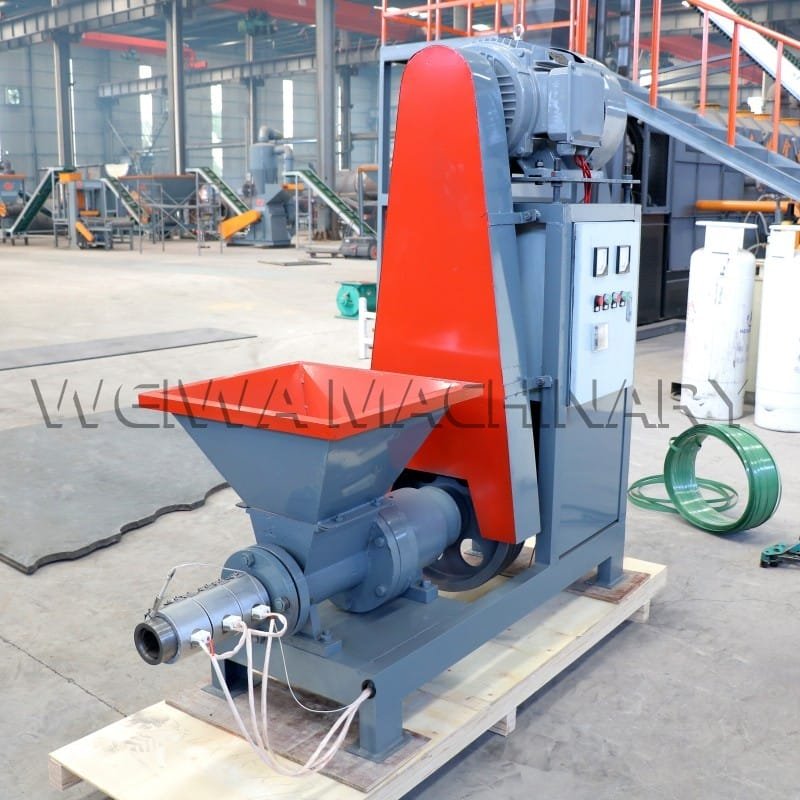
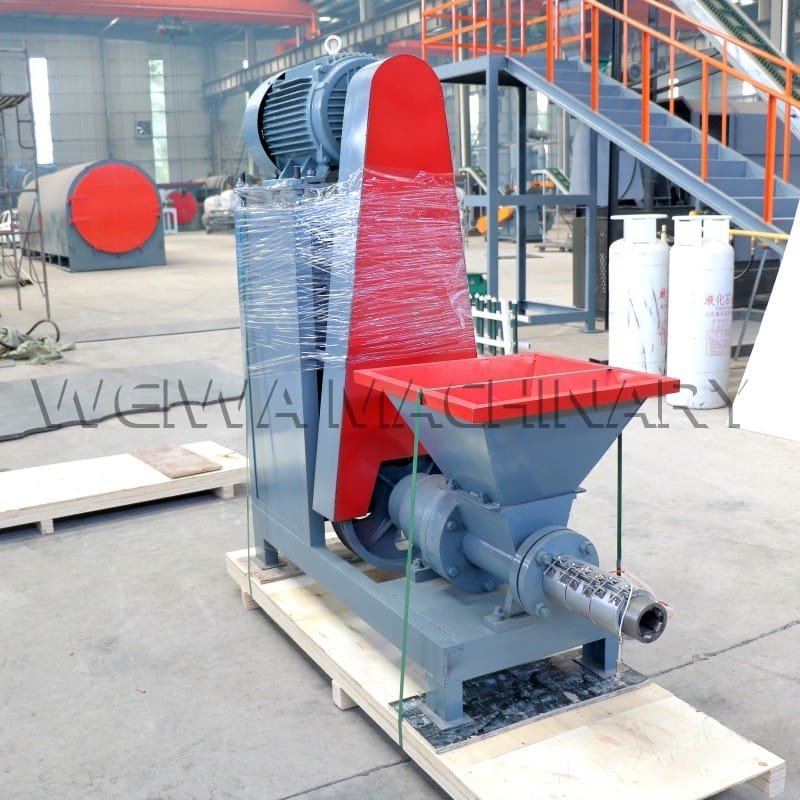
The core of the line is the sawdust extruder itself. Its job is not merely to shape material but to reorganize it at a molecular level. Inside the machine, a hardened screw propeller rotates at fixed speed while a cast heating ring wraps the compaction chamber. Biomass enters cold, absorbs radiant heat from the chamber wall, softens, and is forced forward into a narrowing die. Pressure rises toward the nozzle. Temperature and pressure together liberate lignin from cell walls. Lignin flows, cools slightly at the die exit, and locks wood fibers into a solid stick with a central fifteen to twenty millimeter hole.
Lignin Activation and Screw Compression Physics
Understanding lignin activation helps operators in Venezuela avoid downtime. Lignin is a natural polymer found in all woody biomass. Below two hundred sixty degrees Celsius it stays locked inside fiber. Between two hundred eighty and three hundred twenty degrees Celsius, depending on species, it plasticizes. The sawdust briquette machine maintains chamber temperature in that window using adjustable heating coils. If the coil temperature is too low, sticks exit pale, soft and cracked. If too high, the surface scorches and the screw wears faster. Weiwa calibrates each sawdust extrude machine in Venezuela configuration with a digital temperature controller and warns clients never to run tropical hardwood and pine mix on the same setting without retuning.
Screw compression ratio determines stick hardness. A typical Weiwa sawdust extruder uses a compression ratio near five to one. That means the loose bulk volume entering the hopper leaves the die at one fifth the volume, producing density of one point one to one point four grams per cubic centimeter. Higher density means longer burning time, less ash and better freight economics when shipping charcoal from rural Venezuela to Caracas or export ports.
Briquette Shape, Density and Calorific Value
The Venezuela client selected a hexagonal die with a fifty-millimeter outer diameter. Other available shapes from the same sawdust briquetting machine platform include square, tròn, pentagonal and quadrilateral, with or without edges. Hexagonal sticks stack tightly, resist rolling on conveyor belts and present a familiar profile to barbecue consumers. Finished green briquettes leaving the extruder are not charcoal yet. They are brown, smoky, and still contain volatile compounds. Their calorific value already exceeds ordinary firewood by roughly twenty percent because of compaction, but the real jump comes after carbonization, where fixed carbon content climbs and moisture drops near zero.
Complete Charcoal Line Shipped From Weiwa to Venezuela
The shipment leaving Weiwa’s yard contained five functional zones. First, the crushing zone with hammer mill and vibrating sieve. Second, the drying zone with rotary drum and cyclone. Third, the extrusion zone with one main sawdust extrude machine in Venezuela specification plus one backup screw assembly. Fourth, the carbonization zone with a horizontal batch furnace rated for eight hundred kilograms of green briquettes per cycle. Fifth, the auxiliary zone with electrical cabinet, spare heaters, tool kit and English-Spanish operation manual.
Crushing and Drying Stage Configuration
Raw sawdust from Venezuelan sawmills often carries nails, stones and bark clumps. Weiwa added a magnetic separator before the hammer mill to protect the rotor. After milling, a rotary screener removed oversize particles. The dryer used a counter-flow drum design, chosen over pipe dryer because the client expected throughput above four hundred kilograms per hour of final green briquettes. Counter-flow means hot gas travels against material flow, improving thermal efficiency and reducing charring inside the drum. Exit moisture was verified with a handheld meter during factory test run using simulated Venezuelan sawdust blended with coffee husk.
Sawdust Briquetting Machine Core Parameters
The main sawdust briquette machine in the container was Weiwa model ZBJ-80. It runs on a 37-kilowatt main motor with a 6-kilowatt heating group split across three rings. Rated capacity is three hundred to three hundred eighty kilograms per hour of green briquettes, depending on feedstock bulk density. Screw material is alloy steel treated for continuous twenty-four hour operation. Die material is high-chromium cast iron. Control panel includes ammeter, temperature gauge, emergency stop and phase protector. The Venezuela team will run the machine on 440-volt 60-hertz three-phase power, so Weiwa rewound the motor and replaced the contactors before crating. A second ZBJ-50 unit was packed as a starter machine for a satellite site, giving the client parallel production capability.
Every sawdust extruder leaving Weiwa passes a two-hour no-load test and a one-hour load test using local Chinese sawdust surrogate. Vibration, temperature, amperage and stick surface quality are recorded. The Venezuela unit showed stable amperage at 68 amps under pine-sawdust load and produced hexagonal sticks with clean edges and no axial cracking. That test video was shared with the client via WhatsApp before ocean booking.
Carbonization Furnace and Final Charcoal Quality
Green briquettes from the sawdust briquetting machine cannot be sold as charcoal. They must lose volatiles in a low-oxygen environment. The Venezuela line used a horizontal steel chamber furnace with removable trolleys. Each trolley holds roughly two hundred kilograms of green sticks placed vertically. The chamber is sealed, heated by burning a portion of the off-gas, and held at four hundred fifty to six hundred degrees Celsius for ten to fourteen hours. Final charcoal exits black, lightweight, with fixed carbon above seventy percent and moisture under five percent. Ash content stays below five percent when feedstock is clean hardwood sawdust. If the client later mixes sugarcane bagasse, ash rises slightly but remains acceptable for cooking fuel.
Site Layout and Operator Training for Venezuela Client
Before shipment, Weiwa drafted a site layout for the Venezuela plot measuring thirty meters by eighteen meters. Crushing and drying sit upwind. Extruder sits in a covered middle bay. Carbonization furnace sits downhill with a fire-safety buffer of fifteen meters. We recommended a raised concrete floor with channels for sweeping spilled sawdust, because loose dust near a 300-degree extruder nozzle is the most common cause of small fires in tropical installations. The client received a CAD drawing, a utility list requesting 120 kVA transformer capacity, and a water requirement sheet for occasional screw cooling and furnace quench.
Operator training was delivered remotely in Spanish over three sessions. Session one covered feedstock sorting and mill screen change. Session two covered dryer flame adjustment and moisture checking. Session three covered extruder start-up sequence, heater warm-up, die change and blockage clearing. Weiwa deliberately teaches blockage clearing because a sawdust extruder in Venezuela running mixed agricultural waste will eventually jam. Knowing how to reverse the screw manually and clean the chamber prevents bent shafts. A printed quick-reference card in Spanish was packed inside the electrical cabinet.
Logistics, Packaging and After-Sales Support by Weiwa Machinery
Export packaging followed Weiwa’s standard for humid-climate destinations. Steel frames were built under each machine base. Vibration-damping rubber blocks sat between frame and crate. The sawdust extrude machine in Venezuela order required fumigated wooden boxes because the container will clear Venezuelan customs under ISPM-15 rules. Small parts went into PVC bags then into plywood boxes labeled with machine name and quantity. Spare screws, heaters, bearings and seals were separated into a consolidated spare-parts crate with a bilingual packing list.
Weiwa assigned a logistics coordinator to track the container from Zhengzhou truck to Shanghai port, then to Caribbean transshipment, then to Puerto Cabello. The client received the bill of lading, commercial invoice, packing list, CE declaration and Spanish operation manual before vessel departure. After arrival, Weiwa offers two support paths. Remote support covers wiring verification, inverter setting and process tuning via video. On-site support covers engineer dispatch for foundation alignment, belt tensioning and first carbonization cycle, available if the client confirms within the warranty window.
Warranty on the sawdust briquette machine is eighteen months from shipment or twelve months from commissioning, whichever comes first. Screw and die are considered wear parts with six-month coverage. Weiwa keeps ZBJ-50 and ZBJ-80 screw assemblies in stock for repeat Latin American orders, so a Venezuela client facing screw fatigue can receive air freight replacement within five days if urgent.
Why Buy Sawdust Extruder From Weiwa Machinery?
Weiwa Machinery is not a trading company reselling unknown brands. The factory in Henan operates its own CNC workshop, screw hardening line and dryer drum welding bay. The sawdust extruder model shipped to Venezuela was built on the same platform delivered to clients in Indonesia, Nigeria, Mexico, Russia and South Africa. Shared platform means shared spare parts and shared field data. When Venezuelan humidity caused slight heater corrosion concern, Weiwa swapped standard terminals for marine-grade connectors on this order without price change because the engineering team had seen similar coastline installs in Ghana.
Choosing a sawdust briquetting machine is ultimately a choice about process continuity. A low-price extruder without dryer integration will fail in Venezuela’s rainy season. A correct line, configured by people who have tested pine, coffee husk and bagasse mixtures, will run. Weiwa’s proposal to this client was not the cheapest. It was the one that matched moisture reality, voltage reality, labor skill reality and charcoal market specification in Venezuela.
For buyers comparing sawdust extrude machine in Venezuela listings online, the differentiator is not the screw photo. It is whether the supplier asks about your moisture, your raw material blend, your local voltage, your charcoal diameter preference and your carbonization method before quoting. Weiwa does. That is why the container left the yard with the client’s logo stenciled on the extruder hood.
Về Máy móc Weiwa
Weiwa Machinery is a Chinese manufacturer of biomass briquetting and charcoal production equipment, serving more than 130 countries across Asia, Africa, Europe and Latin America. The product range covers sawdust extrude machine, sawdust extruder, sawdust briquette machine, sawdust briquetting machine, coal briquette press, rotary dryer, máy nghiền, carbonization furnace and complete charcoal plant design. Every export line is engineered per client raw material, capacity and local power standard. Free layout drawing, free raw material test and remote commissioning are included in standard quotes.
Contact Weiwa Machinery:
Đám đông: +8613838093177
WhatsApp: +8613838093177
E-mail: info@cjlmachinegroup.com
If you are planning a charcoal project in Venezuela or anywhere in Latin America and need a sawdust extruder that actually runs on local sawdust, coffee husk and bagasse, write to the team above with your daily tonnage target and available raw material photos. A customized line drawing will follow within three working days.


 WeChat

 +8615937143060
