


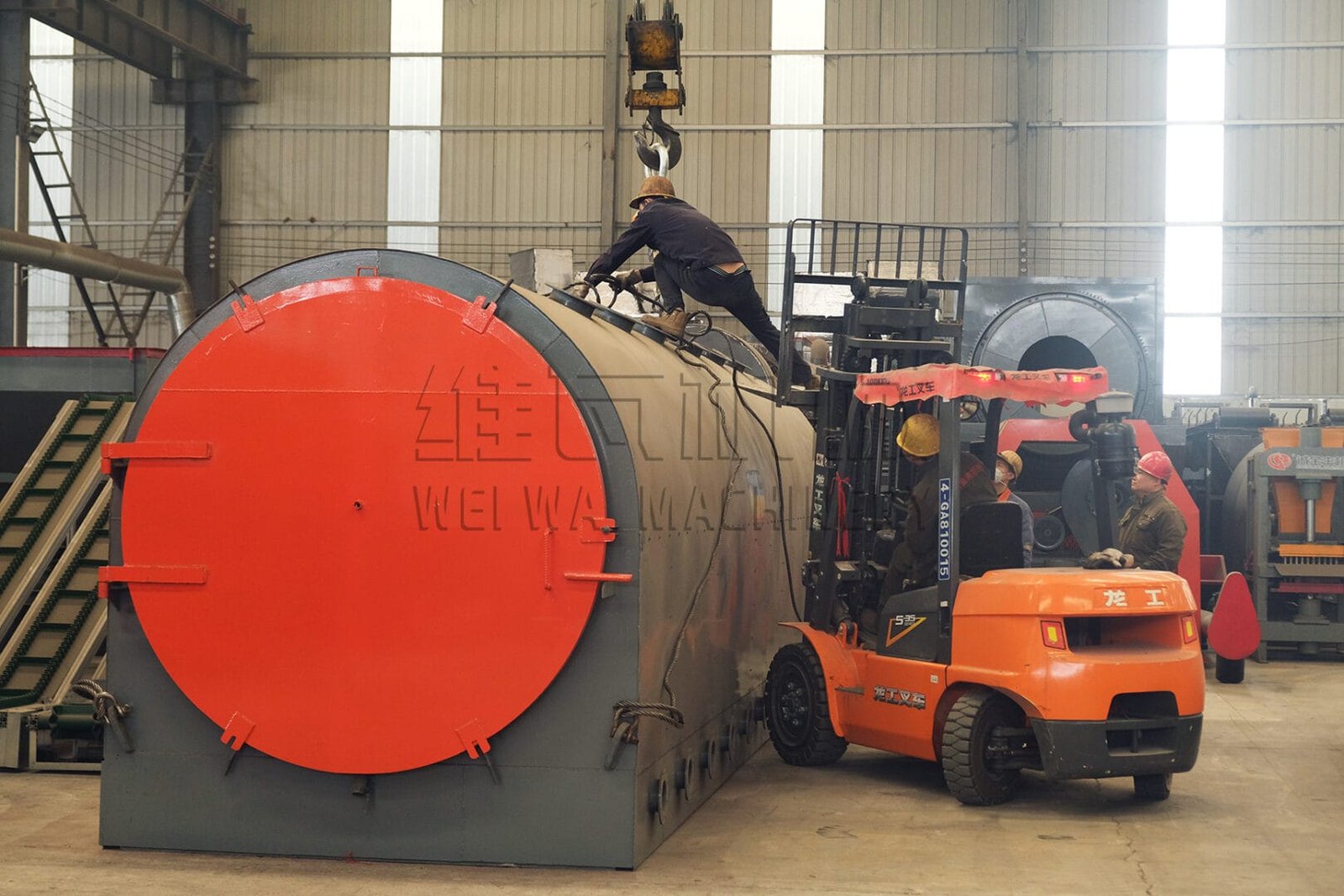
Shipment Scene from Weiwa Factory to Paraguay Bound Container
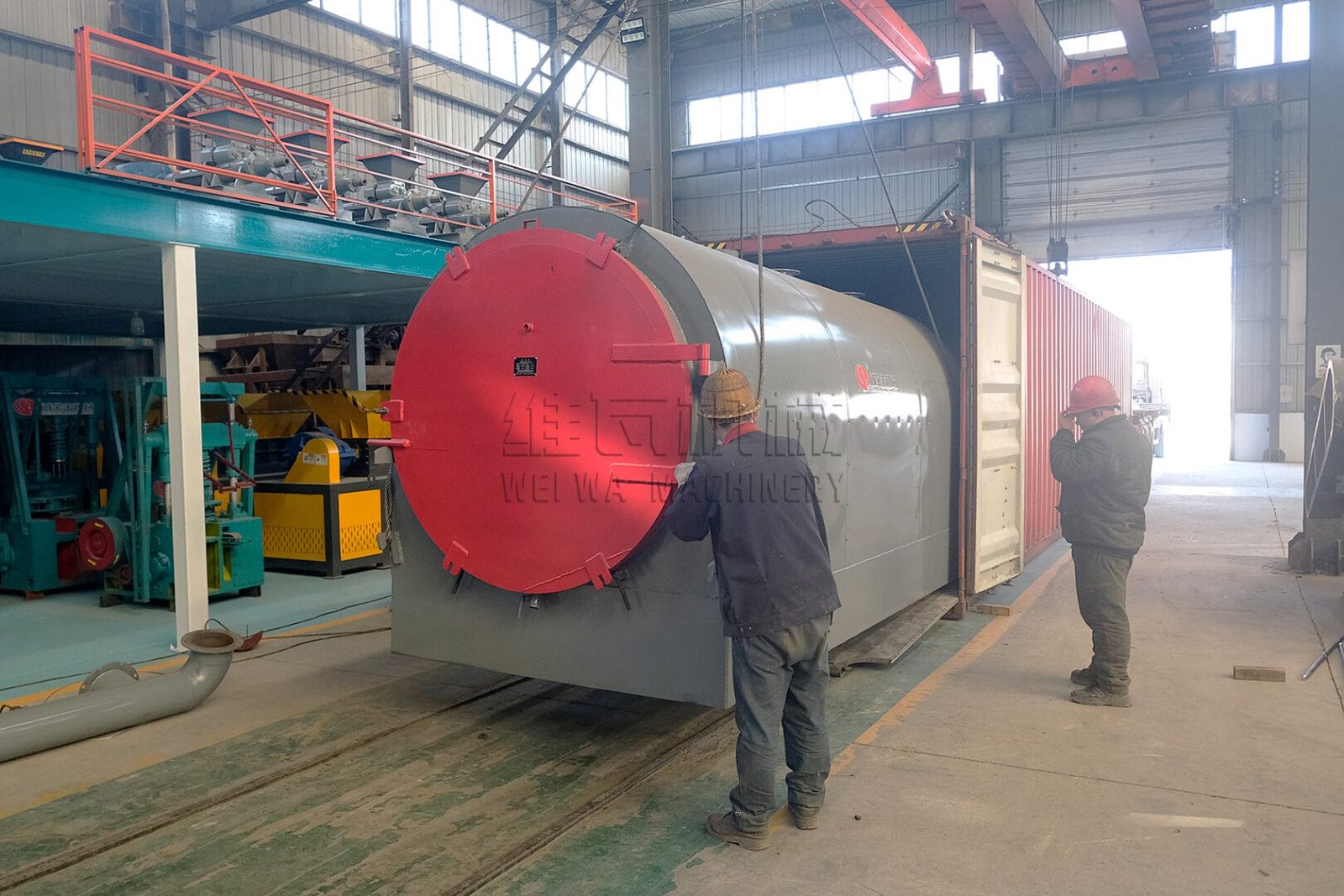
The horizontal carbonization furnace left the Weiwa factory on a flatbed truck toward the export port. The main barrel chamber, rail set, trolley, combustion chamber, purification tower, tar condenser, and control cabinet were packed separately in a 20 foot high cube container. Steel edges were protected with angle bars, the chamber interior was coated with anti rust oil, and the rail assembly was bolted to a wooden skid to prevent displacement during ocean transit to Paraguay.
Our quality inspector checked the packing list against the proforma invoice, confirmed the CE marking plate, and filmed the closing of the container doors. The Paraguay client received the loading video on WhatsApp the same day. For Weiwa Machinery, every horizontal carbonization furnace exported to South America goes through a no load heat test, a pressure seal test, and a rail trolley slide test before departure. The unit shipped to Paraguay was the 6 meter stainless lined model with a 2.3 meter diameter chamber, suitable for 1.2 ĐẾN 1.8 tons of woody biomass per batch depending on bulk density.
Paraguay buyers often ask how long from deposit to container. For stock models the answer is usually 7 ĐẾN 12 working days for repainting and accessory matching. For customized voltage, extra tar precipitator, or dual language PLC panel, the window extends to 25 ĐẾN 30 days. This Paraguay unit was a stock configuration, so the whole process from signed contract to container seal took nine working days.
Why Paraguay Needs a Lò cacbon hóa ngang?
Paraguay has a large agricultural residue base. Small and medium sawmills around Asuncion and Ciudad del Este generate offcuts. Bamboo grows in the eastern departments. Coconut is not native but imported shell from neighboring countries is available in border towns. Rice husk and peanut shell appear after harvest season. All of these materials can become charcoal, biochar, or briquette feedstock. The problem is that most local producers still use pit kilns or simple brick chambers with low fixed carbon recovery and heavy smoke.
A horizontal carbonization furnace in Paraguay changes the economics. Instead of burying wood in earth and accepting 20 ĐẾN 25 percent yield, the Weiwa chamber reaches near oxygen free conditions, recycles its own combustible gas, and returns 28 ĐẾN 35 percent charcoal by weight from dry hardwood. For coconut shell the yield is higher, typically 33 ĐẾN 38 percent. That difference turns a marginal seasonal activity into a bankable charcoal making machine business.
Another Paraguay specific factor is labor. The horizontal design loads with a cart on rails. Workers do not enter the hot chamber. They push the trolley in, close the sealed door, start the burner, and monitor temperature from the dial or PLC. After cooling they pull the cart out and unload lump charcoal. For a family operation in Paraguay this removes the hardest physical step of traditional charcoal making.
How the Horizontal Carbonization Furnace Works in Subtropical Conditions?
Paraguay has a subtropical climate with summer humidity above 70 percent. Freshly cut wood often arrives at 35 ĐẾN 45 percent moisture. The horizontal carbonization furnace is not a dryer, so feedstock should be air dried or mechanically dried to below 15 percent moisture before loading. In our trial we used wood logs at 12 percent moisture and coconut shells at 9 percent moisture to simulate properly prepared Paraguayan feedstock.
The process starts with the trolley pushed into the barrel chamber. The sealing cap locks the door. The external burner heats the combustion chamber. Indirect heat raises the chamber temperature. Xung quanh 160 degrees Celsius the wood begins releasing volatile compounds. Xung quanh 280 degrees tar and wood vinegar form. Between 420 Và 600 degrees the fixed carbon structure stabilizes. The Weiwa purification system cools the flue gas, drops tar and condensate into collection tanks, and sends the cleaned gas back to the burner as supplementary fuel.
Because the returned gas carries calorific value, the external burner consumes far less diesel or firewood. In Paraguay where LPG and electricity carry border pricing, this self heating loop is the single biggest operating cost advantage. The chamber insulation uses ceramic fiber so the outer shell stays below 60 degrees Celsius even when the interior runs at 580 degrees. That matters in hot climates because workers can stand near the machine safely.
Trial Run Batch 1 Wood Logs
We loaded 850 kilograms of mixed hardwood logs, average diameter 90 millimeters, length cut to 600 millimeters to fit the trolley. Moisture 12 percent. Preheat to 200 degrees took 95 phút. Full carbonization temperature of 560 degrees held for 110 phút. Cooling period 240 minutes before cart extraction. Final lump charcoal weight 268 kilograms. Yield 31.5 percent. Fixed carbon tested by local lab strip method 76.8 percent. Ash below 3 percent. Smoke from stack during steady phase was light white vapor, no black plume.
Trial Run Batch 2 Vỏ dừa
We loaded 700 kilograms of half shell coconut pieces, Độ ẩm 9 percent. Preheat 80 phút. Hold at 580 degrees for 90 phút. Làm mát 210 phút. Charcoal output 252 kilograms. Yield 36 percent. Fixed carbon 81.2 percent. This batch simulated a Paraguay client who imports coconut shell from Brazil or Peru and sells hookah charcoal to local lounges in Asuncion.
The two batches proved the horizontal carbonization furnace is not limited to one feedstock. A Paraguay buyer can run wood on Monday, coconut shell on Wednesday, and sawdust briquette on Friday without changing the machine. Only the trolley loading pattern and hold time change.
Charcoal Making Machine for Paraguay BBQ Hookah and Biochar Demand
Demand in Paraguay splits into three channels. First is BBQ lump charcoal for steakhouses and weekend grills. Paraguay has a strong meat culture, and lump charcoal from hardwood logs commands a premium over extruded briquettes. Second is hookah charcoal. Coconut shell charcoal with high fixed carbon and low ash is the preferred input for shisha bars. Third is biochar for soil amendment in soybean and maize rotations, still a small but growing niche.
A charcoal making machine for Paraguay must therefore be flexible. The Weiwa horizontal carbonization furnace produces lump charcoal directly from logs, produces dense coconut shell charcoal for secondary crushing and pressing, and produces fine biochar if the operator stops the cycle earlier and grinds the output. One machine serves all three product lines.
Local importers also care about container resale. A 6 meter horizontal carbonization furnace plus a briquette extruder and a dryer can fit in a 40 foot container and become a turnkey charcoal making machine for Paraguay starters. Several Paraguay inquiries in 2025 asked exactly for this combo, and the shipment in this article is the carbonization unit of such a future line.
Horizontal Carbonization Furnace vs Traditional Paraguayan Earth Kiln
The earth kiln is cheap to build but unpredictable. Yield swings between 18 Và 26 percent. Rain enters the cover. Air leaks create ash. Workers inhale smoke. A horizontal carbonization furnace in Paraguay costs more upfront but recovers the gap in three to five months for a producer moving 10 tons of wood weekly.
Comparison points Paraguayan buyers notice immediately:
Sealed chamber instead of mud cover means fixed carbon stays above 75 percent instead of dropping to 60 percent. Rail trolley instead of manual stacking means loading time falls from two hours to twenty minutes. Gas recycling instead of open flame means fuel cost per ton of charcoal drops by roughly 30 percent. Purification tower instead of direct stack means the neighbor complaint risk disappears.
For a Paraguay cooperative that sells charcoal under a brand, consistency matters more than the lowest machine price. Supermarkets and restaurant chains reject batches with high ash or strange smell. The horizontal furnace removes most of that variance.
Internal Gas Recycling and Fuel Saving in the Weiwa Design
The core of the Weiwa horizontal carbonization furnace is the smoke recovery system. During carbonization, wood releases methane, hydrogen, carbon monoxide, and light tar vapors. Many old furnaces burn this at the stack as waste. Weiwa cools it, separates liquid tar and wood vinegar, and reignites the clean gas under the combustion chamber.
In the Paraguay trial the external burner ran on diesel for the first 70 phút. After the gas return line opened, diesel flow dropped to 28 percent of the initial rate. Total diesel for batch one was 6.4 liters. A conventional indirect heater without recovery would have used about 9.5 liters for the same batch. Over 25 batches a month the saving is roughly 77 liters of diesel, equal to several hundred thousand guaranies at Paraguay retail price.
The tar collected in batch one weighed 14 kilograms. Wood vinegar weighed 22 liters. Both are sellable. Tar can return to the burner as liquid fuel after settling. Wood vinegar diluted becomes an agricultural spray. A Paraguay buyer who ignores these byproducts leaves money on the floor.
Choosing the Right Charcoal Making Machine for Paraguay Importers
Weiwa offers the horizontal carbonization furnace in 2.3 meter, 3.3 meter, 4.8 meter, 6 meter, Và 9.5 meter barrel lengths. For Paraguay the 4.8 Và 6 meter models are the sweet spot. Các 2.3 meter suits a workshop testing the market. Các 9.5 meter suits an established plant near a sawmill.
When Paraguay clients ask us for a quote we ask five questions. What is the main raw material, wood log, vỏ dừa, or briquette? What is the daily target in kilograms of charcoal? What is the local voltage, 220 volt single phase or 380 volt three phase? Do you need a dryer before the furnace? Do you want lump charcoal or pressed briquette as final product? The answers decide chamber length, công suất quạt, tar precipitator grade, and PLC language.
A charcoal making machine for Paraguay should also consider road transport from port to site. Các 6 meter chamber barely fits a standard truck trailer. Buyers in inland departments such as San Pedro or Concepcion should confirm bridge height before ordering. Weiwa can split the insulation jacket for reassembly on site if the road is tight.
After Sales Support for Paraguay Clients via WhatsApp and Email
Distance from Henan to Asuncion is not small, but support is not distance limited. Every Weiwa horizontal carbonization furnace ships with an English and Spanish operation manual, a wiring diagram, a spare parts list, and a QR code linking to the trial run video. Our engineer team answers on WhatsApp at +8613838093177 and replies to email at info@cjlmachinegroup.com within one working day.
For the Paraguay unit we scheduled a remote commissioning call. The client will mount the rail, place the chamber on the concrete base, connect the burner to a diesel tank, fill the purification tower with circulating water, and start the first heat under our video watch. First batch guidance is free. Later spare parts such as sealing rope, thermometer, or pressure valve are stocked in our warehouse and fly out by courier.
We also record every horizontal carbonization furnace serial number. If a Paraguay buyer loses the manual, we resend the exact PDF matched to his chamber length and voltage. This removes the common import machinery pain where the supplier vanishes after the wire transfer.
Why Weiwa Machinery Builds for Export First?
Công ty sản xuất máy móc Henan Weiwa, Ltd. is a professional charcoal and biomass equipment factory. We make horizontal carbonization furnace units, Lò cacbon hóa liên tục, lifting type kilns, sawdust briquette machines, crushers, dryers, and hookah charcoal press lines. Our machines run in Africa, Đông Nam Á, the Middle East, and South America. The Paraguay shipment is part of a wider South American rollout that already includes Guinea, Lebanon, and Uganda references on our site.
We keep stock of 2.3 meter and 3.3 meter chambers all year. We paint export models with marine primer. We pre drill the base channel. We test the rail trolley slide. We label every cable. The goal is simple: when a charcoal making machine for Paraguay arrives after 35 days at sea, the buyer spends two days installing, not two weeks guessing.
Quality first and credit first is not a slogan on the wall. It is the reason the same Paraguay importer who bought one horizontal carbonization furnace in 2025 is now negotiating a second unit with a briquette extruder attached.
Final Notes for Paraguay Buyers Researching the Market
If you are in Paraguay and comparing a horizontal carbonization furnace with a rotary or continuous model, the horizontal barrel is the right entry point when your feedstock is bulky wood or shell and your batch size is below 3 tons per 8 giờ. It is cheaper than a continuous plant, easier to maintain, and tolerant of inconsistent feedstock size. If your input is already uniform sawdust powder, a continuous carbonizer may fit better. If your input is logs and shells, the horizontal carbonization furnace in Paraguay wins on simplicity.
Charcoal yield, fuel saving, and smoke control are not marketing words. They are measurable. Ask any supplier for a trial run sheet with batch weight, Độ ẩm, hold temperature, time, and charcoal output. Weiwa shows ours openly. The Paraguay trial numbers in this article are from a real factory run, not a brochure estimate.
Reach our team directly for a model match and freight estimate to Paraguay.
Contact Máy móc Weiwa
Đám đông: +8613838093177
WhatsApp: +8613838093177
E-mail: info@cjlmachinegroup.com


 WeChat

 +8615937143060
