


Why a Lò cacbon hóa ngang in India Is Gaining Ground?
Indian charcoal buyers have moved away from open pit kilns because downstream buyers now ask for consistent fixed carbon, low ash and traceable batch data. A horizontal carbonization furnace in India answers that shift by replacing open burning with anaerobic dry distillation, recovering pyrolysis gas and producing uniform charcoal from hardwood, mango wood, cashew shell, coconut shell and sawdust briquette. Three factors explain the growth. First, industrial sheds in India often have crane height limits, so the horizontal layout saves vertical clearance compared with tall vertical kilns. Second, Indian processors switch feedstock by season, so a charcoal making machine that takes both wood logs and shell waste without retooling lowers capital risk. Third, port connectivity around Nhava Sheva, Mundra and Chennai lets a full furnace ship in one 20 ft or 40 ft container.
When we discuss a horizontal carbonization furnace for India, we are not talking about a generic export model. Voltage, humidity, raw-material moisture and local labor skill all shape the configuration. The unit shipped this month was tuned for 415 V / 50 Hz, tropical anti-corrosion coating, extra rock-wool insulation for monsoon humidity, and a gas-circulation kit that lets the furnace reuse its own combustible volatiles instead of burning diesel throughout the cycle.
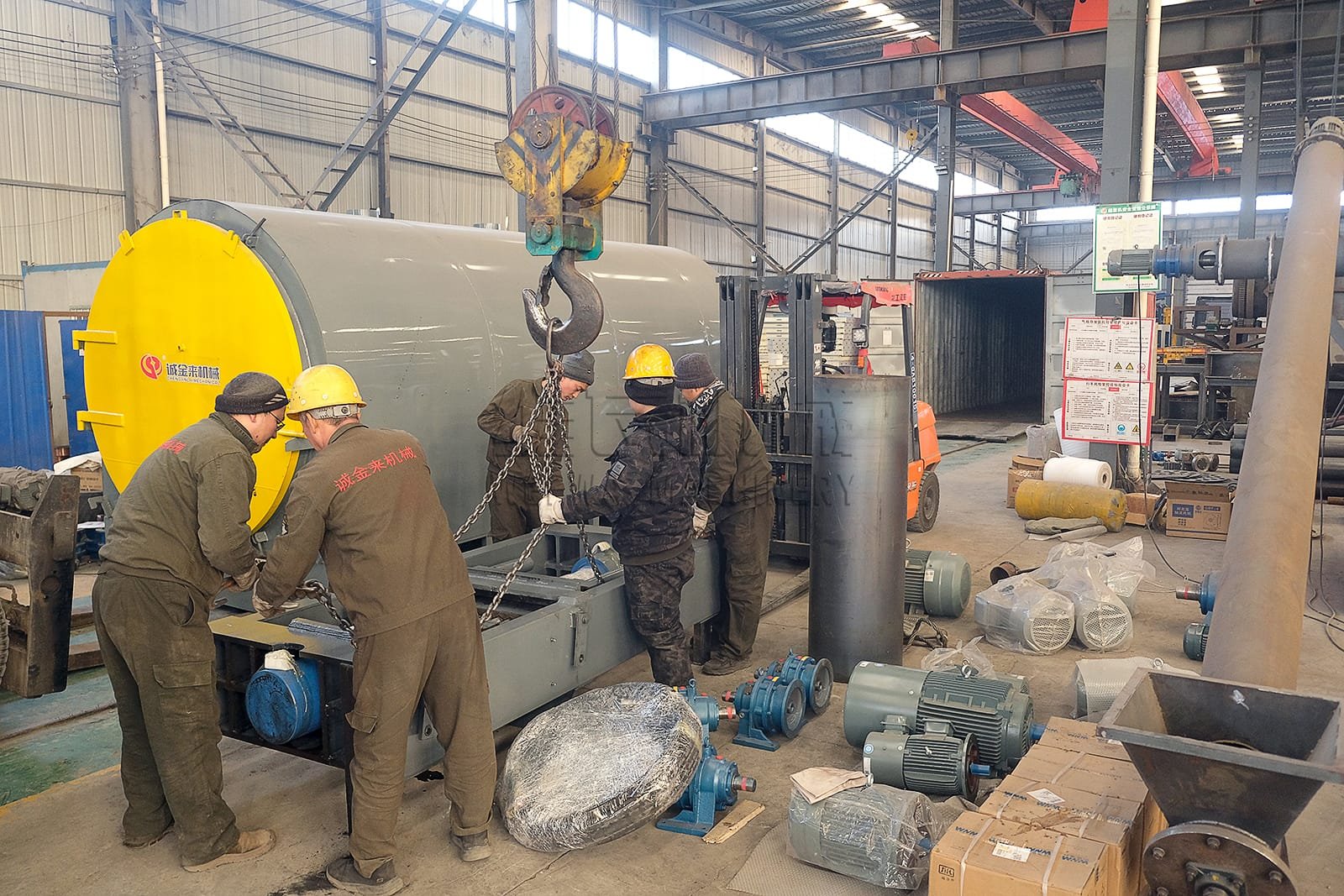
Loading Dock Scene of the Horizontal Carbonization Furnace for India
The loading dock scene started at 8:10 AM. Our quality inspector tagged the main furnace barrel, buồng đốt, the gas purification tank, the trolley frame and the stainless thermometer housing. The horizontal carbonization furnace is modular by design. The cylindrical carbonization tank, the outer insulated shell, the flue-gas return pipe and the chimney stack travel as separate welded assemblies. This reduces deformation during ocean freight and lets Indian technicians reassemble the unit in two working days under video guidance.
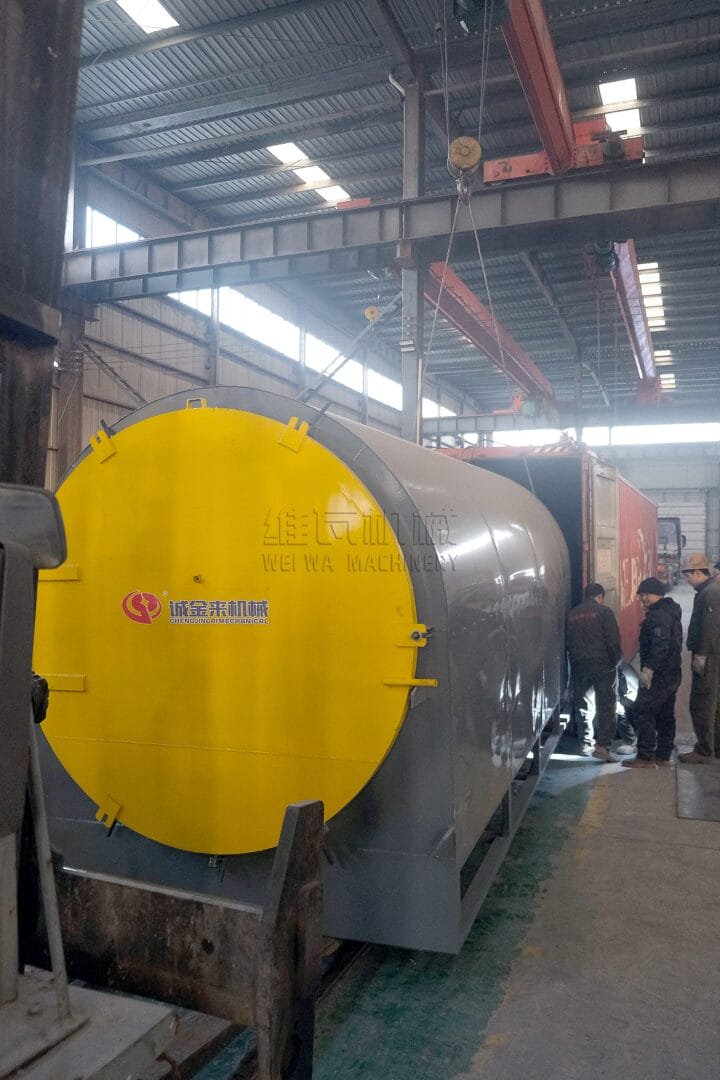
Before crating, every barrel weld was dye-penetrant checked. The furnace door gasket groove was filled with high-temperature asbestos rope and flame-retardant cotton because Indian buyers repeatedly tell us door leakage is the main cause of low fixed carbon and long cycle time. The barrel was lifted by crane, placed on steel saddles and locked with eye bolts inside a 40 ft high-cube container. The gas tank and control cabinet were wrapped in vapor-corrosion inhibitor film, then strapped to laminated wooden skids.
Photographs from the scene show the horizontal carbonization furnace for India leaving our yard with export marks, packing list in a sealed pouch and CE / ISO files handed to the freight forwarder. Commercial invoice, certificate of origin and Hindi-labeled warning plates were prepared for Nhava Sheva customs. The client in India received the bill of lading, foundation drawing and trial-run sheet before the vessel departed.
How a Horizontal Carbonization Furnace Works in Tropical Conditions?
A horizontal carbonization furnace is a batch pyrolysis unit with a barrel-style chamber mounted on rails. Operators load wood or shell onto a cart, push it into the sealed chamber and heat indirectly from the outer wall. As internal temperature climbs past 280 °C, volatiles release. Between 400 °C and 600 °C under oxygen-limited conditions, lignocellulosic structure turns into fixed carbon. Our model sustains near 600 °C with indirect heating and feeds cleaned gas back to the burners.
Rail-Mounted Barrel and Indirect Heating
The rail-mounted barrel is the core difference from vertical kilns. It lets two workers load 800 kg to 3000 kg per cycle without cranes inside the shed. Indirect heating means flame never touches the raw material, so charcoal pieces keep their shape and the fixed carbon stays stable. In India’s coastal humidity, we add a 30 mm rock-wool layer and epoxy primer under the shell to stop condensation corrosion.
Gas Purification and Self-Sustaining Combustion
Volatile tar, wood vinegar and syngas leave the chamber, pass through a condensation and purification tank, then the cleaned yellow gas returns to the bottom burner. Once the chamber crosses 450 °C, external diesel or coal input drops sharply. The horizontal carbonization furnace for India we shipped reached self-sustaining mode 52 minutes after ignition and held 580–610 °C for six hours with only minor burner support.
Trial Run Results of the Charcoal Making Machine with Indian Wood Mix
Before export, we ran a 10-hour trial with a mix that mimics Indian feedstock: 60% seasoned neem and mango wood cut under 18 cm cross-section, 25% vỏ dừa, 15% sawdust briquette. Moisture after open-yard drying was 16%. The charcoal making machine completed one batch in 9 giờ 20 minutes including cooling.
Results from the trial run showed charcoal yield 42% by weight, fixed carbon 76.4%, ash 3.1%, volatile matter 9.5%, and intact piece rate above 90% for wood logs. Smoke at chimney was light grey after the first 40 minutes because tar gas was recycled instead of vented. The Indian client watched the run through shared video and confirmed the curve matched his hookah briquette requirement.
For comparison, a traditional earth kiln with the same wood mix would give 22–26% yield, fixed carbon near 65% and uncontrolled smoke. The horizontal carbonization furnace in India context is not a luxury upgrade. It is a measured replacement for kiln charcoal when the buyer needs documented yield, recoverable gas and a payback period that justifies container freight.
Raw Material Reality for a Horizontal Carbonization Furnace for India
India does not have one biomass profile. A client in Coimbatore may feed coconut shell and tamarind wood, while a unit near Rajkot may process groundnut shell and acacia branch wood. The horizontal carbonization furnace for wood we built accepts pieces under 20 cm in cross-section and moisture under 20%, which matches most seasoned Indian hardwood after two weeks of open-yard drying. For greener material, we pair the charcoal making machine with a rotary dryer upstream, but in this shipment the client already operated a covered drying yard, so we focused on furnace sealing and gas recovery.
Customization Details Weiwa Added for the India Order
Beyond voltage and coating, we adjusted the trolley wheel gauge to match Indian rail-style shed tracks the client already had, added a longer condensate hose for the wood vinegar drum, and painted the outer shell light grey to reduce heat absorption in summer sheds above 40 °C. The unit also included a spare thermocouple, a spare fan capacitor and a full set of door bolts in a labeled pouch. These are small changes, but they are why a horizontal carbonization furnace for India from Weiwa feels different from a unit reshipped from a domestic model. The charcoal making machine is the same physics; the details are local.
Model Selection Reference for Indian Buyers
| Người mẫu | Barrel Size | Batch Capacity | Cycle Time | Quyền lực | Cân nặng |
|---|---|---|---|---|---|
| HC1300 | 1.5 × 3 m | 0.8–1.2 t wood | 12–14 h | 1.5 kW | 4.6 t |
| HC1500 | 1.5 × 4.5 m | 1.5–2 t wood | 12–14 h | 1.5 kW | 5.6 t |
The table above is plain HTML so Google can extract specs for snippet use. When we publish a horizontal carbonization furnace for India case study, we keep data in HTML tables exactly for this reason.
Common Questions India Buyers Ask Before Ordering
Can the furnace run only on its own gas?
Not fully. Above 450 °C the recycled gas covers 60–70% of heat demand, but startup still needs firewood or LPG.
Can it take wet wood?
Up to 18% moisture yes. Above that the dry phase stretches and yield drops.
Can one worker run it?
Loading needs two hands for the cart, but the HMI and burner are one-operator.
Does Weiwa send an engineer?
For India we do remote video commissioning plus optional on-site visit; most clients choose video plus a local electrician.
What are the wear parts?
Door gasket, fan belt, thermocouple and PID relay are the only wear items in year one.
Why Indian Buyers Choose Weiwa Charcoal Making Machine Systems?
Weiwa Machinery is not the cheapest option in the catalogue, and we do not pretend to be. Indian buyers choose our horizontal carbonization furnace because the commercial risk of a failed charcoal batch is higher than the saving on a thinner steel shell. Our barrel uses Q245R boiler plate, the insulation layer combines rock wool and refractory brick, and the door seal survives 400 °C repeated thermal shock. When a Gujarat client compared three suppliers, the deciding point was our gas recovery drawing and the fact that we answered a single question—how much firewood per ton of charcoal—with a number instead of a range.
For a horizontal carbonization furnace in India, after-sales distance is a real concern. We close that gap with annotated Hindi-English manuals, WhatsApp video troubleshooting, spare-gasket kits sent with every container, and a policy that any client who buys a charcoal making machine from Weiwa can request a factory live-call during their first three batches.
Closing Notes on the Horizontal Carbonization Furnace in India
The unit on that truck is now in transit, but the trial data, the packing sheet and the foundation drawing are already in the client’s folder. That is how Weiwa treats a horizontal carbonization furnace order: not as a product handoff, but as a production line handover. For any Indian buyer comparing a charcoal making machine on price alone, the better comparison is batch time, fixed carbon spread, gas recycling ratio and after-sales response on a Sunday evening. The furnace we shipped scored on all four.
If you are evaluating a carbonization furnace for Maharashtra, Tamil Nadu, Kerala or Gujarat, the fastest path is to send us your feedstock moisture and weekly tonnage. We will size the barrel, run a sample trial on your material at our shop and share the numbers before you pay a deposit. That is the same process this Maharashtra client went through, and the reason the container left with his sticker on the door.
Contact Máy móc Weiwa
Đám đông: +8613838093177
WhatsApp: +8613838093177
E-mail: info@cjlmachinegroup.com


 WeChat

 +8615937143060
