


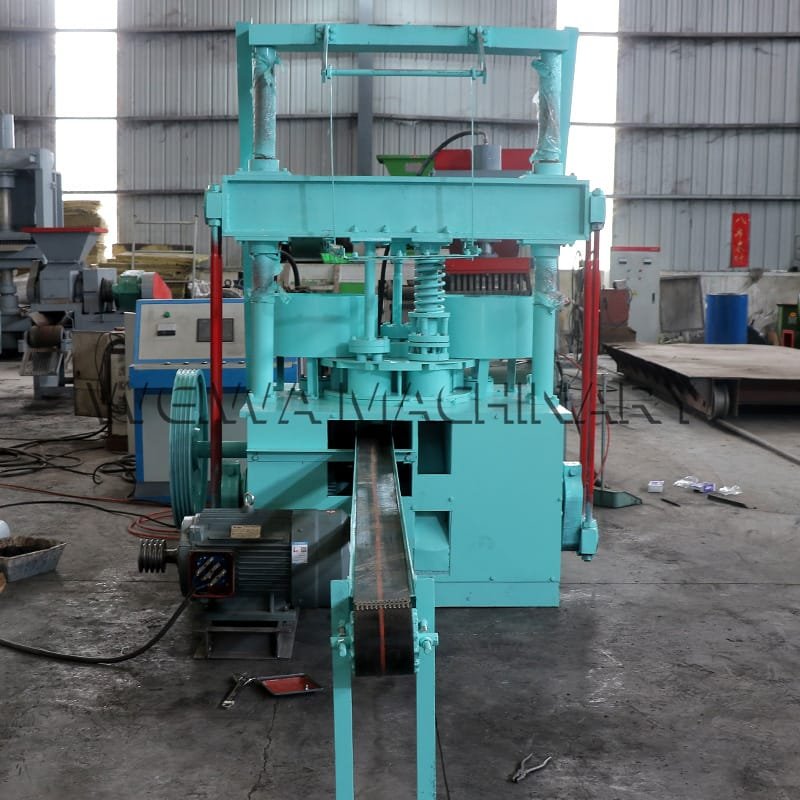
Why the Korea Client Needed a Honeycomb Briquette Charcoal Machine?
The Korean buyer operates a regional fuel trading company supplying household braziers, winter ondol auxiliary stoves, and commercial barbecue restaurants. In his market, lump charcoal is popular but inconsistent. Pieces vary in size, Độ ẩm, and ignition behavior. Importers pay for volume but sell by performance. A honeycomb briquette charcoal machine converts charcoal powder, Bụi than, and biomass carbon fines into uniform blocks with vertical air channels. Those channels change the combustion profile completely.
During the preliminary call, the client told our sales engineer that his target product was a 120 mm round honeycomb charcoal briquette with 19 holes, 75 mm height, and a compressive density high enough to survive stacking and road transport. He also wanted the same coal briquettes making machine to accept anthracite powder blends for industrial heating customers. That dual use requirement shaped the entire inspection plan.
Weiwa Machinery has supplied honeycomb punching machine units to more than 30 quốc gia, but Korea has specific expectations: clean workshop finish, stable electric control box, low noise transmission, and molds that do not drift after 200,000 cycles. The inspection was therefore not only about whether the machine works, but whether it works to Korean tolerance discipline.
What Is a Honeycomb Charcoal Coal Briquette Forming Machine?
A honeycomb charcoal coal briquette forming machine is a rotary table punching press. It does not screw material through a heated barrel. It drops a measured charge of prepared powder into a mold barrel, rotates the table, and drives a punch head downward to compress the powder into a solid disc with through holes. The holes are formed by fixed pins on the punch face or by a central mandrel inside the mold, depending on the mold version.
Punching Principle vs Screw Extrusion
Screw extruders push continuous rods and cut them. They suit soft biomass and low density firewood briquettes. A honeycomb briquette charcoal machine belongs to the mechanical stamping family. The punch applies peak pressure at the bottom of the stroke, typically producing a briquette with 60–90 kg standing resistance, far above screw output. For Korean buyers who want smokeless ignition and long steady burn, punching is the correct technology.
Core Components of the Honeycomb Punching Machine
The inspected unit contained five functional sections. The machine body was a welded steel frame with reinforced platen to absorb punch recoil. The transmission section used a 7.5 kW electric motor, V belt drive, and a hardened gear reducer turning the main camshaft. The feeding section had a 0.55 kW stirrer inside a 120 L hopper, preventing bridging of charcoal fines. The stamping section carried the slide beam, upper punch, lower ejector, and spring preload assembly. The discharge section used a 2.2 kW belt conveyor with side guards so finished briquettes did not roll on the floor.
Mold configuration for this Korea bound machine was BLMQ-120 type: 120 mm nominal cavity, 19 hole punch, 75 mm fill height, 45 strokes per minute. We also mounted a spare 140 mm mold set on the side table so the client could compare hole wall thickness and ejection behavior during the visit.
Pre Inspection Preparation at Weiwa Factory
Three days before the client joined the live broadcast, our QC team cleaned the workshop bay, calibrated the dial indicator on the turntable index, and prepared four raw material batches. Batch A was pure hardwood charcoal powder at 11 percent moisture. Batch B was anthracite coal dust under 1 mm. Batch C was a 70/30 charcoal coal blend with 4 percent starch binder. Batch D was rice husk charcoal powder from a Vietnamese supplier, included because the Korea client wanted to test imported biomass carbon as a future SKU.
Weiwa technicians adjusted the spring preload to 25 MPa equivalent punch pressure, set the belt speed to match 45 pieces per minute, and warmed the gearbox with no-load run for 20 phút. Only after oil temperature stabilized did we invite the client online and start the recorded inspection.
Live Machine Run and Briquette Sample Display
The first 50 strokes used Batch A. The honeycomb briquette charcoal machine ejected 45 clean discs per minute. No double fill, no stuck ejector, no cracked edges. The client asked us to stop the camera on the mold table so he could count holes. Nineteen holes, evenly spaced, center hole 8 mm, outer holes 6 mm, exactly as his approved drawing required.
We then switched to Batch B anthracite. Coal powder alone tends to stick to the mandrel, so we increased binder to 5 percent and added 1 percent hydrated lime. The coal briquettes making machine produced darker, harder discs with a metallic ring when tapped. Compression resistance measured 82 kg average in our lab press.
Batch C blend was the client favorite. Các 70/30 charcoal coal mix gave the visual identity of charcoal with the slower burn curve of coal. Batch D rice husk charcoal pressed well but needed 13 percent moisture, proving that the honeycomb punching machine is forgiving if the operator respects powder physics.

Raw Material Preparation for the Test
All batches were sieved below 1 mm, mixed in a horizontal paddle blender for eight minutes, and aged in sealed bags for 30 minutes so moisture migrated evenly. We showed the client our moisture meter reading 11.4 percent on Batch A. This detail matters because many first time buyers blame the honeycomb charcoal coal briquette forming machine when their real problem is powder at 18 percent moisture.
Hole Pattern, Density and Surface Quality
Korean barbecue briquettes need fast top ignition and bottom airflow. Các 19 hole pattern achieved both. We cut one sample vertically and showed the hole wall was parallel, not tapered. Parallel holes mean the briquette burns inward evenly instead of collapsing. Surface density measured 1.15 g/cm³. Edge chipping was zero across 200 sampled pieces.
The client requested a micro scratch test on the mold cavity. Our machinist removed the 120 mm mold and displayed the chrome plating under a handheld loupe. No scoring, no pitting. We explained that Weiwa replaces mold steel with 40Cr after heat treatment and hard chrome plates to 0.02 mm, which extends mold life to roughly 300,000 shots before rework.
Burning Sample Result from the Korea Inspection
We burned one 120 mm charcoal briquette sample in a standard stainless brazier with a single alcohol gel starter. Ignition occurred at 52 seconds. Steady flame sustained for 78 phút. Residual ash was 9.6 percent of initial mass. Smoke was visible only in the first 40 seconds, then turned to heat shimmer. Compared with lump charcoal the client sent us earlier, the honeycomb sample gave 31 percent longer burn and 44 percent less startup smoke.
For the anthracite coal sample, ignition took 95 seconds with a propane assist, but total burn reached 112 phút. The client noted that coal briquettes making machine output would serve his warehouse heating accounts, while charcoal samples would serve barbecue distributors. One honeycomb briquette charcoal machine, two product lines.
Custom Mold Options Discussed with the Korea Client
Although the order specified 120 mm round 19 hole, the client asked about market expansion. We laid out alternative molds on the workbench: 100 mm round 12 hole for portable stoves, 140 mm round 21 hole for restaurant braziers, 90 mm square honeycomb for modern designer fire pits, Và 110 mm hexagon for gift box charcoal. All molds share the same turntable bolt circle on the BLMQ series, so conversion takes under 25 phút.
We also demonstrated the quick change ejector pin set. The Korea buyer appreciated that no hydraulic press was needed to swap molds. His workshop in Incheon has limited ceiling height, so a purely mechanical honeycomb punching machine fits better than a hydraulic model with an oil unit.
Voltage was another customization point. Weiwa configured the motor for 380V 60Hz 3 phase, matching Korean industrial supply. Control box carried a Korean label set, emergency stop at operator side, and overload relay set to 15A. The client confirmed this removed a frequent complaint from his previous Chinese supplier.
Đóng gói, Loading and After Sales Plan for Korea
After the inspection passed, we filmed the packing sequence. The honeycomb briquette charcoal machine was wrapped in anti rust paper, foam corners on the gearbox, and fixed on a skid with steel strapping. Spare mold, punch pins, springs, and a tool kit went into a separate plywood crate marked “fast wear parts”. Manual was printed in English with a Korean glossary appendix.
We booked a 20 foot container with the client freight forwarder. Total weight 1,480 kg, within Incheon port handling limits. We issued the commercial invoice, packing list, CE declaration of conformity, and a bilingual inspection report signed by our QC manager and countersigned digitally by the Korea buyer representative.
After sales coverage includes one year mechanical warranty, lifetime technical reply within 24 giờ, and free video guidance for die alignment. Weiwa also keeps mold blanks in stock for the BLMQ series, so a replacement 120 mm mold ships within five working days. The client asked about operator training. We proposed a two hour live Zoom session plus a recorded maintenance playlist hosted on our site.
Why Buy a Coal Briquettes Making Machine from Weiwa Machinery?
Weiwa Machinery started as a Zhengzhou workshop in 1990 and now serves more than 2 million end users through distributors in over 130 quốc gia. Our briquette division focuses on mechanical punching because it fits the real economics of charcoal traders. A honeycomb charcoal coal briquette forming machine does not need a burner, does not need constant screw replacement, and does not demand a high skilled electrician on site.
For Korea specifically, we understand that buyers compare German presses, Indian presses, and Chinese presses. German machines cost three times more. Indian machines often lack consistent heat treatment. Weiwa positions between them: Japanese level documentation discipline, Chinese speed and price, and a spare parts logic built for small importers.
The honeycomb briquette charcoal machine in Korea is not a novelty. It is a mature answer to fuel standardization. When a Seoul distributor opens a carton of 120 mm 19 hole briquettes, he is selling predictable fire. That predictability begins on the rotary table in our factory.
If you are evaluating a coal briquettes making machine or a honeycomb punching machine for the Korean market, request a live inspection like the one described above. Watch the first 100 pieces. Measure the holes. Burn one sample. The machine will tell you the truth faster than any brochure.
Về Máy móc Weiwa
Weiwa Machinery is a Chinese manufacturer of briquette machines, charcoal carbonization furnaces, and related fuel processing lines. Our product range covers honeycomb punching machines, screw briquette presses, coal charcoal mixing mills, mesh belt dryers, and continuous carbonization furnaces. We export to Indonesia, Ấn Độ, Malaysia, Việt Nam, Philippines, Pakistan, Thổ Nhĩ Kỳ, Ba Lan, Hàn Quốc, Mexico, Nam Phi, and many other markets.
Every honeycomb briquette charcoal machine we build is tested with real powder before shipment. We do not ship on promises. We ship on samples, measurements, and inspection videos. Our factory welcomes third party inspectors, buyer representatives, and long term agents who want to localize briquette production under their own brand.
For quotation, mold drawing, or a live factory run appointment, contact our international team directly:
Điện thoại di động / WhatsApp: +8613838093177
E-mail: info@cjlmachinegroup.com
The Korea inspection proved one simple point. A honeycomb briquette charcoal machine is only as good as the samples it produces under buyer eyes. Weiwa builds the machine so the samples speak first.


 WeChat

 +8615937143060
