


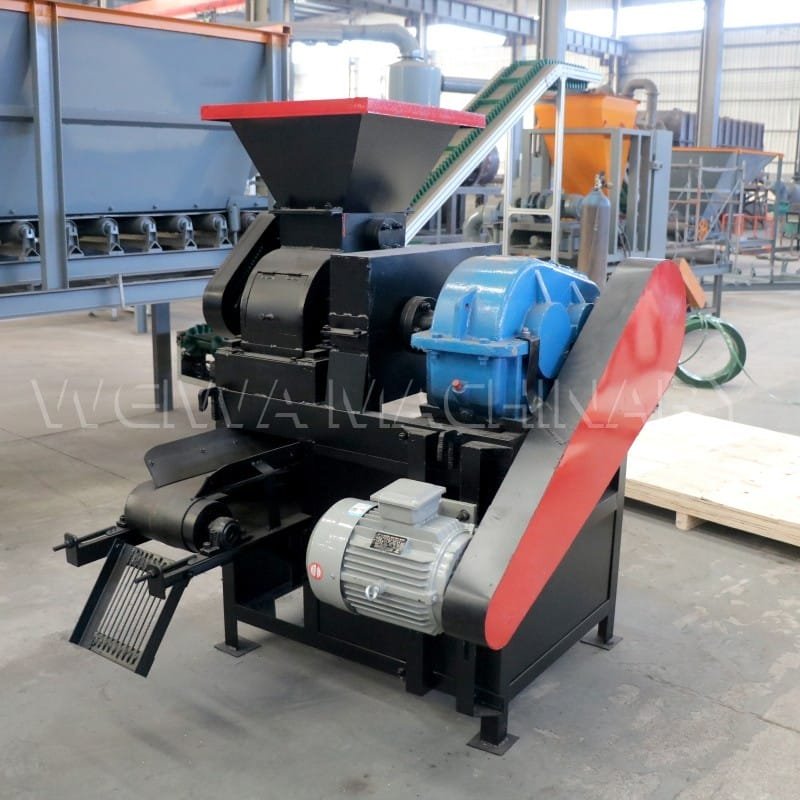
Tại máy móc Weiwa, every loaded container represents more than just steel and components. It carries the trust of our global partners and the technical expertise built over thirty years of specialization in industrial briquetting equipment. Gần đây, our factory successfully prepared and dispatched a complete ball charcoal briquettes machine and supporting production line to a valued client in the United Arab Emirates. This shipment not only highlights our manufacturing readiness but also reflects the growing demand for making charcoal balls in UAE and surrounding Middle Eastern markets where high-density briquettes are increasingly preferred for commercial barbecue, hospitality, and metallurgical applications.
As the truck left our Gongyi production base bound for the port, our technical team conducted final inspections on the charcoal ball press machine, verifying roller alignment, pressure systems, and electrical control cabinets. The client in UAE required a stable output capacity with uniform oval and pillow-shaped briquettes sized between 20 ĐẾN 60 millimeters. Our double-roller high-pressure design was selected because it applies concentrated mechanical force to compress loose charcoal powder, Bụi than, and certain metal or mineral powders into dense, crack-resistant balls that maintain shape during transport and combustion. This level of precision is essential for making charcoal balls that meet premium BBQ and industrial standards in competitive markets like Dubai and Abu Dhabi.
During the on-site packing process, small-size units such as the twin shaft mixer and mesh belt dryer components were carefully wrapped and placed into reinforced wooden cases suitable for LCL shipping, while the main ball charcoal briquettes machine frame was securely fastened for full container load transport. We followed our standard export protocol which includes anti-rust coating on exposed shafts, moisture-proof film around control panels, and shock-absorbing blocks under heavy rollers. These details may seem minor, but they ensure that when the charcoal briquette machine arrives in UAE, it can be installed and commissioned with minimal adjustment. Our after-sales engineers remained available via video call to guide local workers through foundation preparation and lubrication procedures before arrival, reflecting the continuity of service Weiwa Machinery provides beyond the moment of shipment.
Field Observations From the UAE Shipment Site
The UAE client visited our factory prior to production and observed multiple ball charcoal briquettes machine models in trial operation using local charcoal samples mixed with controlled binders. In desert climates where ambient temperatures can exceed forty degrees Celsius, equipment stability is critical. Our charcoal ball press machine incorporates enhanced sealing, heat-resistant grease points, and optionally upgraded cooling for hydraulic units when requested. Trong thời gian xét xử, the machine maintained consistent pressure without noticeable roller slippage, producing evenly compacted briquettes with smooth surfaces and high drop-resistance. The client noted that uniform making charcoal balls in UAE facilities would help standardize product presentation for hospitality chains and retail packaging, reducing complaints related to powder loss and irregular burning rates.
Another observation from the shipment site involved raw material adaptability. Although the order was primarily for charcoal and coal powder processing, the same charcoal briquette machine can be configured with customized roller pockets to handle magnesium oxide powder, Bột sắt, bột đồng, quặng crom, thạch cao, and desulfurization sludge. This flexibility is valuable in UAE where diversified industrial zones process both energy and metal-related powders. By adjusting feeding speed, binder ratio in the twin shaft mixer, and pressing gap, operators can switch between fuel briquettes and metallurgical briquettes without replacing the entire production line. Such versatility aligns with the needs of entrepreneurs making charcoal balls in UAE while keeping options open for future expansion into mineral agglomeration.
Logistics also played a key role in the shipment process. We coordinated with freight forwarders familiar with Middle East routes to ensure customs documentation matched the technical specifications of each charcoal ball press machine component. Nameplates were engraved in English with rated capacity, roller diameter, motor power, and safety warnings to facilitate clearance and on-site identification. For clients new to importing heavy machinery, Weiwa Machinery provides a pre-shipment checklist covering foundation drawing confirmation, voltage compatibility, and spare parts inventory. These measures reduce delays and reflect our understanding that a successful delivery is measured not only by goods arriving intact but by the production line starting smoothly in its new environment.
Tanzania Market Potential for Charcoal Briquette Machine Adoption
While the shipment itself was destined for UAE, our conversation with international distributors highlighted a parallel opportunity in Tanzania that deserves attention. Tanzania, like many East African economies, faces a sustained demand for clean and affordable cooking fuel. Traditional charcoal production from whole wood logs contributes to deforestation and inconsistent quality. Introducing a charcoal briquette machine that converts sawdust, Charcoal vỏ dừa, rice husk carbon, and loose charcoal powder into uniform balls or pillow shapes can significantly improve energy efficiency and create local value chains. Making charcoal balls in Tanzania is not merely a technical upgrade but a response to urbanization, population growth, and the need for smokeless household fuel in cities such as Dar es Salaam, Arusha, and Mwanza.
The market potential for ball charcoal briquettes machine in Tanzania is supported by several factors. First, agricultural and forestry residues are abundantly available near processing zones and farming communities. With a properly configured crushing and mixing system, these wastes can be transformed into high-calorific briquettes that burn longer than loose charcoal and emit less smoke. Second, small and medium enterprises in Tanzania are increasingly aware of branding and packaging. Uniform charcoal balls produced by a charcoal ball press machine allow consistent weighing, stacking, and retail presentation, which helps differentiate products in local markets and cross-border trade with Kenya, Uganda, and Zambia. Third, policy discussions around sustainable energy and circular economy practices create a favorable narrative for briquette projects that reuse by-products rather than extracting fresh wood biomass.
From a technical perspective, Tanzanian operators often start with semi-automatic lines due to space and power considerations. A typical entry-level setup includes a simple crusher, a twin shaft mixer with manual binder addition, a ball charcoal briquettes machine with medium roller diameter, and a sun-drying yard or small mesh belt dryer depending on climate and throughput. Weiwa Machinery has supplied similar configurations to other African regions and can adapt the design to local voltage, humidity, and maintenance preferences. The key to success in Tanzania is not only installing a charcoal briquette machine but ensuring operators understand moisture control, binder selection, and roller maintenance. Our after-sales team supports this through manuals, remote troubleshooting, and periodic spare parts planning so that production continuity is protected.
It is also worth noting that Tanzania’s proximity to port infrastructure enables entrepreneurs making charcoal balls in UAE or other export-oriented markets to consider regional supply strategies. While most Tanzanian briquettes serve domestic cooking and small-scale heating, there is emerging interest in supplying shaped charcoal to Middle Eastern buyers who value consistent sizing for hookah or BBQ use. A ball charcoal briquettes machine producing oval or egg-shaped briquettes with high density can meet such specifications. By linking Tanzanian raw material availability with UAE-level quality expectations, a well-planned briquette business can capture both local and export margins. Weiwa Machinery views this interconnectivity between Africa and the Middle East as a long-term trend worth preparing for through flexible machine design and reliable technical support.
Understanding the Ball Charcoal Briquettes Machine and Complete Production Line
To appreciate why shipments to UAE and market growth in Tanzania are gaining momentum, it is necessary to understand how a charcoal ball press machine functions within a complete production ecosystem. The ball charcoal briquettes machine itself is a roller-type press that forms powdered materials into spheres, ovals, pillows, squares, or custom shapes through high-pressure mechanical compaction. Two counter-rotating rollers with aligned pockets draw material from the feeding hopper, compress it gradually to the maximum pressure point at the roller centerline, and then release the formed briquette as pressure drops past the center. This process does not rely on high heat but on precise pressure and material preparation, which makes it energy-efficient and suitable for a wide range of fine powders including charcoal, than đá, metal, and mineral dusts.
Tuy nhiên, the charcoal briquette machine alone cannot guarantee quality if upstream and downstream steps are neglected. A professionally designed line begins with crushing. Raw materials such as lump charcoal or coal need to be reduced to a consistent fine powder, usually below three to five millimeters depending on roller pocket depth and binder performance. Inconsistent particle size leads to weak spots inside the briquette, causing cracks during drying or handling. Weiwa Machinery typically recommends a suitable crusher type based on material hardness and moisture, ensuring the ball charcoal briquettes machine receives uniform feed that compacts evenly across the roller width.
After crushing, the powder moves to a twin shaft mixer where water and binders such as starch, molasses, or inorganic agents are added in controlled proportions. The goal is to achieve a plastic yet non-sticky consistency that holds under pressure but releases cleanly from the roller pockets. Over-wetting causes deformation, while under-wetting results in crumbly briquettes. Making charcoal balls in UAE or Tanzania therefore requires adjusting recipes to local raw material characteristics. Our technical team often advises clients to conduct small batch tests before full-scale production, and we can simulate these conditions in our factory using client-sent samples. This pre-production validation reduces risk and improves the first-run yield of the charcoal ball press machine.
Once mixed, the material is temporarily stored in a silo or buffer hopper to ensure continuous feeding into the ball charcoal briquettes machine. Variable frequency drives on the screw feeder help synchronize material flow with roller speed, preventing overload or empty-pocket operation that accelerates wear. The molded briquettes then enter a drying phase. For small operations, shaded sun drying on flat trays may suffice in dry climates, but for consistent commercial output, a mesh belt dryer offers controlled temperature and airflow to remove moisture gradually without surface cracking. Overly rapid drying can cause internal vapor pressure to fracture the briquette, so balancing residence time, temperature, and humidity is part of the line design. The final dried products from a charcoal briquette machine line are stacked, cooled, and packaged for distribution as BBQ charcoal, shisha charcoal, nhiên liệu công nghiệp, or metallurgical additives depending on formulation and shaping choices.
Key Components and Customization in Charcoal Ball Press Machine
When clients order a ball charcoal briquettes machine from Weiwa Machinery, one of the most impactful customization points is the roller. Roller material, surface treatment, and pocket geometry determine service life and briquette appearance. For abrasive materials like silicon manganese alloy powder or hard coal, we may use alloy steel rollers with surface hardening to resist wear. For food-grade or premium BBQ charcoal making charcoal balls in UAE markets, polished cavity surfaces reduce sticking and improve release. Pocket shape can be oval, egg, pillow, quảng trường, tròn, or bread-shaped, with diameters commonly ranging from twenty to eighty millimeters. Custom embossing such as a logo or brand initials can also be engraved on the roller to help clients differentiate their products visually.
Pressure system configuration is another area of customization. Our charcoal ball press machine can be equipped with ordinary mechanical transmission for standard applications or enhanced with hydraulic auxiliary systems when materials require variable pressure compensation. Hydraulic units help maintain constant pressure despite fluctuations in feed density and can protect rollers from damage caused by foreign hard objects. For clients in Tanzania exploring diverse raw materials, this adaptability is valuable because agricultural charcoal batches may vary in moisture and impurity content. A charcoal briquette machine that tolerates minor process variability without frequent jamming supports smoother daily operation and lower operator stress.
Control and safety features are increasingly important as buyers professionalize their plants. Weiwa Machinery integrates motor protection, emergency stop circuits, overload indicators, and optional PLC touchscreen panels that display current, pressure trends, and alarm history. Even if a client initially chooses a basic control box, the wiring layout is designed to allow future upgrades without rewiring the entire line. This forward-compatible thinking is part of our thirty-year manufacturing philosophy. Whether the end user is making charcoal balls in UAE for high-end resorts or supplying Tanzanian households with affordable fuel, the underlying equipment should be robust today and extensible tomorrow.
Connecting Shipment Quality With Long-Term Market Success
The shipment to UAE reminded us that equipment quality and market insight must go hand in hand. A ball charcoal briquettes machine that arrives well packed and well aligned shortens the time to first briquette, but sustainable success depends on understanding customer needs, raw material behavior, and local regulations. In UAE, premium appearance, tro thấp, and consistent burn time matter for hospitality clients. In Tanzania, affordability, smokeless combustion, and community acceptance are central. The charcoal ball press machine is the same category of technology, yet its configuration, binder strategy, and drying method should adapt to these contexts. Weiwa Machinery positions itself not only as a machinery exporter but as a technical partner that discusses these nuances with clients before finalizing proposals.
Our factory floor often hosts trial runs where visitors from Middle East and Africa watch their own material being pressed into briquettes. These moments build confidence because they move the conversation from theoretical capacity to visible, tangible output. Seeing a charcoal briquette machine produce uniform balls from previously wasted powder helps clients imagine their own workshop in operation. It also allows us to fine-tune roller gaps, mixer timing, and dryer temperature settings in real time. By the time shipment occurs, both parties already share a reference point of success. This approach reduces post-installation uncertainty and aligns with our goal of seeing every ball charcoal briquettes machine we ship contribute to a running, profitable line rather than sitting idle due to mismatched expectations.
Looking at the broader picture, the global shift toward resource efficiency benefits both UAE and Tanzania in different ways. In UAE, making charcoal balls from imported or locally sourced charcoal dust supports waste reduction and premium fuel branding. In Tanzania, converting biomass residues into briquettes conserves forests and creates rural employment. The charcoal ball press machine sits at the intersection of these narratives as a practical tool for densification and value addition. Weiwa Machinery continues to refine our designs to meet diverse climatic, electrical, and economic conditions, because we believe that a machine leaving our workshop should be capable of integrating into a client’s reality thousands of kilometers away, whether that reality involves desert heat, tropical humidity, or fluctuating raw material supply.
Why Weiwa Machinery Focuses on Complete Solutions Rather Than Single Machines?
Many inquiries begin with a request for a charcoal briquette machine price, but experienced buyers soon realize that single-machine purchases can lead to bottlenecks if crushing, mixing, or drying are not properly matched. Weiwa Machinery emphasizes complete solutions because the ball charcoal briquettes machine is only one stage in a material flow that starts with raw lumps and ends with packaged goods. Our engineers evaluate required hourly output, available workshop space, local power supply, and expected raw material moisture before recommending crusher models, mixer volume, silo capacity, and dryer length. This holistic planning prevents undersized feeders that starve the charcoal ball press machine or oversized dryers that waste energy and floor area.
For clients making charcoal balls in UAE under space-conscious industrial layouts, we may propose compact linear arrangements with elevated platforms to utilize vertical space for conveyors and control panels. For Tanzanian sites with ample land but limited three-phase power, we might prioritize mechanically driven equipment with optimized motor ratings and recommend solar-assisted drying structures where feasible. These adaptations are not random but derived from field feedback across more than one hundred thirty countries where our machines operate, including Indonesia, Ấn Độ, Malaysia, Thổ Nhĩ Kỳ, Ai Cập, Ethiopia, Nam Phi, and Mexico. Each region teaches us something about durability, maintenance habits, and operator training needs, which we feed back into our design and packaging standards.
Spare parts strategy is another reason we advocate complete-line responsibility. When Weiwa Machinery supplies the full charcoal briquette machine line, we can standardize bearings, belts, and roller materials to reduce inventory complexity. Clients benefit from clearer parts lists and faster response when wear items like scraper blades, coupling bushes, or mesh belts need replacement. Our after-sales team prepares recommended spare parts kits proportional to machine size and expected runtime, so that a ball charcoal briquettes machine in UAE or Tanzania can be maintained without prolonged downtime waiting for international shipping. This continuity is part of what we mean by professional support that extends beyond the invoice date.
Technical Considerations for Making Charcoal Balls in UAE and Tanzania
Although both regions may use similar charcoal ball press machine models, technical considerations differ. In UAE, humidity is low but temperatures are high, which influences binder choice and drying. Some organic binders ferment or lose viscosity in extreme heat if stored improperly, and hydraulic oil cooling becomes more important for continuous operation. Dust control is also significant in arid environments to protect roller bearings and electrical enclosures. Weiwa Machinery addresses this with sealed bearing housings, optional air purging, and protective covers around moving parts. For making charcoal balls in UAE at tourist-facing quality levels, surface finish and dimensional tolerance are tightly controlled, often requiring finer powder preparation and higher pressing forces, which our heavy-duty ball charcoal briquettes machine frames are built to sustain.
In Tanzania, moisture from seasonal rains and varying raw material storage conditions means the crusher and mixer must handle occasional clumps and higher inherent water content. Pre-drying of raw powder or adjusting binder percentage becomes part of daily operation. The charcoal briquette machine line may include a simple rotary drum dryer before mixing if incoming material is too wet for direct briquetting. Roller gap setting and spring-loaded pressure systems help accommodate slight fluctuations in feed density without frequent manual adjustment. Our experience in similar climates suggests that operator training on moisture testing and visual briquette inspection pays off more than purely automated systems in early-stage plants, so we tailor control interfaces accordingly while keeping upgrade paths open.
Energy cost and maintenance skill level also shape recommendations. In both UAE and Tanzania, we have seen successful installations where the client started with semi-automatic feeding and manual palletizing, then gradually added automation as volume and cash flow allowed. A charcoal ball press machine does not have to be fully automatic from day one to be profitable. What matters is that the core compression unit—the ball charcoal briquettes machine—is built with accurate machining, reliable gears, and accessible adjustment points so that incremental upgrades integrate cleanly. Weiwa Machinery designs with this phased growth in mind, because we know many of our clients are entrepreneurs scaling from pilot to commercial scale rather than large corporations with turnkey expectations only.
Scientific Principles Behind Briquette Formation and Quality Control
Beyond machinery, understanding the science of agglomeration helps clients optimize results. When a charcoal briquette machine compresses powder, several mechanisms occur simultaneously. Particle rearrangement fills voids, elastic-plastic deformation increases contact area, and binders or natural adhesives in the material create capillary and van der Waals forces that hold particles together after pressure release. If pressure is too low, bonds are insufficient and briquettes crumble. If pressure is too high without adequate plasticity, spring-back cracking appears as the material leaves the roller pocket. The ball charcoal briquettes machine must operate within a material-specific window where density, binding ability, and moisture align. This is why making charcoal balls in UAE or Tanzania benefits from small laboratory-style tests before committing to production rollers.
Quality control extends beyond visual shape. Clients often measure drop resistance, compressive strength, water resistance for outdoor storage, and combustion characteristics such as ignition time, flame stability, and ash content. A well-tuned charcoal ball press machine contributes to these metrics by ensuring uniform density and minimal internal laminations. Inconsistent feeding causes density variation from pocket to pocket, which later shows up as uneven burning or premature ash fall. Our feeders and silo designs aim to minimize pulsation, and we advise clients on hopper angle, vibration avoidance, and level indicators to maintain steady head pressure above the rollers. These details distinguish a professional charcoal briquette machine line from a loosely assembled press with a hopper on top.
Another scientific aspect is binder chemistry. While some operators prefer binder-free briquetting using high pressure and inherent lignin activation in biomass, many charcoal applications still use starch or molasses-based binders to improve green strength before drying. The twin shaft mixer before the ball charcoal briquettes machine plays a crucial role in dispersing binder evenly. Poor mixing leads to soft spots even if the press itself is excellent. Weiwa Machinery sizes mixer volume and paddle arrangement to ensure retention time sufficient for homogeneity without over-working the material, which can pre-compact it and reduce fill efficiency in roller pockets. Getting this balance right is part of the technical guidance we provide when discussing complete lines for making charcoal balls in UAE hospitality supply chains or Tanzanian household fuel distribution.
Global Footprint and Local Relevance of Weiwa Machinery
Shipments like the recent UAE delivery and ongoing interest from Tanzanian entrepreneurs are part of a broader pattern. Over the past thirty years, Weiwa Machinery has exported to more than one hundred thirty countries, adapting ball charcoal briquettes machine designs to local voltages, languages, raw materials, and certifications. We have served clients in Indonesia, Ấn Độ, Malaysia, Lào, Myanmar, Thái Lan, Việt Nam, Philippines, Pakistan, Sri Lanka, Lebanon, Georgia, Thổ Nhĩ Kỳ, Ba Lan, Cộng hòa Séc, Mông Cổ, Hàn Quốc, Romania, Ai Cập, Sudan, Tunisia, Algeria, Ethiopia, Tanzania, Equatorial Guinea, Zambia, Mexico, Nam Phi, and many others. This geographic spread teaches us that while the charcoal briquette machine is a universal concept, its optimal configuration is always local.
Our factory welcomes visits from overseas buyers who want to inspect welding quality, machining accuracy, and assembly discipline before ordering. Seeing a charcoal ball press machine under assembly—rollers being ground, gearboxes filled with specified oil, control cabinets wired with labeled terminals—builds trust that specifications are not just written but executed. For clients unable to travel, we provide detailed photos, test videos with their own material, and third-party inspection coordination. These practices support transparent communication and align with the way modern B2B buyers research and validate heavy equipment suppliers online, where trust signals such as documented shipments, repeat orders, and long-term experience matter greatly.
The UAE shipment also reaffirmed the importance of documentation. Along with the ball charcoal briquettes machine, we provided English operation manuals, electrical schematics, foundation drawings, spare parts lists, and maintenance schedules. For making charcoal balls in UAE where multilingual workforce may be involved, clear diagrams and safety symbols help bridge language gaps on the shop floor. Similarly, for Tanzanian clients where technical training resources may be limited, we emphasize simple, durable designs with accessible grease points and visible adjustment markers so that routine care does not depend on advanced instrumentation. Matching documentation and design complexity to user context is part of responsible exporting that we prioritize at Weiwa Machinery.
Future Outlook for Charcoal Briquette Machine Markets in UAE and Tanzania
Nhìn về phía trước, nhu cầu về hiệu quả, shaped solid fuel and recycled powder agglomeration is likely to grow in both UAE and Tanzania, though driven by different motivations. In UAE, premium BBQ culture, hotel industry standards, and industrial efficiency goals push buyers toward high-specification charcoal briquette machine lines that deliver consistent oval or egg-shaped briquettes with low dust and reliable packaging appearance. Environmental messaging around waste-to-resource conversion also resonates with UAE’s sustainability frameworks, creating opportunities for ball charcoal briquettes machine applications beyond charcoal, such as metal and mineral powder recovery in manufacturing clusters.
In Tanzania, the outlook is anchored in energy access, rural industrialization, and environmental conservation. Making charcoal balls from residues can reduce pressure on natural forests, create jobs in aggregation and pressing, and offer urban consumers a cleaner cooking option compared to loose charcoal or firewood. As financing mechanisms and technical awareness improve, more entrepreneurs may invest in charcoal ball press machine lines, starting small and scaling as distribution networks solidify. Weiwa Machinery aims to support this trajectory by offering scalable equipment, transparent technical advice, and responsive after-sales service that acknowledges the realities of operating in emerging markets while maintaining international quality benchmarks.
Ultimately, every container leaving our factory with a ball charcoal briquettes machine inside represents a connection between Chinese manufacturing expertise and global resource utilization needs. Whether the destination is a port in UAE or a growing industrial town in Tanzania, the core objective remains the same: enable clients to transform loose, undervalued powder into uniform, transportable, marketable products through reliable charcoal briquette machine technology. By focusing on shipment quality, market-specific configuration, and educational support around production lines, Weiwa Machinery continues to refine how we deliver not just machines, but the conditions under which those machines succeed.
Về máy móc Weiwa
Weiwa Machinery has more than thirty years of professional working experience in designing, chế tạo, and exporting industrial machinery, specializing in ball charcoal briquettes machine, Máy briquette than, and complete production lines. Our factory employs excellent materials, reliable structural design, and precision manufacturing to ensure high pressure, high yield, and long service life. We maintain a professional after-sales team that provides installation guidance, operator training, and technical support. Customization services include tailored roller shapes, capacity adjustments, and design drawings for factory layout planning to optimize site usage. More than two million customers across over one hundred thirty countries have chosen Weiwa Machinery as their trusted partner. We welcome factory visits and inquiries to discuss how our charcoal ball press machine solutions can fit your project in UAE, Tanzania, or anywhere in the world.
Contact us today for a quotation and technical consultation.
Đám đông: +8613838093177
WhatsApp: +8613838093177
E-mail: info@cjlmachinegroup.com
Learn more about our ball charcoal briquettes machine here:


 WeChat

 +8615937143060
