


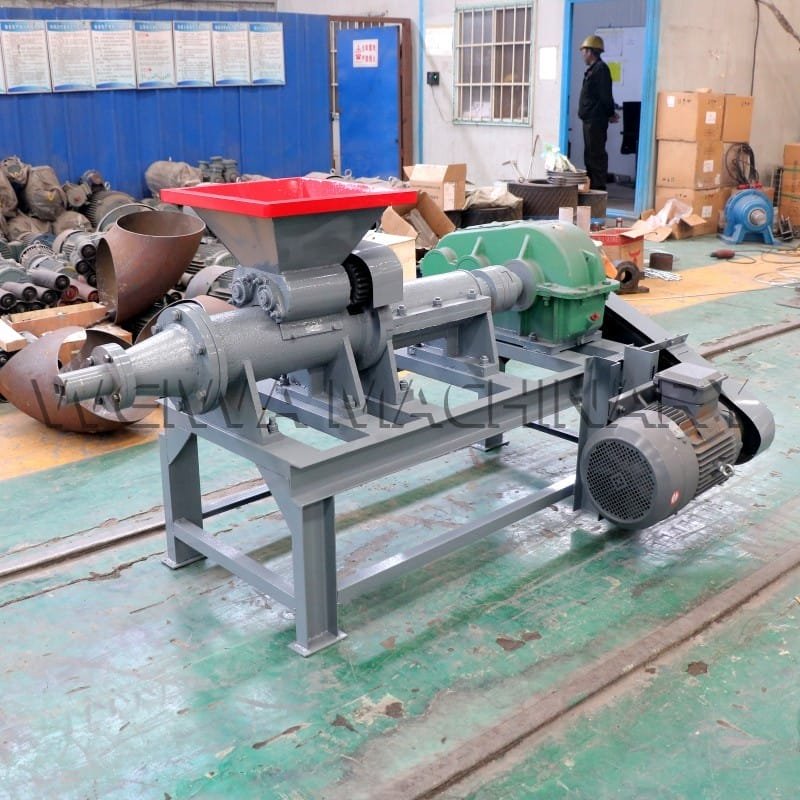
From Our Workshop in Henan to the Port Bound for Congo
The Congolese client first contacted us through WhatsApp in March. He sent two photos: one of locally screened wood charcoal powder mixed with palm kernel shell char, and one of a roadside BBQ stall in Pointe-Noire burning irregular lump charcoal with heavy smoke. His brief was clear. He wanted a charcoal extruder machine in Congo that could run on unstable voltage, handle powder finer than 3 มม., switch between round BBQ sticks and 33 mm hexagonal rods, and survive a 200 km truck ride from Matadi port to his shed without the gearbox loosening.
We invited him to a video call, then ran a bench trial with a simulated Congo sample. The sample arrived by courier: 70 mesh wood char, 9 percent moisture, 15 percent mineral coal fines added by local brokers. Our engineer adjusted the binder ratio to 6 percent cassava starch slurry and 14 percent water, ran the screw at 52 rpm, and extruded a continuous rod that cooled without cracking. We recorded the density at 1.25 g/cm³ and burned a 10 cm segment beside imported lump charcoal. The extruded rod lit faster, held a calmer flame, and left less than half the ash.
After the trial, the real work began. The charcoal extruder machine frame was built from national certified carbon steel. The motor was wound with 100 percent copper coil rated for 22 kW at 380 V, with a variable frequency drive so the client can slow the screw when feedstock is wet. The propulsion shaft carried a high manganese alloy propeller machined to 0.2 mm tolerance. The gearbox was a hardened ZQ unit filled with extreme-pressure oil. We bolted the die head with six hex socket caps so a local mechanic can swap molds in under twenty minutes.
Packaging followed our Africa protocol. Every rotating part was coated with anti-rust oil, then the whole coal rod machine in Congo was wrapped in thick plastic film, including the motor and coupling. We placed the extruder inside a custom iron box with wooden reinforcement panels and shock-absorbing foam at the base. The crusher and mixer went into separate wooden crates labeled in French and English. The dryer disassembled into three sections to fit the container height. Ms. Wang, our logistics lead, printed a packing list with HS code 8474.80, marked “charcoal briquette machine line, not hazardous, no battery,” and forwarded it to the freight forwarder for the Shenzhen–Durban–Matadi route.
On loading day, Mr. Li from production and Mr. Zhang from export sales stood by the container. The crane lifted the iron box first, then the crates. Our QC inspector tapped each crate with a rubber mallet to confirm no loose bolt sound. The client watched live on video. When the last pallet of spare propellers slid in and the doors closed, Mr. Zhang sent one sentence on WhatsApp: “Your coal rod machine in Congo is on the water. We will be online for commissioning.”
Why Congo Is a Natural Market for a Coal Rod Machine?
The Republic of Congo and the broader Congo Basin share a paradox. Urban households in Brazzaville and Pointe-Noire still cook on charcoal. Roadside grills sell roasted fish and plantain over solid fuel every night. At the same time, sawmills around Ouesso and timber yards near the coast dump sawdust, and charcoal traders sweep fine dust off every sack they screen. That dust is unsellable loose, but it is gold inside a charcoal making machine.
A coal rod machine in Congo closes the loop. It takes what used to be waste and turns it into 20–40 mm rods that stack tightly in a 25 kg sack. Transport cost per kilogram drops because hexagonal and square rods pack denser than round lumps. Retail vendors prefer uniform shape because customers trust a stick that looks the same every time. Wholesale buyers in Kinshasa and Lubumbashi resell Congolese rods across the border, which means a small workshop in Pointe-Noire can serve four countries if quality holds.
Government policy nudges the same direction. The Congo government’s green economy references, combined with NGO clean-cooking programs funded from Europe, reward any producer who can show lower deforestation pressure. A charcoal briquette machine that reuses existing charcoal fines does exactly that. It does not need fresh trees. It needs dust that already exists in the supply chain.
Power remains a constraint, but not a blocker. Our Congo-bound charcoal extruder machine ships with a VFD and a soft starter. Many clients run the 22 kW extruder on a 50 kVA diesel generator during daytime and switch to grid power at night. The mixer and crusher draw far less. A 100 kVA generator covers a full line if the dryer is the mesh belt type with insulated panels.
Labor is available. Collection of charcoal dust is informal and cheap. Bagging rods is light work. The skill gap is not in operation but in binder tuning, and that is why our export desk shares a one-page moisture and starch table with every Congolese buyer before the container leaves China.
What a Charcoal Extruder Machine Actually Does?
Many buyers confuse a charcoal extruder machine with a roller press or a hydraulic briquette machine. The screw extruder is different. It does not press powder between two rollers. It drags wet powder forward with a rotating screw and squeezes it through a heated die head until the material plasticizes and exits as a self-supporting rod.
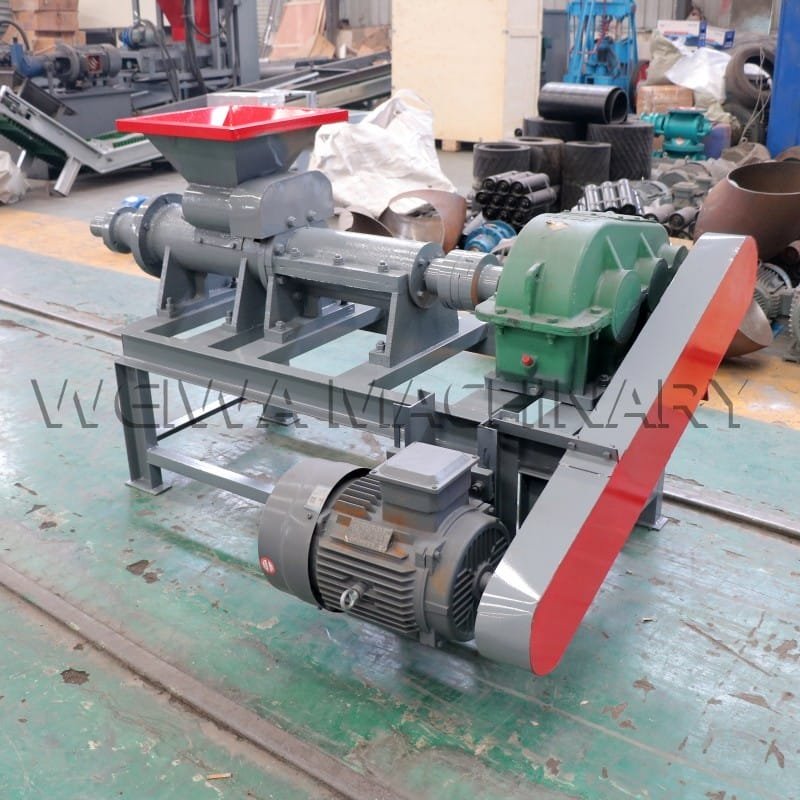
Screw Extrusion Instead of Hydraulic Pressing
In a Weiwa charcoal extruder machine, the motor sends torque through a triangle belt to the gearbox. The gearbox output couples to the propulsion shaft through a floating coupling that absorbs misalignment. On the shaft sits the high manganese propeller. As powder drops from the hopper, the propeller bites it, compresses it against the barrel, and pushes it toward the die. Pressure rises from near zero at the hopper to roughly 35–45 MPa at the die throat. The friction heats the mass to 80–110 °C. No external burner is required for most charcoal fines because the binder gels from screw heat alone.
This matters for Congo because screw extrusion gives continuous output. A roller press pulses. A hydraulic press cycles. A screw machine, once tuned, runs for eight hours and only stops when the hopper empties. For a wholesale charcoal rod business, continuity is revenue.
Die Head and Mold Shapes Congolese Buyers Ask For
The die head is a removable block of #45 steel with a bored profile. The standard request from a coal rod machine in Congo buyer is three molds: อัน 28 mm cylinder for household BBQ, อัน 33 mm hexagon with a 5 mm central hole for premium grill sticks, and a 30 mm square column for bakery ovens and fish smoking. Weiwa machines the mold to ±0.1 mm and hardens the inner surface to HRC 50. When the client wants to change shape, he loosens six bolts, pulls the old die, slides the new one, and retightens. No lathe required on site.
Shape is not cosmetic. A hexagon packs tighter than a circle. A square rod radiates heat evenly for smoking fish. A cylinder ignites fastest for street corn sellers. A charcoal extruder machine in Congo earns its price only when the mold set matches the local resale channel.
Full Charcoal Making Machine Line Behind One Coal Rod Machine
A single screw extruder is never the whole business. The charcoal making machine line around it decides whether rods come out cracked, soft, or premium. For the Congo order we configured four upstream and downstream stations.
Crushing and Sieving Under 3 มม.
Raw charcoal from Congo comes in chunks, fines, and occasional nail-sized shell fragments. The hammer crusher reduces oversize to under 3 มม.. A vibrating screen separates the fraction above 3 mm and returns it to the crusher. If the feed is already fine, the client skips crushing. But most Congo samples we receive run 30 percent oversize, so the crusher pays for itself in two months.
Wheel Mixing With Cassava Starch Binder
The grinding wheel mixer is the quiet hero. Charcoal powder alone will not hold shape. The operator adds 6–8 percent cassava starch slurry and 12–16 percent water. The wheel rotates, the scraper moves material from edge to center, and after nine minutes the mass rolls into balls that flatten slowly under thumb pressure. That plasticity window is where a charcoal extruder machine performs best. Too dry and the screw chatters. Too wet and the rod smears at the die. Our Congo client settled on 6 percent starch and 14 percent water after two trial batches.
Drying the Extruded Rods in Tropical Humidity
Fresh rods exit the die at 90 °C and semi-plastic. They need thirty to fifty minutes of controlled cooling. In Congo’s coastal humidity, sun drying alone fails in rainy season. We supplied a three-layer mesh belt dryer with 18 kW electric heating and a biomass burner option. The rods sit on stainless mesh, hot air passes bottom-up, and moisture drops from 18 percent to 6 percent before bagging. A charcoal briquette machine line without a proper dryer ships defective rods to market.
ROI Reality for a Charcoal Briquette Machine in Central Africa
Buyers ask the same question in every Congo call: how fast does the machine pay back? Based on three Weiwa lines running in Pointe-Noire, Kinshasa, and Lubumbashi, อัน 1.2 ton per hour coal rod machine in Congo configuration costs roughly 38,000–46,000 USD landed, including crusher, เครื่องผสม, extruder, เครื่องเป่า, spares, and sea freight to Matadi. Local charcoal dust purchases at 60–90 USD per ton. Cassava starch at 400 USD per ton blended at 6 percent adds about 24 USD per ton of rods. Power and labor run another 30 USD per ton. Total production cost lands near 140–180 USD per ton of finished rods.
Wholesale rod charcoal in Pointe-Noire sells at 280–340 USD per ton in peak BBQ season. Even at the low end, gross margin clears 100 USD per ton. ที่ 1.2 tons per hour and single-shift operation, daily output is roughly 10 ตัน. That is 1,000 USD daily gross margin, 25,000 USD monthly, and payback inside seven to nine months before financing cost. Buyers who add a second shift and lock a supermarket contract recover capital in under six months. A charcoal extruder machine in Congo is not a charity purchase. It is a small factory with a nine-month clock.
The risk is not the machine. The risk is feedstock consistency. Congo charcoal dust varies by region, by kiln, and by broker. That is why Weiwa insists on a 2 kg sample before deposit. We sieve it, burn it, and tell the client which binder works. Skipping this step is the number one reason briquette startups in Africa fail.
Why This Congolese Buyer Chose Weiwa Machinery?
He compared three suppliers. Supplier A offered a cheaper screw extruder with a cast iron propeller. We have seen those propellers wear flat in three weeks on shell char. Supplier B pushed a hydraulic press at 18 ton pressure, but hourly output was 250 กิโลกรัม, too low for wholesale. Weiwa presented the Model 160 with a forged high manganese propeller, a ZQ gearbox, VFD control, three molds, French labels, and a factory layout drawing adapted to a twelve-meter shed with a corrugated roof.
During the acceptance test, the client’s brother flew to Zhengzhou. He watched the line crush 200 kg of simulated Congo sample, mix it, extrude hexagon rods, dry them, and bag them. He measured rod length with a ruler, dropped a rod from 1.2 m onto concrete, and inspected the edges. Then he opened the gearbox cover with our engineer and looked at the bearings. That visit closed the deal. A charcoal briquette machine is a long-term neighbor, not a parcel. The buyer wanted to meet the neighbor before moving in.
Weiwa’s export desk now sends the Congo client a weekly check-in for the first three months. The first container carried a digital manual, a wiring diagram, a mold drawing, and a spare parts list priced in USD. If the client upgrades to a 5 ton per hour line next year, we can dispatch a technician to Matadi for on-site commissioning once visa and accommodation are handled locally.
เกี่ยวกับ เครื่องจักร Weiwa
Weiwa Machinery is a Chinese manufacturer with more than thirty years of working experience in briquette presses, เตาถ่าน, crushers, เครื่องผสม, and drying systems. We are not a trading company reselling unknown brands. We build the frames, machine the screws, wind the motors, wire the cabinets, and load the containers ourselves in Henan. Our equipment runs in over 130 ประเทศ, รวมถึงอินโดนีเซียด้วย, อินเดีย, ประเทศมาเลเซีย, เวียดนาม, ไก่งวง, โปแลนด์, แอฟริกาใต้, and across Central Africa.
Every charcoal extruder machine leaving our workshop passes three test stages: static inspection, no-load run, and load run with real charcoal powder. Our after-sales team answers in English and French on WhatsApp. We provide custom site layout drawings, voltage adaptation, mold design, and spare part kits sized to the first 2,000 operating hours. For a coal rod machine in Congo, we also pre-install French safety labels and bundle a cassava starch mixing chart tuned to tropical humidity.
If you are evaluating a charcoal making machine line for Congo, Gabon, Angola, or any Central African market, send us two kilograms of your local charcoal powder. We will run a free bench trial, return pressed samples, and quote a full line with ocean freight to your nearest port. Customization is not an upsell. It is how the machine survives its first rainy season.
Contact Weiwa Machinery directly:
ม็อบ / WhatsApp: +8613838093177
อีเมล: info@cjlmachineGroup.com
Whether you need a single charcoal extruder machine in Congo, a full charcoal briquette machine plant, or a turnkey coal rod machine in Congo with dryer and generator set, our engineering desk will reply within one working day. The container in this story is already at sea. Yours can be the next one loaded under the same steel shutter in Zhengzhou.


 Wechat

 +8615937143060
