


Horizontal Carbonization Furnace Shipped to Nepal – On-Site Delivery and Charcoal Making Guide with Charcoal Kiln
Early this month, Weiwa Machinery completed the factory test, anti-rust treatment, and container loading of a complete horizontal carbonization furnace bound for Kathmandu, Nepal. This shipment marks another milestone in our long-term commitment to supplying reliable charcoal making machine solutions across South Asia.
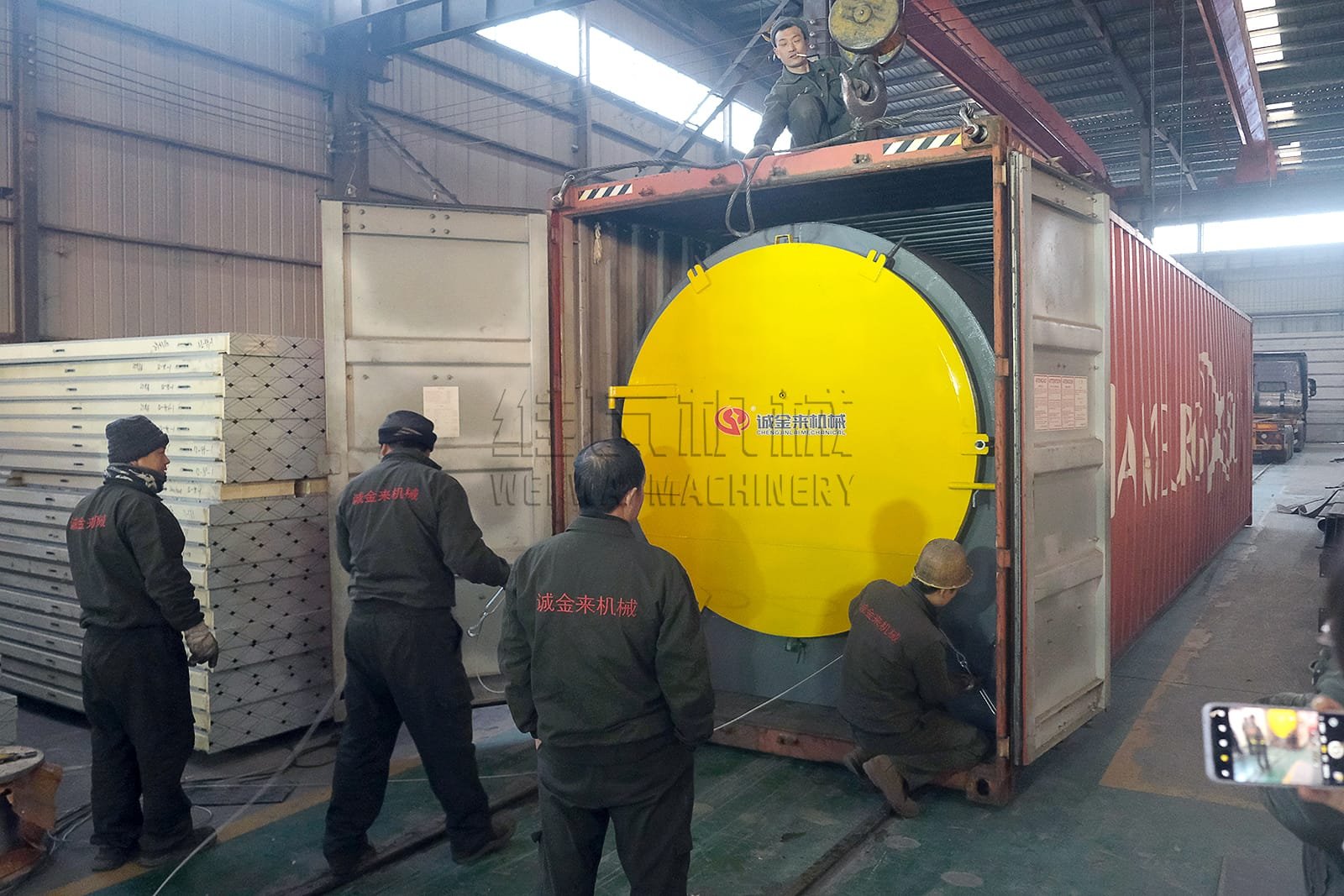
Shipment Scene – Loading the เตาเผาคาร์บอนแนวนอน for Nepal
The ordered unit is a rail-mounted barrel-style horizontal carbonization furnace with a 1.5 m diameter carbonization chamber, suitable for 700–1000 kg per batch. Before packing, our QC team ran a no-load heating trial to verify the thermocouple accuracy, gas recirculation valve response, and door-seal integrity using ceramic fiber packing. Photographs taken on site show the furnace body, smoke purification tank, combustion chamber, and spare parts crated on European-standard pallets. The main body was skidded and pulled into a 40-foot high-cube container with heavy-duty ratchet straps and angle iron bracing to prevent shifting during ocean and overland transport to the horizontal carbonization furnace in Nepal customer’s warehouse in the Kathmandu Valley.
Accompanying documents included a bilingual operation manual in English and basic Nepali terminology, a certificate of conformity, packing list, commercial invoice, and a one-year warranty sheet issued by Weiwa Machinery. Our sales engineer also scheduled a remote video commissioning session so the end-user can confirm utility connections—LPG or recovered syngas, cooling water inlet-outlet, and exhaust piping—before the first firing of the charcoal making machine.
What Is a Horizontal Carbonization Furnace and How Does This Charcoal Maker Work?
Basic Principle of Anaerobic Pyrolysis in a Charcoal Kiln Alternative
Unlike an open charcoal kiln built from mud or brick that relies on partial combustion and suffers from uneven temperature, a horizontal carbonization furnace carries out pyrolysis in a sealed, oxygen-deficient chamber. Raw biomass—typically wood logs, bamboo sections, หอยมะพร้าว, or sawdust briquettes—is loaded onto a cart and pushed into the horizontal barrel. After sealing the door, the external burner raises the internal temperature to 180–220 °C for predrying, then to 400–600 °C for the actual carbonization phase. Volatile matters such as tar vapor, acetic acid mist, and combustible gas are drawn into the purification system. The cleaned gas is partly recycled to the combustion chamber as supplementary fuel, which significantly cuts external energy consumption compared with a conventional charcoal kiln.
Key Components of the Charcoal Making Machine Supplied to Nepal
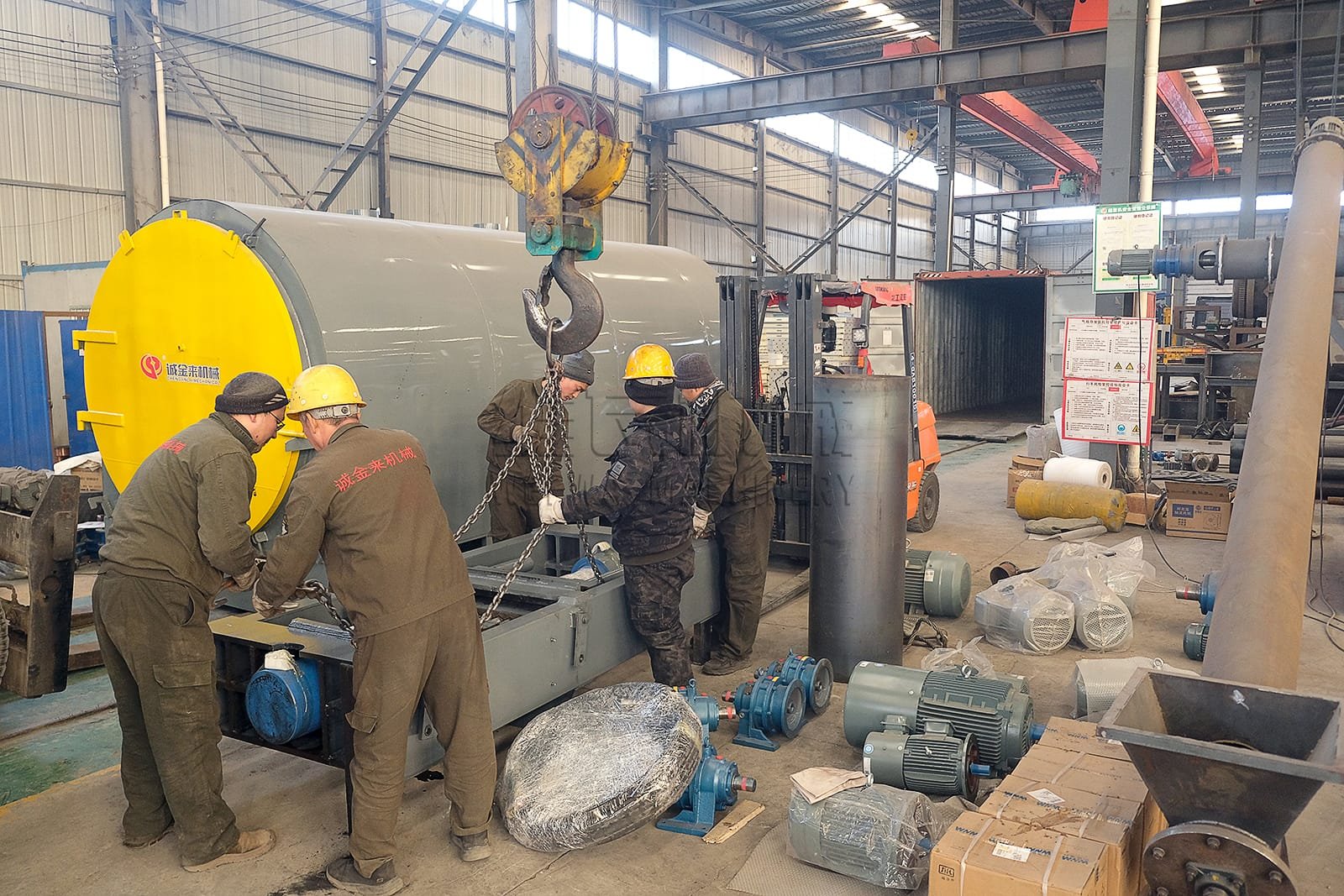
ที่ เครื่องทำถ่าน exported to Nepal consists of the horizontal retort body with three-layer insulation (inner high-temperature steel plate, middle aluminum silicate fiber, outer painted steel casing), a gas condensation and tar separation tank, a secondary combustion chamber, a water-spray cooling jacket, and a PLC-based temperature indicator with over-temperature alarm. The rail system allows the material cart to be rolled out after cooling, minimizing labor and avoiding contact with hot charcoal. All wetted or high-heat parts comply with Chinese national standard GB/T specifications and carry CE-related test reports on request.
Typical Carbonization Cycle of a Charcoal Maker
For hardwood with moisture below 15 เปอร์เซ็นต์, a full cycle in this charcoal maker runs approximately eight to ten hours: two hours for heating and moisture removal, four to five hours for main carbonization, and two to three hours for natural or water-assisted cooling before discharge. Coconut shells and bamboo may require slightly adjusted soaking time at peak temperature to achieve uniform fixed carbon content. The operator monitors the process through the dial thermometer and adjusts the auxiliary burner air damper. No smoke escapes to the atmosphere because the entire off-gas stream passes through the closed purification loop—one of the biggest environmental advantages over a traditional earth charcoal kiln.
Why the Horizontal Carbonization Furnace in Nepal Market Is Gaining Momentum?
Nepal’s Biomass Resources Suitable for a Charcoal Kiln Replacement
Nepal has substantial annual residues of sal wood branches, bamboo from community forests, rice husk in the Terai region, and imported coconut shells used by the incense and activated carbon cottage industries. Traditional pit burning or beehive charcoal kiln methods yield only 18–22 percent charcoal by weight and emit heavy smoke. A professionally engineered horizontal carbonization furnace in Nepal context can raise yield to 28–33 percent fixed carbon with uniform quality, which translates into higher resale value for BBQ charcoal, metallurgical reducing agent, or activated carbon precursor. นอกจากนี้, the gas-recycling feature aligns with Nepal’s increasing emphasis on cleaner small-scale industry under its national air quality management framework.
Power Reliability and Space Considerations for Charcoal Making Machine Installation
Many Nepali workshops face intermittent three-phase power supply. The base model of our เครื่องทำถ่าน requires only a small 0.55 kW exhaust fan and a circulating pump, both operable on a domestic single-phase line or a small diesel generator. The horizontal layout also occupies less headroom than a vertical hoisting furnace, which is advantageous in factories with low eave height common in industrial estates around Bhaktapur and Lalitpur. For customers wanting larger throughput, parallel battery configurations of the same เตาถ่านแนวนอน model can be installed sharing one common gas purification station.
Economic Perspective – From Charcoal Kiln to Industrial Charcoal Maker
Although the initial investment in a charcoal maker of industrial grade exceeds that of building several mud charcoal kiln units, the payback period is often under fourteen months when factoring in higher yield, reduced wood consumption per ton of saleable charcoal, saved labor for loading-unloading, and the possibility of selling by-products such as crude wood vinegar after simple settling. Several of our Sri Lankan and Indian clients operating similar biomass profiles reported 30–40 percent net margin improvement after switching from traditional kilns to the horizontal carbonization furnace system supplied by Weiwa Machinery.
Comparison Between Traditional Charcoal Kiln and Horizontal Carbonization Furnace
A traditional brick or earth charcoal kiln is cheap to construct but difficult to control. Temperature gradients inside the pile cause some wood to over-char into ash while other sections remain under-carbonized. Ignition of the pile is manually timed and smoke suppression is nearly impossible. By contrast, the horizontal carbonization furnace provides a closed reactor with monitored temperature zones, flameless exhaust gas combustion, and consistent residence time per batch. The charcoal produced by the charcoal making machine shows lower moisture uptake during storage, denser structure, and more uniform size—key traits for export-grade BBQ charcoal preferred by buyers in the Middle East and Europe who sometimes source indirectly from Nepal via trading hubs.
It is worth noting that some Nepali entrepreneurs start with one horizontal carbonization furnace to establish product quality and later add a second unit or a briquette press to utilize sawdust that would otherwise be discarded. This staged expansion path is common among charcoal maker startups in developing markets and is fully supported by our optional layout design service.
After-Sales Support for Horizontal Carbonization Furnace in Nepal and Spare Parts
Weiwa Machinery provides a full English video library covering daily startup, shutdown, door gasket replacement, tar-tank cleaning interval, and troubleshooting of thermocouple deviation. Critical spares such as ceramic packing strips, pressure relief valves, and thermocouple probes are shipped together with the charcoal making machine order or can be air-freighted from our Zhengzhou warehouse. For major installations of the horizontal carbonization furnace in Nepal or neighboring countries, we can dispatch a technician subject to visa and insurance arrangements. All correspondence is handled via email and WhatsApp to ensure quick response irrespective of time zone difference.
เกี่ยวกับ เครื่องจักร Weiwa
เครื่องจักร Weiwa (เครื่องจักร Wei wa) is a professional manufacturer of biomass carbonization and briquetting equipment based in Zhengzhou, จีน. With decades of engineering experience, we design and export horizontal carbonization furnace, hoisting carbonizer, continuous carbonization line, and complete charcoal making machine plants to more than forty countries across Asia, แอฟริกา, Europe, and the Americas. Our factory covers a large modern workshop equipped with CNC cutting, welding, and pressure-test facilities. Every charcoal maker we produce undergoes a pre-delivery run test. We also offer customized capacity planning, foundation drawing, and on-site or remote guidance for installation and operator training.
If you are exploring a horizontal carbonization furnace in Nepal or comparing a modern system against a traditional charcoal kiln, contact our sales team for a tailored proposal matching your raw material type and daily output target.
Contact Weiwa Machinery:
ม็อบ / WhatsApp: +86 138 3809 3177
อีเมล: info@cjlmachineGroup.com


 Wechat

 +8615937143060
