


Kenya Charcoal Market and Why a เตาเผาคาร์บอนแนวนอน Fits
Kenya consumes large volumes of charcoal for urban cooking and rural heating, yet most of that charcoal still comes from earth mound kilns that waste wood, emit thick smoke, and give inconsistent quality. A horizontal carbonization furnace changes the equation because it carbonizes biomass inside a sealed barrel chamber, recycles its own pyrolysis gas, and cools the batch in a controlled way. For a Kenya buyer who previously burned one ton of wood to get two hundred kilograms of marketable charcoal, moving to a charcoal making machine for Kenya that recovers tar and condensate is not a luxury, it is a margin decision.
Biomass Waste Available to Kenya Producers
Kenya has steady supplies of coconut shell from the coast, maize cob and rice husk from irrigation belts, coffee husk from central highlands, and croton nut shell from arid counties. All of these are excellent feedstock for a horizontal carbonization furnace when moisture stays under thirty percent. Unlike a continuous rotary kiln that prefers uniform small chips, the horizontal barrel chamber accepts logs up to a certain length, basket loaded briquettes, and shell mixes without pre crushing everything. That flexibility matters in Kenya where raw material shape varies by season.
Policy Shift Away from Earth Kilns
Government pressure on open burning, forest logging bans, and county level air quality rules push producers toward enclosed equipment. A charcoal making machine for Kenya that can show reduced smoke and tar recovery on site has a better chance of passing inspection and winning cooperative or NGO funded projects. Weiwa designed the horizontal carbonization furnace with this compliance path in mind, not only with private resellers.
What a Horizontal Carbonization Furnace Does in Simple Terms?
A horizontal carbonization furnace is a barrel style chamber mounted on rails, enabling easy loading via carts and gradual carbonization under indirect heating. Its compact footprint and advanced gas purification system allow it to recycle tar and condensates, feeding clean combustible gas back into the burners to sustain internal temperatures near 600 C, thus reducing fuel consumption and smoke. Designed for wood logs, ไม้ไผ่, หอยมะพร้าว, sawdust briquettes, และสารตกค้างทางการเกษตร, this model excels in balanced heat distribution and automation, offering low maintenance and high charcoal yields for small to medium scale producers.
Indirect Heating and Gas Recycling Explained
The furnace does not burn the raw wood directly. It heats the chamber from outside while the biomass inside breaks down anaerobically. Volatile gases escape, pass through a condensation and purification stage, drop their tar, and the cleaned gas returns to the burner as supplementary fuel. In the Kenya trial we measured external firewood use drop by roughly thirty percent after the second batch because the furnace was eating its own gas. That is the core selling point of any horizontal carbonization furnace in Kenya where firewood purchase price eats profit.
Why Kenya Buyers Compare It with Other Charcoal Making Machines?
Weiwa also makes hoisting carbonization furnaces and continuous carbonization plants. The hoisting model lifts inner pots vertically and suits tight height workshops. The continuous model suits sawdust and rice husk at scale. The horizontal carbonization furnace sits between them: batch style, rail cart loading, lower height than vertical pots, bigger door than a rotary kiln, and simpler control than a fully automatic line. For a Kenya client doing two to four batches per day with three laborers, it is usually the safest first charcoal making machine.
Inside the Weiwa Shipment Headed to Kenya
The container we sent contained the main horizontal barrel with refractory lining, the rail track and loading cart, the combustion chamber with dual burners, the gas purification tower with tar collection drum, the water cooling jacket pipe set, the PLC control box with temperature sensors, and a crate of graphite seals and pressure gauges. We wrapped the barrel in moisture proof film, bolted the rail assembly to a steel skid, and printed Swahili and English labels on the control panel after the client asked for bilingual marks.
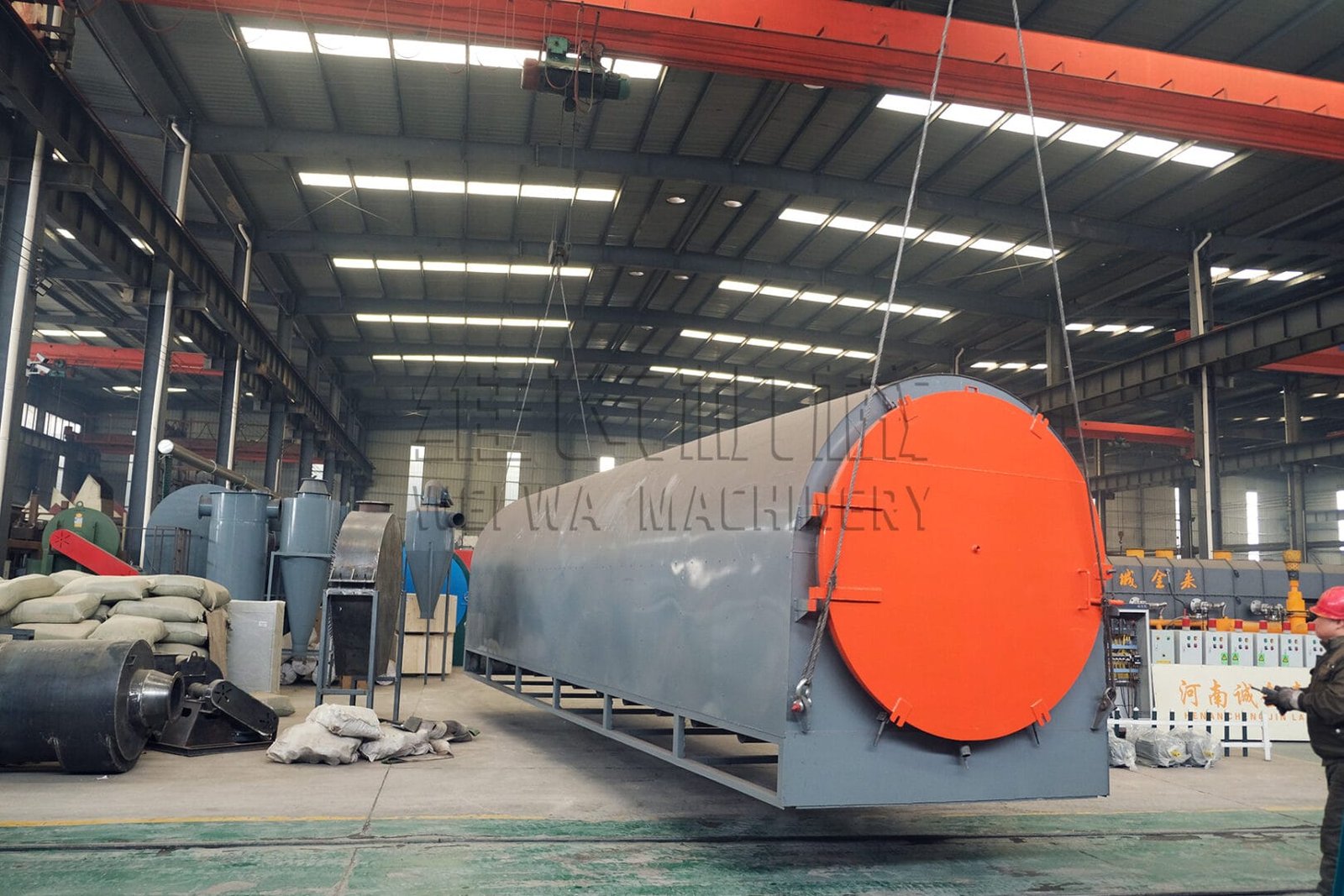
Factory Loading and Rail Mounted Barrel Chamber
Because the horizontal carbonization furnace features a barrel style chamber mounted on rails, our team rolled the filled cart into the barrel during the factory trial so the Kenya buyer could watch loading on video. The cart carries roughly eight hundred kilograms of mixed hardwood per batch. Two workers push it in, the door hydraulically clamps, and the seal inflates. No crane is needed on site, which removes a common headache for charcoal making machine for Kenya installations outside Nairobi.
Spare Parts and Operator Training Pack
Every Weiwa horizontal carbonization furnace export includes a training USB with procedure drawings, a printed startup checklist, and a spare parts list priced separately. For Kenya we added extra door gaskets and a spare thermocouple because humidity near Mombasa can shorten sensor life. The client also received a WhatsApp video call schedule for the first three batches, which is part of how Weiwa supports a charcoal making machine for Kenya order after the container clears customs.
On Site Trial Run Results in Kenya
The Kenya team ran three batches in the first week. Batch one was dry Acacia log cuts. Batch two was coconut shell from Kwale. Batch three was a mix of coffee husk briquette and maize cob. All three reached carbonization temperature and produced sellable charcoal.
Temperature Curve Near 600 C and Cycle Time
After sealing, the burner raised chamber temperature to 180 C for drying, held 280 C for one hour, then climbed to 580 ถึง 610 C for the main carbonization window. The horizontal carbonization furnace sustained 600 C for about four hours using mixed external firewood and recycled gas. Total cycle from cold start to safe open was roughly fourteen hours, including water cooling. That matched our factory number and gave the Kenya buyer confidence the furnace was not oversold.
Charcoal Yield and Fixed Carbon Observation
From eight hundred kilograms of seasoned Acacia input, the client collected two hundred and forty kilograms of solid charcoal, about thirty percent yield, better than the eighteen to twenty two percent he reported from earth kilns. A local laboratory strip test showed low ash and strong fixed carbon feel. While we did not run a full proximate analysis on site, the fracture sound and water sink test both indicated dense charcoal suitable for Nairobi middle class brazier market, the premium segment for any charcoal making machine for Kenya investor.
Smoke Reduction and Tar Condensate Recovery
During the first hour the chimney showed light steam. After gas routing engaged, visible smoke dropped sharply. The purification drum collected roughly six liters of brown tar condensate per batch, which the client stored for further wood vinegar testing. Neighbors who normally complain about kiln smoke visited the site and stayed for tea, which in rural Kenya is the real air quality certificate for a horizontal carbonization furnace.
Horizontal Carbonization Furnace in Kenya Buying Checklist
Weiwa prepared a pre order checklist for Kenya buyers so they do not size the machine wrong. A charcoal making machine for Kenya must fit raw material shape, labor skill, and county power reality, not just price budget.
Matching Feedstock Size to Furnace Volume
If the client mainly has coconut shell and sawdust briquette, a smaller horizontal carbonization furnace volume of three cubic meters is enough. If they buy whole sun dried mango branches from farms, they need the wider barrel and a cart with adjustable divider. Oversizing wastes steel and cooling water. Undersizing forces overnight double shifts. Weiwa sizes the barrel after seeing two photos of the raw material, not after a phone quote.
Power Water and Workshop Footprint in Nairobi or Rural Counties
The horizontal carbonization furnace itself runs mostly on gas and gravity, but the water cooling jacket needs a tank and a small pump, and the PLC needs stable single phase power. In rural Kenya where voltage dips at night, we supply a voltage stabilizer inside the control box. Footprint is about six meters by four meters with cart clearance. That fits a half acre charcoal yard easily. A charcoal making machine for Kenya in Nairobi industrial area may need louder burner silencers, so we swap the fan housing on request.
Why Weiwa Machinery Recommends This Model for Kenya?
Weiwa Machinery has shipped carbonization equipment to more than fifty countries. The horizontal carbonization furnace keeps winning Kenya orders because it balances three things African buyers repeat in every call: low smoke, fair price, easy fix. The rail cart removes crane cost. The gas recycle cuts firewood bills. The barrel lining can be patched locally by any welder who has seen a kiln. Spare seals arrive by courier from China in five days. For a first time charcoal making machine for Kenya entrepreneur, that combination reduces the chance of a stranded project.
The model also scales. A producer can start with one horizontal carbonization furnace doing three batches a day, then add a second barrel sharing the same purification tower. When volume passes two tons of charcoal per day, Weiwa upgrades the client to a continuous carbonization furnace and keeps the first horizontal unit as a backup or for odd shaped logs. That upgrade path is why we do not push the most expensive machine on day one.
Contact Weiwa Machinery for Kenya Delivery
If you are comparing a horizontal carbonization furnace in Kenya with imported vertical kilns or local drum modifications, send Weiwa Machinery your raw material photos, moisture level, and daily target. We will send a layout drawing, a cycle calculation, and a container packing list with Swahili panel option. We reply on WhatsApp, email, and phone within one working day.
Contact: ม็อบ +8613838093177, Whatsapp +8613838093177, Email info@cjlmachinegroup.com.
Weiwa Machinery is a Henan based manufacturer with three decades of experience in biomass carbonization and charcoal production lines. Our flagship products include horizontal carbonization furnaces, เตาเผาคาร์บอนอย่างต่อเนื่อง, เครื่อง briquette, and turnkey charcoal making machine systems for wood, กะลา, แกลบ, and agricultural residue. We have served more than two million customers across Africa, Asia, และละตินอเมริกา, and we provide factory trial videos, spare parts kits, and remote commissioning for every charcoal making machine for Kenya order.


 Wechat

 +8615937143060
