


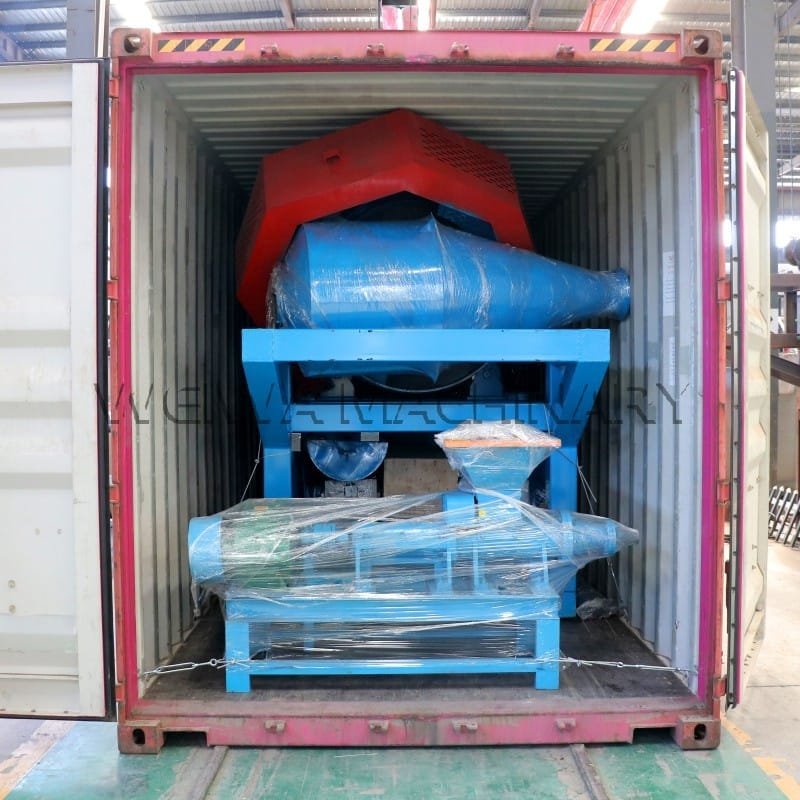
Tajikistan is a mountainous, energy-sensitive country. Urban cafés in Dushanbe and Khujand want uniform BBQ sticks. Rural households in Khatlon and Badakhshan still burn loose coal or irregular kiln charcoal for winter heating. A charcoal extruder machine in Tajikistan sits precisely between those two needs because one screw press with swappable dies can serve both the 28 mm restaurant stick and the 45 mm square heating brick. That flexibility is the reason Weiwa treats the order as a reference project for the whole Central Asian corridor rather than a one-time export.
Factory Trial Day for the Tajikistan เครื่องขับไล่ถ่าน
The trial began at 9:12 am. Our electrical team connected the 22 kW 100% copper-coil motor to the hardened gearbox, checked rotation direction, and ran the belt drive dry for six minutes. The floating coupling between gearbox output shaft and propulsion shaft was set to 0.3 mm axial play, which is the Weiwa standard for the WB180 class charcoal briquette machine. After the dry run, we fed a 60 kg batch of pre-crushed wood charcoal powder blended with 18% local coal tailing and 4.5% tapioca starch binder.
Material entered the hopper at 21% ความชื้น. The first chamber of the double-stage barrel de-aired the plug while the auger pushed it forward. The second chamber, fitted with a high manganese propeller and a 28 mm cylindrical die, applied the main forming pressure. The first rod exited at 9:41 am. It was 28 mm in diameter, 100 mm long before the auto-cutter, dark grey, smooth surfaced, and rang with a dull metallic tone when tapped. Our technician broke one rod by hand. The cross-section showed no central void, no shell crack, and no soft core.
We switched the die to a 45 mm square profile in 38 minutes. The same powder recipe produced heating-grade bricks at 1.42 g/cm³ bulk density. For comparison, the client’s previous single-layer press from another Henan supplier delivered 1.12 g/cm³ with visible end cracking after the mesh belt dryer. The Tajikistan client joined the trial by video link. He asked for a 33 mm hexagonal hollow die as a third option, which we mounted in the afternoon and ran for 22 minutes at 1.8 ไทย. The motor current stayed at 34 A against a 45 A rated load.
By the end of the day the เครื่องอัดรีดถ่าน had run 240 minutes, consumed 81 kWh, and produced 4.3 tons of mixed rods. Breakage after a simulated 30-minute cooling window was 1.7%. The client sent a confirmation email the next morning.
What a Coal Rod Machine Actually Is?
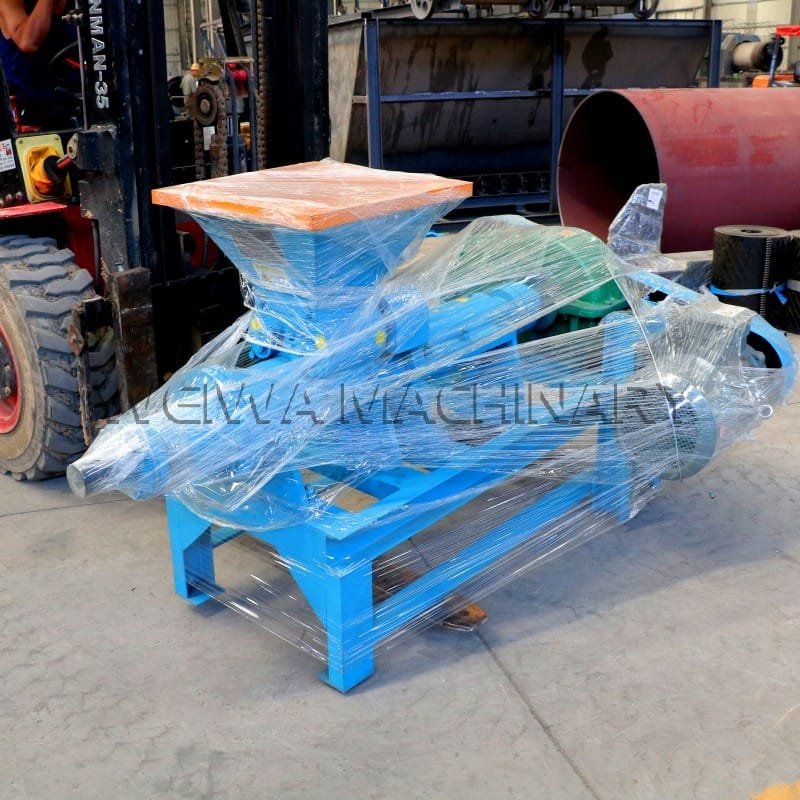
A coal rod machine is a screw-type forming unit that compresses fine coal or charcoal powder into continuous shaped sticks. In many export markets the same equipment is called a charcoal extruder machine, charcoal rod machine, coal stick machine, or charcoal briquette machine depending on the die and the raw material. The common principle is screw extrusion. Powder under 3 mm enters the hopper, a rotating screw conveys it forward, the barrel volume narrows, pressure rises, and the material is forced through a die head into a fixed cross-section.
The coal rod machine in Tajikistan differs from a roller press in three ways. First, it handles finer powder and higher moisture tolerance. Second, it produces hollow or solid rods instead of pillow-shaped pills. Third, it lets the operator change market focus by swapping only the die head rather than the whole compression system. For a small Dushanbe workshop that sells BBQ sticks in summer and heating bricks in winter, that die swap is the difference between one machine and two.
Screw Extrusion Principle in Plain Terms
The motor transmits power to the transmission through a triangle belt. The output shaft of the transmission transmits power to the propulsion shaft through a floating coupling. The propeller on the propulsion shaft pushes the coal material out through the forming die head, and the high pressure coal rod is produced. In a single-layer design one screw does conveying, de-aeration, compaction, and shaping at once. In the Weiwa double-stage design the first screw only pre-compacts and releases trapped air upward through a vent slot. The second screw receives a cohesive plug and applies the main pressure. This split reduces torque spikes, lowers power per ton, and removes the micro-voids that cause drying cracks.
Raw Material Window That Decides Success
เลขที่ เครื่องทำถ่าน can fix bad input. For Tajikistan we advise charcoal powder under 3 มม., moisture 18–22% for BBQ rods and 22–26% for heating bricks, binder 4–6% starch or 2% lignin slurry, and no live embers in the feed. If the raw material is above 3 มม., a charcoal crusher must run before the mixer. If binder is under-gelatinized, rods soften at the surface even when pressure is correct. Our remote training for the Tajikistan team spent 40 minutes on mixer scraper speed and binder tank temperature before discussing die change.
Why Tajikistan Is a Real Market for Charcoal Extruder Machines?
Tajikistan holds substantial coal reserves and faces rising urban energy demand. Market research indicates the national coal briquette segment was valued near USD 232 million in 2025 with steady growth forecast through 2032, supported by rural heating needs, infrastructure projects, and government interest in cleaner compact fuel alternatives. Many local producers still use outdated manual presses or imported single-layer machines that waste binder and generate fragile rods. ที่ coal rod machine in Tajikistan answers three local gaps at once: it upgrades product grade, lowers binder cost through denser compaction, and reduces breakage on mountain roads from Dushanbe to regional towns.
Urban BBQ culture in Tajikistan centers on summer courtyards, café grills, and weekend shashlik vendors. Stick diameter preference sits between 25 mm and 30 mm for household BBQ. Industrial and heating users accept 33 mm to 50 mm hexagonal or cylindrical rods. A single charcoal extruder machine in Tajikistan with three die sets covers both segments. Winter heating policy in smaller municipalities favors dense briquettes over loose coal because dense rods release less fine dust. That regulatory drift toward calibrated size and calorific value is what single-layer machines struggle to hit consistently and what the Weiwa double-stage press holds batch after batch.
Cross-Border Spillover into Uzbekistan and Kyrgyzstan
Weiwa does not treat Tajikistan as a one-time shipment destination. Equipment proven in Tajikistan can be referenced by buyers in Uzbekistan, Kyrgyzstan, and southern Kazakhstan where similar heating and grilling habits exist. Neighboring Uzbekistan already imports Tajik coal, showing cross-border fuel trade will continue. A Tajikistan workshop that brands its 28 mm BBQ sticks can later export to Tashkent or Osh without changing machinery. ที่ charcoal briquette machine therefore acts as a regional entry asset, not a single-country tool.
Machine Configuration We Shipped for the Tajikistan Order
The confirmed configuration was the WB180DL double-stage coal rod machine built on national certified carbon steel base, 22 kW copper coil motor, hardened tooth surface gearbox, floating coupling, high manganese alloy propeller, และ #45 steel die heads. Accompanying line items included a charcoal crusher for input under 3 มม., a grinding wheel mixer for powder and binder, and a mesh belt dryer recommendation for post-forming moisture drop from 21% ถึง 8%.
Die set supplied: 28 mm round for BBQ export, 33 mm hexagonal with center hole for café premium sticks, และ 45 mm square solid for rural heating bricks. Die change takes one worker about 40 minutes including cooling and coupling check. The client can switch market focus without buying a second machine.
Combustion Result from the Trial Batch
In a 500 gram rod burn test using coconut shell and wood charcoal blend, the double stage coal stick machine output sustained measurable heat for 82 ถึง 88 minutes. The old single-layer rod from the same powder stopped at 58 ถึง 64 minutes. Ash content after full burn dropped from 6.8% ถึง 5.1%. Binder in the Tajikistan formula was reduced from 6% ถึง 4.5% because dual compression holds shape mechanically. Lower binder means lower volatile release at ignition and less risk of soft black crust on the rod surface.
Commissioning Steps We Recommend for Tajikistan Buyers
Weiwa sends a commissioning checklist with every เครื่องอัดรีดถ่าน export. The Tajikistan client will follow nine steps after container arrival. First, pour concrete foundation per the layout drawing and align anchor bolts. Second, mount the machine with a level gauge, deviation under 2 mm per meter. Third, connect the 22 kW motor to the local 380 V supply and verify rotation direction. Fourth, run the empty machine for ten minutes and listen for bearing noise. Fifth, pre-gelatinize binder in a heated tank at 60 °C. Sixth, mix charcoal powder, coal tailing, and binder for eight minutes in the wheel mixer. Seventh, feed the hopper at 60% volume for the first hour. Eighth, inspect the first 20 rods for surface and cross-section. Ninth, switch dies and repeat the check.
This sequence prevents the most common failure we see in Central Asia: blaming the เครื่องทำถ่าน for poor raw material preparation. The machine only realizes the potential of a good recipe.
Market Potential for Charcoal Briquette Machine Lines in Tajikistan 2026 ถึง 2030
We expect Tajikistan demand to favor machines with capacity between 1 และ 3 tons per hour, matching CM140 to CM180 class frames. Buyers usually start with one เครื่องอัดรีดถ่าน, add a crusher and wheel mixer, then later invest in a mesh belt dryer. Weiwa supports that roadmap with line layout drawings rather than selling isolated machines. The driver is not only BBQ growth. Winter heating cannot fully switch to gas in mountainous districts. Electricity and LPG prices remain sensitive to regional supply. Youth entrepreneurship programs encourage small manufacturing. Municipal procurement in smaller cities is starting to specify calibrated briquette size and calorific value.
For a 2 t/h workshop the math is straightforward. ที่ 300 working days the double-stage press saves roughly 11% electricity per ton versus a single-layer screw. Binder reduction of 1.5 percentage points on 6 tons per day saves about 90 kg starch daily. Breakage drop from 6% ถึง 1.7% recovers more than 400 kg of sellable rods per day. Combined, those three lines cover a meaningful part of the upgrade cost before counting retail price uplift from grade A uniformity.
Why Tajikistan Buyers Choose Weiwa as the Charcoal Making Machine Partner?
Weiwa Machinery has more than thirty years of working experience in coal rod and charcoal molding equipment. The double stage coal stick machine is not a cosmetic update. ที่ 2026 version shipped to Tajikistan carries five structural revisions compared with our 2021 single-layer export unit: widened gearbox mount, reinforced carbon steel frame, floating coupling upgrade, parallel twin pressure sleeve inside the barrel, and resurfaced high manganese screw. Beyond hardware, the difference is service architecture.
We assign a dedicated after-sales engineer to every Central Asian order. The Tajikistan client received a WhatsApp contact, a 42-page English-Russian manual, a spare parts list with SKU codes, and a layout drawing scaled to his 240 m² workshop. Die drawings, foundation drawings, and electrical wiring diagrams were sent before container departure. Our team joins the first commissioning call by video and stays reachable for the first 60 production days. Customization is not limited to dies. We adjust hopper height for manual bag feeding, move the control box to the left side for right-wall installation, and tune screw pitch for high-fiber biomass blends.
Weiwa Machinery has become the first choice for more than 2 million customers across 130 ประเทศ, รวมถึงอินโดนีเซียด้วย, อินเดีย, ประเทศมาเลเซีย, ลาว, พม่า, เวียดนาม, ฟิลิปปินส์, ปากีสถาน, ไก่งวง, โปแลนด์, อียิปต์, ซูดาน, ประเทศแอลจีเรีย, เอธิโอเปีย, Tanzania, เม็กซิโก, and South Africa. The Tajikistan project follows the same playbook: understand raw material, simulate the recipe in our factory, ship a line not a machine, and train the operator before the first commercial rod.
Contact เครื่องจักร Weiwa for a Tajikistan-Ready Coal Rod Machine
If you are evaluating a coal rod machine in Tajikistan, อัน charcoal extruder machine in Tajikistan, or a complete charcoal briquette machine line, our engineering team can run a material test on your sample powder and propose a layout drawing before you pay a deposit. We welcome factory visits in Zhengzhou and remote video trials in Russian, English, or Chinese.
ม็อบ: +8613838093177
Whatsapp: +8613838093177
อีเมล: info@cjlmachineGroup.com
Weiwa Machinery — thirty years of screw extrusion experience, double-stage coal rod technology, and Central Asia-ready commissioning support.


 Wechat

 +8615937143060
