


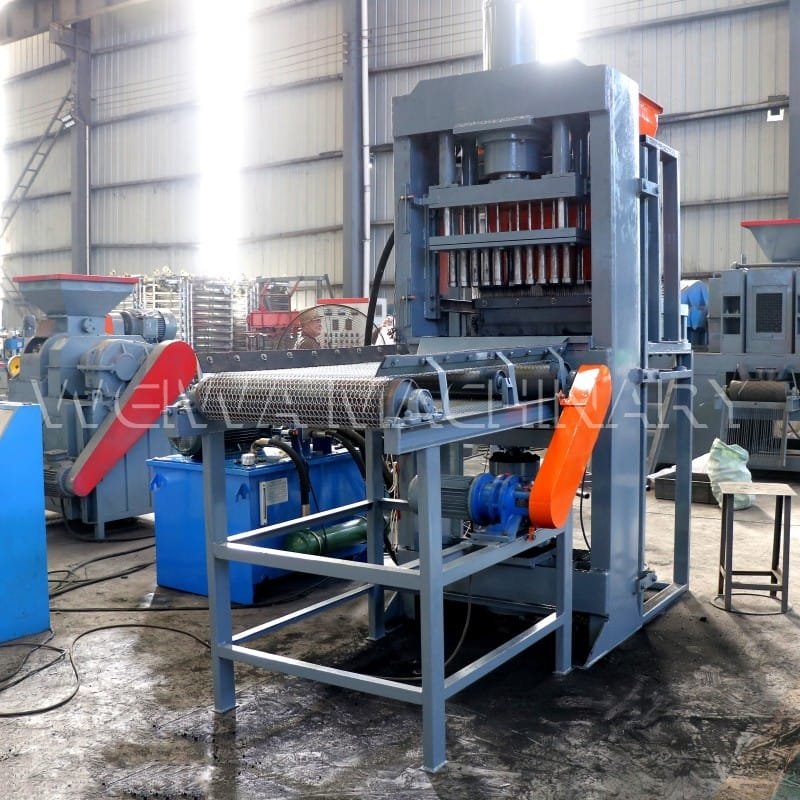
Nigeria has one of the largest solid fuel markets in Africa. Urban cooking, suya grilling, shisha lounges, and outdoor BBQ restaurants all need steady heat. At the same time, नारियल शेल लकड़ी का कोयला, ताड़ की गिरी का खोल, चूरा, लकड़ी का कोयला पाउडर, and coal fines are available in large quantities. The problem is that loose powder has almost no commercial value until it is compressed. A hydraulic briquette press solves this problem by applying controllable static pressure and producing uniform blocks with high density.
Why A Nigeria Client Visited Weiwa Machinery Workshop?
The Lagos client already owned a small manual charcoal shop. He was buying lump charcoal from local kilns, repacking it, and selling to neighborhood vendors. His margin was thin because lump charcoal prices kept moving and breakage during transport reduced his profit. He had watched several machine videos online but did not want to buy a hydraulic briquette machine he had never seen working.
When he contacted Weiwa Machinery, our team did not send only a quotation. We asked for his raw material type, moisture level, target shape, daily output, and local voltage. After reviewing the information, we invited him to the factory for a live trial. This approach is common for serious African buyers because a hydraulic press briquetting machine is not a household appliance. It is a production asset that must prove itself under real material conditions.
How The Hydraulic Press Briquetting Machine Trial Was Prepared?
A good trial is not a sales show. It is a small replica of the client future factory. Before the first pressing cycle, Weiwa engineers prepared the material, checked the hydraulic station, calibrated the PLC, and selected the correct mold. The Nigeria client stood next to the machine and watched every step.
Raw Material Preparation For Nigerian Charcoal Powder
The client brought coconut shell charcoal powder with particle size around 80 mesh and moisture close to 9 प्रतिशत. Our team crushed the material again to below 3 मिमी, because uniform particle size is critical for dense briquettes. After crushing, the powder entered the binder mixer with cassava starch and a small amount of water. Mixing time was around nine minutes. The target was uniform color, no dry pockets, and stable moisture before feeding the hopper.
नाइजीरिया में, binder selection matters because some regions prefer cassava starch while others test gum arabic, molasses, or bentonite clay. The hydraulic briquette machine does not change the binder chemistry, but it delivers consistent pressure so the same recipe gives the same block quality batch after batch.
Hydraulic Station And Pressure Setting
The tested hydraulic briquette press used a 200-ton main cylinder with pressure gauge, relief valve, cooling system, and adjustable pressure curve. For shisha cube format, our engineer set holding pressure at 160 टन, dwell time at 1.2 seconds, and return stroke at 0.8 seconds. For denser BBQ blocks, the second batch was pressed at 185 टन.
Hydraulic pressure behaves differently from roller pressure. A roller press compresses material through rotating pockets, while a hydraulic briquette machine applies static force from the upper head and ejects the block from the lower head. For brittle charcoal powder, static pressure reduces edge cracks and improves surface smoothness. That is why many Nigerian buyers upgrade from roller press to hydraulic press when product quality becomes important.
PLC Control And Mold Change
The machine was equipped with a PLC control cabinet. The Nigeria client tested manual mode first, then automatic mode. He adjusted pressing time, return speed, and cycle count from the touchscreen. The PLC language can be set to English or French, which is useful for West African operations.
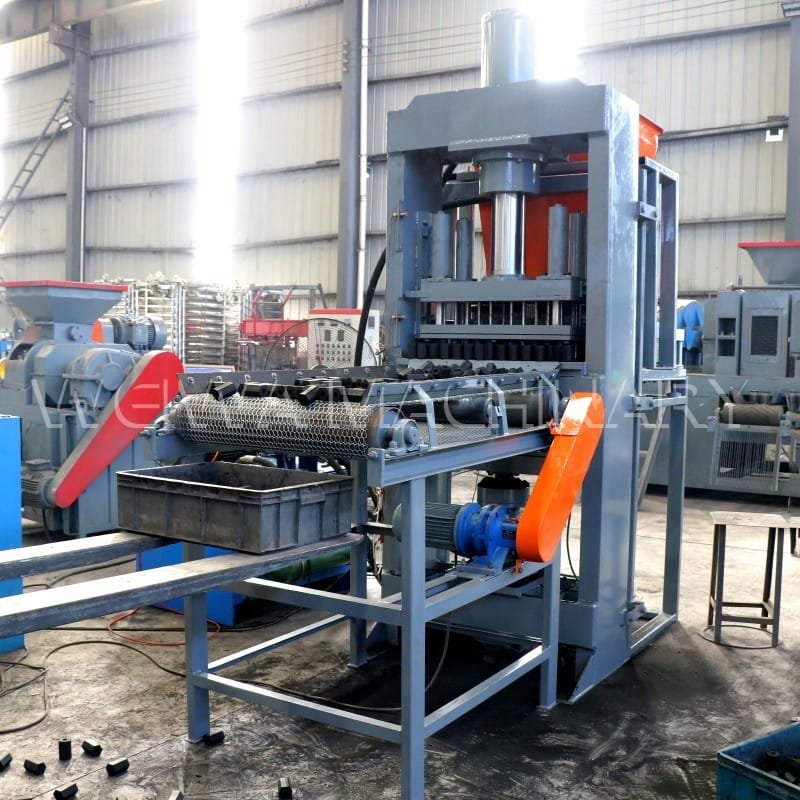
Mold change is another reason hydraulic briquette in Nigeria is attracting investors. With one machine, the client can run cube shisha charcoal, round BBQ balls, finger sticks, hexagon shapes, or rectangular blocks. The trial mold was a 33-cavity finger shape. Our team also showed a 25 mm round mold and a 22 mm hexagon mold. Switching molds took less than twenty minutes.
What The Nigeria Client Saw During Live Pressing?
The hopper was filled, the rear cart pushed material into the cavity, the upper hydraulic head descended, and the lower ejector lifted the finished block onto the discharge belt. The first cube weighed 12.4 grams with size 25 x 25 x 25 मिमी. After five cycles, average density reached 1.08 g/cm³ with zero edge fracture.
The client tapped two cubes together and immediately noticed the difference. His old supplier blocks cracked during drying. The hydraulic press briquetting machine produced sharp edges, smooth faces, and a clean knocking sound. For a charcoal trader, that sound means fewer rejects, better bagging, and stronger resale price in the Nigerian market.
Weiwa engineers also showed discharge consistency. Because the PLC controls cycle time, one operator and one feeder can manage the machine without constantly adjusting mechanical parts. For Nigerian factories with fluctuating labor experience, this stability is a major advantage.
Why Hydraulic Briquette In Nigeria Has Strong Market Potential?
Nigeria is not a small test market. With more than two hundred million people, rapid urban growth in Lagos, Abuja, Kano, Ibadan, and Port Harcourt, and massive agro-waste resources, the country has every condition for briquette business expansion. A hydraulic briquette machine is no longer only an environmental machine. It is a profit center that connects waste material, fuel demand, and local manufacturing.
Raw Material Availability In Nigeria
नारियल के खोल, ताड़ की गिरी का खोल, चूरा, चावल की भूसी का कोयला, लकड़ी का कोयला पाउडर, and coal fines are found across different states. In southern Nigeria, agro-processing waste is common. In northern Nigeria, wood charcoal and BBQ fuel demand remain strong. A hydraulic briquette press allows local entrepreneurs to buy cheap powder, add a low-cost binder, and sell finished fuel at a higher margin.
BBQ And Shisha Charcoal Demand
Suya vendors, buka kitchens, hotel bars, and shisha lounges want uniform heat. Irregular lump charcoal burns unevenly and creates more ash. Machine-made briquettes burn longer, ignite faster, and pack neatly in bags. As Nigerian cities grow, distributors prefer standardized products because they are easier to price, इकट्ठा करना, and deliver.
Waste To High Density Fuel Business Model
The business logic is straightforward. Collect or buy charcoal fines, crush and mix, press with a hydraulic briquette machine, dry the blocks, pack them, and supply local dealers. Raw powder may be inexpensive near kilns. Finished cubes or BBQ balls can sell at a clear premium. With the right mold and pressure setting, one hydraulic press briquetting machine can serve several customer segments at the same time.
Hydraulic Briquette Machine Vs Roller Press For Nigerian Buyers
Many Nigerian buyers start with a roller press because the initial price looks lower. Roller presses can work for oval balls, pillow shapes, and medium-density products. तथापि, when the market demands premium shisha cubes or high-density BBQ blocks, hydraulic pressure becomes more attractive.
A hydraulic briquette machine gives better control over pressing force, longer mold life for complex shapes, fewer cracks on brittle charcoal, and more stable block weight. The investment is higher, but rejection rate drops and product grade improves. For exporters targeting Middle East shisha buyers or high-end Lagos BBQ suppliers, that quality difference can decide repeat orders.
Weiwa Machinery does not say hydraulic is always better. We say the machine must match the product. If the client only makes low-cost ball briquettes, a roller press may be enough. If the client wants finger shisha sticks, cube charcoal, or premium BBQ blocks with smooth edges, a hydraulic briquette press is usually the better choice.
How Nigerian Entrepreneurs Can Start A Briquette Project?
The first step is material testing. Send us a photo of the raw material, mesh size, moisture level, and daily target. Weiwa engineers review the sample data and propose a line from crusher, मिक्सर, hydraulic briquette machine, ड्रायर, and packing equipment.
The second step is factory layout. Weiwa provides 3D design drawings and site planning so the client can build the shed, pour the concrete base, and prepare the dryer area before the container arrives. Foundation drawings are shared with the machine serial number, not generic brochure drawings.
The third step is trial and confirmation. The client can come to China, bring his own powder, and watch the hydraulic press briquetting machine produce his target shape. If travel is difficult, Weiwa records the commissioning video on the same machine serial number and sends the density report, photos, and cycle data.
The fourth step is shipment and after-sales. One machine can be packed in a wooden case and sent by LCL. A full line is loaded in a 20-foot or 40-foot container with waterproof wrapping. आगमन के बाद, the Weiwa after-sales team supports installation by video call, spare parts supply, and mold replacement guidance.
Why Buyers Choose Weiwa Hydraulic Briquette Press?
Weiwa Machinery is not the cheapest factory in China. Nigerian buyers choose us because the commissioning video matches the shipped machine, the foundation drawing matches the real base, and the after-sales engineer replies on WhatsApp without sending generic catalogs.
Our Gongyi workshop has decades of experience in charcoal machinery, hydraulic press briquetting machine production, जलकर कोयला भट्टियां, crushers, binder mixers, and dryers. We have exported charcoal and briquette plants to more than ninety countries. The Nigeria trial described here is one of several West African cases this year. The pattern is usually the same. The buyer visits, tests the material, checks the packing, and then orders with confidence.
Customization is another reason. Weiwa can adjust mold shape, pressure tonnage, motor power, voltage, PLC language, control panel color, and discharge direction. For Nigerian conditions, we commonly configure 380V 50Hz or 440V 60Hz and can propose a smaller hydraulic briquette machine for generator-based workshops.
के बारे में वेइवा मशीनरी
Weiwa Machinery has more than thirty years of working experience in briquette machines, hydraulic press briquetting machines, charcoal equipment, and recycling machinery. We serve more than two million customers worldwide across the charcoal, बायोमास, and waste-recycling sectors.
Our team includes engineers, workshop technicians, export document staff, and a professional after-sales team. We provide customization service, design drawings, factory layout planning, commissioning recordings, spare parts support, and mold development. Whether the client needs one hydraulic briquette machine or a full shisha and BBQ charcoal production line, Weiwa can plan the project from carbonization to packing.
We welcome Nigeria clients to visit our factory, run a live trial, and compare roller press versus hydraulic press with their own material. A machine quotation is easy to send. A machine that performs in your factory is much harder to fake.
Contact Weiwa Machinery For Nigeria Project
If you are a Lagos charcoal trader, a Kano cooperative leader, an Abuja importer, or a Port Harcourt fuel distributor, Weiwa Machinery can help you choose the right hydraulic briquette machine and plan your site before payment.
Send us your raw material photo, नमी, daily target, and local voltage. We will reply with a configuration sheet, mold suggestion, foundation drawing, and factory layout plan.
भीड़: +8613838093177
Whatsapp: +8613838093177
ई-मेल: info@cjlmachinegroup.com


 WeChat

 +8615937143060
