


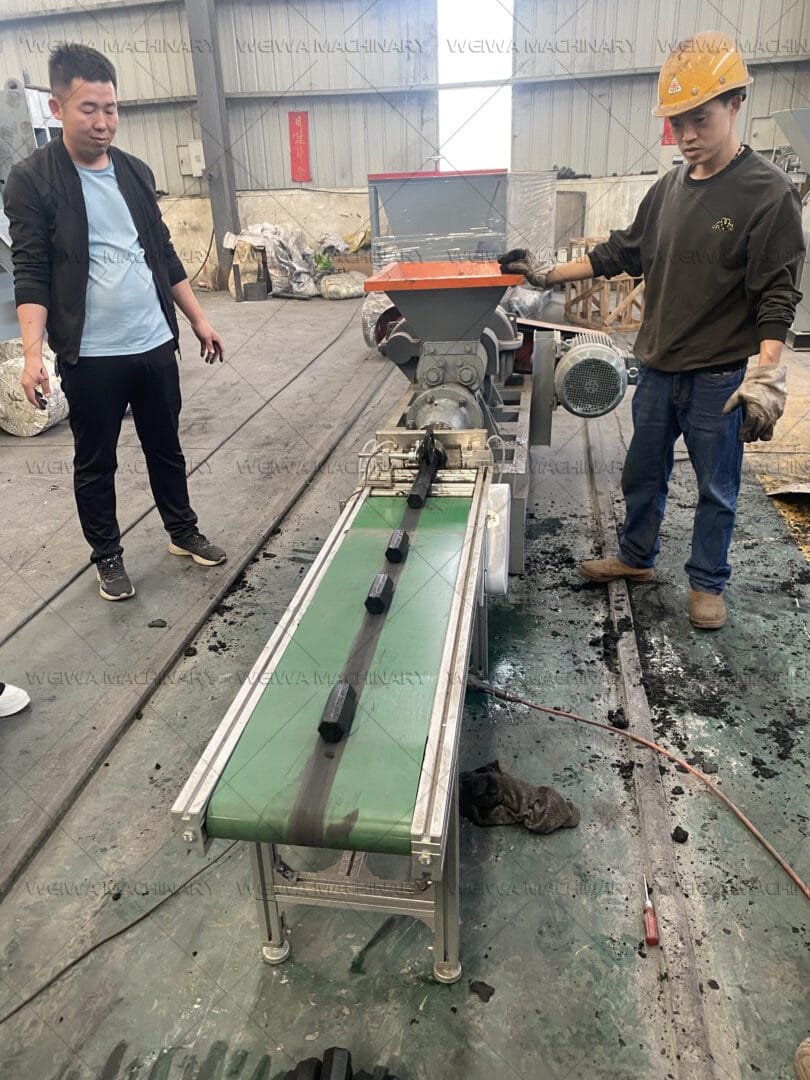
Why the Indonesia Customer Site Visit Mattered?
The Indonesian customer processes coconut shell charcoal powder, लकड़ी का कोयला पाउडर, and a portion of coal powder. At the beginning, the line worked well. Later, the operator reported uneven rod density, occasional hopper bridging, and slightly lower hourly output during the rainy season. Instead of asking the customer to send videos forever, our engineer flew in, opened the control panel, checked the screw wear, measured moisture content, and watched one full shift.
This kind of visit is valuable because a coal briquette machine is not a standalone box. It is part of a system: कुचल, mixing, binding, extrusion, सुखाने, cooling, and packing. If the mixer adds too much water, the extruder suffers. If the dryer is too hot, the rod surface cracks. If the raw material sieve is wrong, the screw wears faster. The Indonesia revisit helped us see the whole chain, not just one machine.
What Is a Coal Briquette Machine in Real Production?
A coal briquette machine is a broad term. In many markets it can mean a roller press, hydraulic press, punching machine, or screw extruder. For coal rods and charcoal sticks, the screw-type charcoal extruder is the most common choice because it can turn fine powder into continuous shaped rods under high pressure.
The working idea is simple but the execution is technical. Powder enters the hopper. A mixing or feeding zone moves the material toward the screw. The high manganese propeller pushes the material forward. Pressure increases inside the barrel. The material is forced through a forming die head. The result is a solid rod with consistent shape, higher bulk density, and better combustion behavior than loose powder.
Screw Extrusion vs Roller Briquetting
Screw extrusion is preferred when the customer wants cylindrical, वर्ग, हेक्सागोनल, or custom cross-section rods. Roller briquetting is preferred when the customer wants oval, pillow, or ball shapes. Many first-time buyers search for charcoal extruder and coal briquette machine at the same time because the terminology overlaps. In practice, the product shape decides the machine type.
For Indonesia BBQ export, 25 को 30 mm cylinders and 33 mm hexagonal rods are common. For industrial fuel, larger diameters and higher compression ratios are used. For Kenya BBQ and institutional cooking, uniform shape and long burning time matter more than fancy appearance.
How Weiwa Engineers Re-Debugged the Coal Rod Machine?
The first issue was moisture. The customer’s charcoal powder had absorbed humidity during storage. The binder was added at the same ratio as in the dry season, so the mix became too sticky. The extruder screw slipped, pressure dropped, and rod ends became soft.
Raw Material Moisture and Binder Adjustment
Our engineer measured moisture with a handheld meter, reduced binder water, and asked the customer to pre-dry the powder for twenty minutes before mixing. After that, the mix flowed better. Hopper bridging disappeared. The screw loaded evenly. Rod surface became smoother.
Propeller and Mould Calibration
The second issue was screw wear. After months of running coal powder mixed with charcoal, the propeller edge lost some material. Output was still acceptable, but pressure consistency changed. Our engineer measured the clearance, replaced the high manganese propeller, cleaned the floating coupling, and re-aligned the transmission shaft.
Mould selection was also adjusted. The customer originally used one hexagonal die for everything. We recommended keeping one cylinder die for local household market and one hexagon die for export buyers. Changing dies takes minutes on a well-designed charcoal extruder, but many operators never use that advantage because nobody trained them.

Trial Run Results at the Indonesia Factory
After re-debugging, the trial run lasted one full shift. The machine fed smoothly. Rods came out straight. Density was stable from the first minute to the last minute. Surface finish improved. Breakage after drying dropped. The operator could read the ammeter, adjust feeder speed, and understand why pressure changed when moisture changed.
The customer’s manager told our team the biggest difference was not a new part. It was understanding the process. Once the team knew how moisture, बांधनेवाला, screw speed, and die pressure connect, they stopped blaming the machine for problems created upstream.
For Weiwa Machinery, this is the real value of a site revisit. A charcoal extruder can be manufactured correctly in the factory, but it only performs well when the customer’s raw material, workshop, climate, and operator skill are included in the commissioning logic.
Why Charcoal Extruder Machine Users in Kenya Ask Similar Questions?
We receive many inquiries from Kenya about charcoal extruder machine in Kenya projects. The questions are surprisingly similar to Indonesia. What binder should I use? Why does my rod crack after drying? Can one machine make both BBQ charcoal and industrial fuel? How do I keep output stable when charcoal dust quality changes?
Kenya has a strong BBQ culture, active hospitality sector, and large volumes of charcoal fines, चूरा, चावल की भूसी का कोयला, and coconut shell charcoal dust. A coal briquette machine helps entrepreneurs convert low-cost powder into uniform fuel with better packaging, better logistics, and better resale value.
The mistake is buying a machine without testing local raw material. Charcoal from Nakuru is not the same as charcoal from Mombasa. Coconut shell char behaves differently from wood charcoal. Coal powder needs different surfactant and sometimes lime addition. A good supplier does not only sell equipment. A good supplier explains the formula.
Southeast Asia Market Potential for Coal Rod Machines
Indonesia is only one example. वियतनाम, फिलीपींस, मलेशिया, थाईलैंड, म्यांमार, and Laos all share the same pattern: abundant biomass residue, growing urban cooking demand, rising charcoal prices, and stronger interest in cleaner solid fuel.
In Southeast Asia, the coal rod machine is not only a charcoal business tool. It is also a waste-utilization tool. Rice husk charcoal, चूरा, palm kernel shell residue, नारियल के खोल का पाउडर, and coal dust can all enter the same production logic if the binder and compression ratio are correct.
Government energy policies in the region increasingly mention renewable energy, waste-to-energy, and cleaner cooking. That does not mean every village will buy a machine tomorrow. It means the market is moving from informal manual pressing to semi-automatic and automatic lines. Early adopters who build a reliable brand now will have an advantage when distributors and supermarkets start demanding uniform certified fuel.
The Southeast Asia opportunity is not only about selling one charcoal extruder. It is about selling crushing, mixing, extrusion, सुखाने, cooling, screening, and packing as one system. Customers who start with a single machine often return for a full line after six months because the market rewards consistency.
What Indonesian and Kenyan Buyers Should Check Before Ordering?
Before placing an order, buyers should send raw material samples to the manufacturer. They should share workshop size, local voltage, target monthly tonnage, preferred rod shape, and export destination. They should ask for a trial report, not only a photo of the machine.
A serious coal briquette machine supplier should explain crusher mesh size, binder type, mixer speed, screw material, die material, dryer type, and ammeter range. If the seller only talks about price and promises every material works the same, the buyer should be careful.
Weiwa normally recommends a simple flow for new customers. Raw chunk charcoal or coal is crushed below 3 मिमी. Powder enters the grinding wheel mixer with binder and water. The homogeneous mix feeds the charcoal extruder. Rods pass through a dryer. Final product is cooled, का निरीक्षण किया, counted, and packed. This logic works for Indonesia, केन्या, and most developing fuel markets.
के बारे में वेइवा मशीनरी
Weiwa Machinery is a Chinese manufacturer of charcoal and coal briquette equipment, जलकर कोयला भट्टियां, crushers, mixers, ड्रायर, and complete biomass fuel production lines. With more than thirty years of experience, Weiwa has supplied machines to customers in Indonesia, भारत, मलेशिया, वियतनाम, फिलीपींस, पाकिस्तान, केन्या, Tanzania, दक्षिण अफ्रीका, टर्की, पोलैंड, and many other countries.
Our advantage is not only steel fabrication. It is process engineering. We help customers choose the right charcoal extruder, match the correct binder, design the workshop layout, train operators, and provide remote or on-site commissioning. Machines are built with carbon steel frames, कॉपर कॉइल मोटर्स, hardened gearboxes, high manganese propellers, और 45 स्टील के ढाले.
Whether you need a coal briquette machine for industrial fuel, a charcoal extruder for BBQ export, or a full plant for Southeast Asia and Africa, Weiwa Machinery can configure the line around your raw material and market.
वेवा मशीनरी से संपर्क करें:
भीड़: +8613838093177
WhatsApp: +8613838093177
ई-मेल: info@cjlmachinegroup.com
Send your raw material type, daily ton target, workshop size, and voltage. Our engineering team will return a configuration sheet, layout drawing, and quotation so you can plan your charcoal or coal rod factory before placing the order.


 WeChat

 +8615937143060
