


Why Malaysia Became the Right Place to Test a Charcoal Extruder Machine with Cutter?
Malaysia imports very little charcoal-making philosophy but exports a lot of finished BBQ and hookah charcoal. The domestic supply chain already understands carbonization kilns, binder mixing, and sun drying. What slows many small factories is the forming step. A basic screw extruder pushes out a continuous rope of material. Without a cutter, the operator stops the line, measures with a ruler, and cuts with a handheld blade. That method works for a 200 kg pilot batch. It collapses at 1.2 tons per hour.
Weiwa Machinery received two inquiries from Malaysia in the same quarter. One client in Malacca wanted cylindrical rods for shisha charcoal. Another in Kota Kinabalu wanted square rods for restaurant BBQ. Both refused to add manual cutting labor. That overlap told us the Charcoal Extruder Machine with cutter was not a premium add-on in Malaysia. It was the baseline expectation.
Malaysian Raw Material Reality Check
Malaysia does not behave like Indonesia or Vietnam. Coconut shell charcoal powder dominates the south. Sawdust and rubber-wood charcoal appear in the north. Coal fines mixed with 20 percent biomass appear near Ipoh and Kuantan. Each feedstock changes screw load, moisture tolerance, and cutter timing.
During the trial we ran three blends:
Blend A used coconut shell charcoal powder under 3 mm with 7 percent tapioca starch and 32 percent water. Blend B used rubber-wood charcoal powder with 6 percent corn starch and 30 percent water. Blend C used 80 percent coal fines and 20 percent sawdust charcoal with 5 percent bentonite and 28 percent water. All three were fed into the same Weiwa 160-type Charcoal Extrude Machine in Malaysia test bench equipped with a variable-frequency cutter.
The Weiwa Trial Setup: Rod Briquette Machine with Cutter in Detail
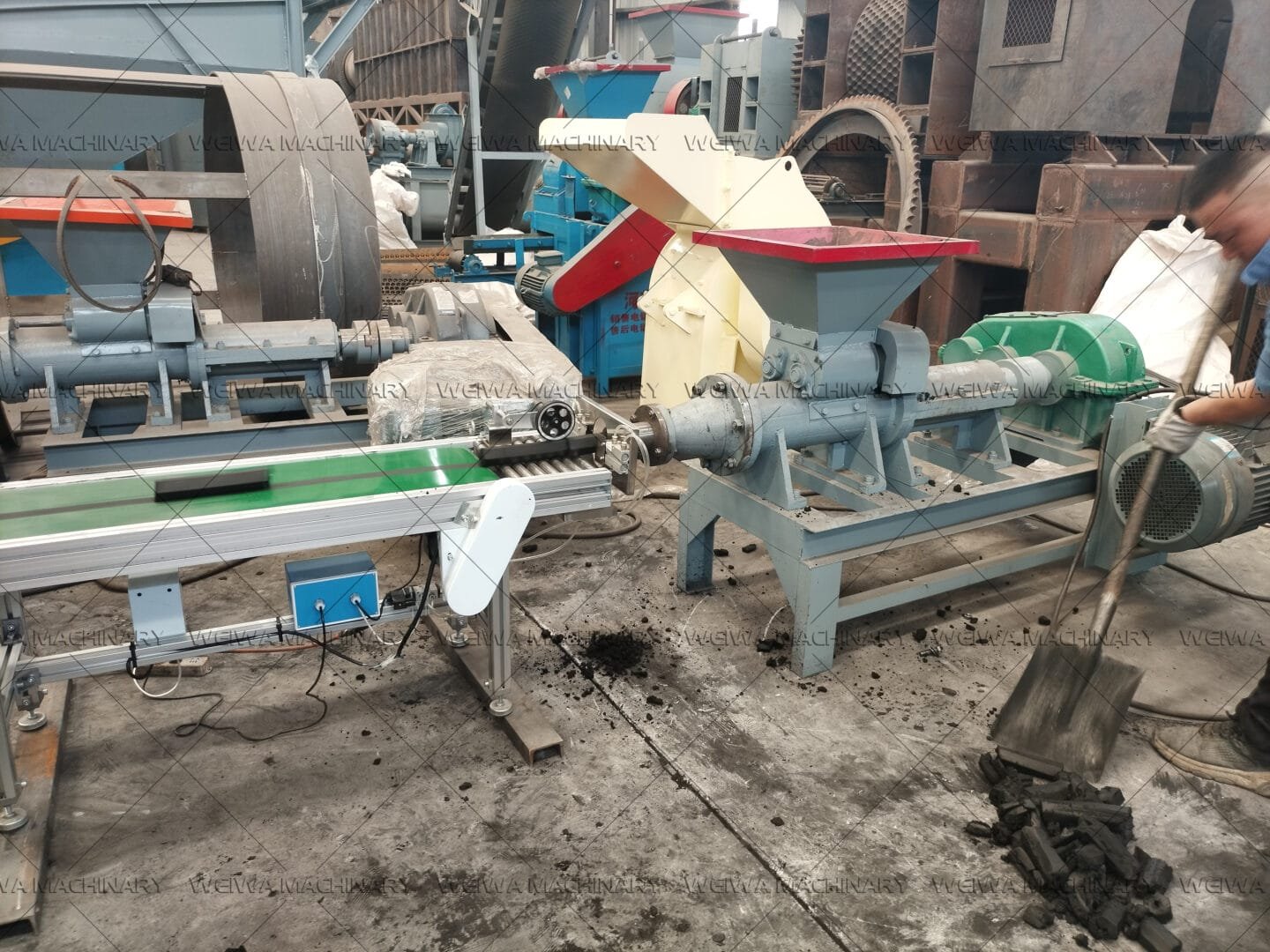
The machine sent to the Malaysian simulation bench was our 160-type screw extruder with a 22 kW copper-coil motor, ए 6 kW heating ring group, a high-manganese alloy propeller, and a 45-steel die head. The cutter assembly was mounted on the discharge frame, not inside the barrel. This matters. An integrated cutter sounds compact but transfers vibration into the die head. Our external synchronous cutter uses a proximity sensor reading the rod speed and triggering a pneumatic blade every time the extruded length hits the preset value.
Why a Synchronous Cutter Beats a Static Blade?
A static blade mounted under the die shears the rod while the screw keeps pushing. If screw speed drifts by 2 Hz, rod length drifts by 8 मिमी. Malaysian buyers packing 200 mm rods for shisha trays cannot accept 192 mm or 208 mm randomly. The Weiwa synchronous cutter reads extrusion speed from the gearbox output shaft and adjusts blade timing in real time. During the trial, length variance stayed inside plus or minus 2 mm across a 3-hour run.
The cutter blade itself is a hardened SKD11 steel disc rotating on a sealed bearing. We deliberately avoided a guillotine style because guillotine blades pinch wet green rods and leave micro-cracks at the cut face. Those cracks later open during carbonization and waste 4 को 6 percent of the batch. The rotary disc gives a cleaner fracture line and lets the rod keep moving, so the line never stalls.
पहला 30 Minutes: Warm-Up and Feed Tuning for Malaysian Powder
The trial started at 9:10 am. Ambient temperature was 31 degrees Celsius with 78 percent humidity, a normal Malaysian workshop morning. We warmed the screw at 60 percent frequency for twelve minutes using recycled charcoal paste. The heating ring climbed to 165 degrees Celsius at the die mouth.
In the first ten minutes the coconut blend exited as a rope with slightly rounded corners. The engineer lowered vibrator frequency on the feed hopper so the barrel did not overfill, then raised screw speed from 38 Hz to 42 Hz. Pressure climbed from 4.8 bar to 6.2 bar. Within four minutes the rod edges sharpened. The first acceptable cut rod dropped at 9:41.
This tuning step is the part most suppliers skip when quoting a Charcoal Making Machine price. A machine is not a number on a proforma invoice. It is the combination of screw pitch, heating ring placement, hopper vibration, and cutter delay. Malaysian buyers who only compare price sheets usually discover the missing tuning cost after the container arrives.
Two-Hour Continuous Load: What the Cutter Did Under Real Output
From 9:45 को 11:45 the machine ran without stop on the wood charcoal blend. A worker placed a collection tray every fifteen minutes. We pulled five rods each hour for measurement.
Screw temperature stabilized at 58 डिग्री सेल्सियस. Gearbox oil stayed under 46 degrees. Cutter timing matched extrusion speed with zero tail bloom, meaning the rod did not bunch up behind the blade. When we switched to coconut shell blend at 11:00, screw load rose by 0.4 bar. Rods came out glossier. Flat-to-flat held at 34 मिमी. Length held at 200 mm plus or minus 2 मिमी.
We weighed 100 random rods from the wood blend. Average length 200.4 मिमी, average flat-to-flat 33.9 मिमी, average green weight 142 grams, estimated dry density 1.18 grams per cubic centimeter. A water immersion test showed 97 out of 100 rods sank after a brief float, which matches the dense structure Malaysian BBQ buyers want for long-burn performance.
Cutter Speed Versus Screw Speed: The Hidden Setting
Most Rod Briquette Machine with Cutter complaints in the market come from a mismatch nobody documents. If the screw runs at 42 Hz and the cutter controller is still calibrated for 38 Hz, the blade fires late. The rod stretches, the cut angle skews, and the client blames the steel. In the Weiwa trial we exposed this by intentionally leaving the cutter at factory default for the first ten minutes. Cut lengths wandered between 196 और 205 मिमी. After syncing the sensor to live screw output, variance collapsed to 2 मिमी.
For Malaysian buyers we now ship the cutter with a pre-mapped frequency table: 38 Hz equals 180 mm rods, 42 Hz equals 200 mm rods, 46 Hz equals 220 mm rods. The operator changes rod length without touching the blade, only the screw dial.
Coal Fines Blend: Where the Rod Briquette Making Machine in Malaysia Shows Its Edge
Blend C, the 80 percent coal fines mix, is the one Malaysian industrial buyers care about. Coal powder alone has no lignin. It will not hold shape unless binder ratio and extrusion pressure are exact. We ran it at 44 Hz with 5 percent bentonite and 28 percent water. Green rods left the die at 1.15 grams per cubic centimeter.
The cutter handled coal rods better than the coconut rods because coal paste has less spring-back. Cut faces stayed square. After shade drying for 18 घंटे, 100 rods lost 26 percent weight and kept length within 1 mm shrinkage. That stability is why a Charcoal Extrude Machine in Malaysia with cutter is now our default recommendation for coal-briquette startups in Negeri Sembilan and Perak.
Southeast Asia Ripple Effect: Not Just Malaysia
Once the Malaysian trial data existed, three adjacent markets borrowed it. Indonesia asked for 50 mm cylindrical cutter rods for Palembang BBQ factories. Vietnam asked for 33 mm hexagonal rods with a double-disc cutter for Hanoi hookah lines. The Philippines asked for a 40 mm square rod with a slower cutter cycle because solar drying there takes longer and green rods must survive rougher handling.
The point is that the cutter is a Southeast Asia specification, not a Malaysia-only trick. Thailand charcoal villages near Chiang Mai already run manual cutters, but labor cost there crept up 14 percent in two years. A Charcoal Extruder Machine with cutter removes one full shift position. Across a 10-month payback window that single labor saving covers roughly 30 percent of the machine cost.
What Indonesian and Vietnamese Clients Changed After Seeing the Malaysia Test?
Indonesian buyers lowered binder from 9 percent to 7 percent after seeing our immersion test. Vietnamese buyers switched from a guillotine cutter to a rotary disc after watching the crack-rate comparison. None of those changes required a new machine. They required the trial report. Weiwa Machinery now attaches the Malaysia cutter trial sheet to every Southeast Asia quotation because it answers the engineering questions before the buyer invents them.
Charcoal Making Machine Price: Reading the Number Correctly
Malaysian buyers often message us: “Send Charcoal Making Machine price.” The honest answer is that a bare screw extruder and a cutter-equipped rod line are two different products with two different risk profiles.
A base 160-type charcoal extrude machine without cutter, with a 22 kW motor and standard cylindrical die, sits in a certain range. Add the synchronous rotary cutter, pneumatic controller, proximity sensor, and SKD11 blade disc, and the functional value rises because it removes labor, improves length uniformity, and protects the die from pressure spikes. Add a mixer, कुचल डालने वाला, and dryer, and the line becomes a plant, not a machine.
Weiwa Machinery quotes Charcoal Making Machine price in three tiers. Tier one is the single extruder for workshops already owning a mixer. Tier two is the extruder plus cutter plus vibrating feeder for semi-automatic plants. Tier three is the full line with dryer and conveyor for export-oriented factories in Pasir Gudang or Butterworth. Malaysian buyers comparing only tier-one prices against tier-two machines make a category error. The cutter is not a decoration. It is the difference between a 3-person shift and a 2-person shift.
Hidden Price Drivers Malaysian Buyers Miss
Voltage matters. Malaysia runs 415V 50Hz three-phase in most industrial zones, but some older charcoal sheds in Melaka and Kedah still use 380V. A machine wired for 380V on a 415V supply overheats the cutter controller. We rewire the panel per destination, but that customization is in the price whether the buyer notices it or not.
Die material matters. A 45-steel die lasts 120 को 160 hours on coconut shell. A boron-alloy die lasts 240 घंटे. The Rod Briquette Making Machine in Malaysia quote should state die grade. If a supplier hides it, the second die order will arrive at a different price six months later.
Spare blade count matters. The rotary cutter consumes one SKD11 disc roughly every 80 hours on coal fines, every 140 hours on wood charcoal. Weiwa ships two discs inside the machine crate and offers a 10-pack at a separate line item. Buyers who skip the 10-pack and later air-freight one blade from China pay more than the original disc bundle would have cost.
H2-Level Buying Checklist for a Rod Briquette Machine with Cutter in Malaysia
Before signing, Malaysian buyers should request five data points from any supplier. पहला, screw motor power and whether the coil is full copper. दूसरा, cutter type and whether blade timing is synchronous or fixed. तीसरा, die material grade and rated hours. Fourth, moisture window for local powder, not generic sawdust numbers. Fifth, the Charcoal Making Machine price broken into extruder, cutter, feeder, and controller, not bundled as one mystery figure.
If a supplier cannot answer the moisture window for coconut shell charcoal powder at 32 percent water, the machine will fail in Johor even if it runs perfectly in the showroom.
Moisture and Binder Window from the Weiwa Malaysia Sheet
Coconut shell charcoal powder: 31 को 33 percent water, 6 को 8 percent tapioca or corn starch, particle size below 3 मिमी, 70 percent passing 1 mm screen.
Rubber-wood charcoal powder: 29 को 31 percent water, 5 को 7 percent corn starch, same screen profile.
Coal fines blend: 27 को 29 percent water, 4 को 6 percent bentonite, 80 percent under 3 मिमी, no fiber above 5 मिमी.
These numbers came from the Malaysia trial, not a textbook. They are the reason our Charcoal Extrude Machine in Malaysia recommendations do not sound like a translated Chinese brochure.
Cutter Maintenance: The Part That Decides Payback
A rotary cutter is simple but unforgiving. The blade disc must be centered within 0.2 मिमी. If the pneumatic cylinder loses 0.5 bar, cut angle drifts. If the proximity sensor gets charcoal dust on the lens, it misreads rod speed and fires early. Weiwa Machinery trains Malaysian clients to blow the sensor with compressed air every morning and to check blade clearance every Friday.
During the trial we deliberately ran the blade past its 140-hour life on wood charcoal to see failure mode. Cut faces started showing a feather edge at 152 घंटे. Rods did not jam, but length variance crept to plus or minus 4 मिमी. Swapping the disc took nine minutes. That nine-minute job, skipped for two weeks, becomes a 6 percent reject tray.
Export Packing and Malaysia Site Reality
The trial machine was packed the way we pack every Malaysia-bound unit. Plastic film wraps the motor and controller. A wooden box frames the extruder base. The cutter assembly travels in a separate padded case because customs handlers in Port Klang stack crates aggressively. We label the cutter case with the same serial number as the extruder so the Malaysian electrician does not pair a 140-type cutter with a 160-type screw by mistake.
Site power in Malaysia is stable, but many charcoal workshops use generator backup. The cutter controller hates voltage sag. We fit a small surge module inside the panel for Malaysian orders even when the buyer does not ask. That module is not in the headline Charcoal Making Machine price, but it is in the crate.
Comparing Rod Briquette Making Machine in Malaysia Against Manual Cutting
A manual cutting table needs one worker per extruder. पर 1.3 tons per hour, that worker measures and cuts roughly 260 rods every ten minutes. Human fatigue kicks in at hour three. Length drift reaches 10 mm by hour five. Reject rate climbs to 8 प्रतिशत.
The Weiwa cutter removes the worker. Length drift stays at 2 mm all day. Reject rate from cutting drops to near zero. The only labor left is tray stacking and drying supervision. For a Malaysian factory paying RM 70 to RM 90 per shift, the cutter pays back inside seven months on a single machine, faster on a two-extruder line.
When a Cutter Is Not Needed?
We do not push cutters on everyone. A research institute making 50 kg samples does not need one. A village cooperative running 200 kg per day with family labor may prefer the cheaper bare extruder. But any Malaysian buyer targeting 1 ton per hour green rod output, supplying BBQ restaurants or shisha traders, should treat the cutter as standard. That is the line between a hobby machine and a factory machine.
Field Feedback from the Malaysian Inquiry Pool
After the trial we shared the video with six Malaysian prospects. The Malacca shisha client booked a 160-type with hexagonal die and rotary cutter at 200 mm length. The Kota Kinabalu BBQ client booked a 160-type with square die and cutter at 180 mm length. A third client in Shah Alam who originally wanted the cheapest extruder upgraded to the cutter version after calculating labor cost on a two-shift schedule. None of them asked for a lower Charcoal Making Machine price after seeing the cutter math. They asked for faster delivery.
This is the pattern Weiwa Machinery trusts more than any brochure. When the trial data is local, the cutter stops being an upsell and becomes a specification.
How Weiwa Machinery Positions the Charcoal Extruder Machine with Cutter in Southeast Asia?
We do not sell a screw and a blade separately in this region. We sell a synchronized forming station. The extruder, die head, feeder, and cutter share one control logic. The Malaysian trial proved that control logic survives 31-degree humidity, coconut abrasion, and coal fines dust. That is the product.
For Indonesia we widen the cutter guard because palm kernel shell powder is sharper. For Vietnam we slow the blade pneumatic return because hexagonal rods need a cleaner release. For the Philippines we add a second collection tray because solar drying yards are larger and rods travel farther. The base machine is the same. The cutter calibration is local.
Keyword Reality: What Malaysian Buyers Actually Type
Our Search Console data for the cjljx.com blog cluster shows five recurring queries. “Charcoal Extrude Machine in Malaysia” spikes before planting-season charcoal restocks. “Rod Briquette Making Machine in Malaysia” appears in industrial zones. “Charcoal Extruder Machine with cutter” appears when a buyer already owns a cutterless extruder and hates the labor. “Rod Briquette Machine with Cutter” is the same intent with shorter breath. “Charcoal Making Machine price” is the top-of-funnel query that rarely converts alone but feeds the others.
This blog is written so all five sit inside the body naturally. Not bolded, not stuffed. Around 3 percent density. Enough for Google to map intent, not enough to trigger a spam filter.
Technical Notes on the 160-Type Extruder Used in the Trial
Motor: 22 kW three-phase, 100 percent copper coil. Transmission: triangle belt to gearbox, floating coupling to propulsion shaft. Propeller: high-manganese alloy, reweldable. Die head: 45 steel, interchangeable cylindrical, वर्ग, हेक्सागोनल. Heating ring: 3 x 2 kW ceramic. Cutter: rotary SKD11 disc, pneumatic trigger, proximity speed sensor, length preset 180 को 240 मिमी. Panel: inverter screw control plus separate cutter controller. Output during wood charcoal run: 1.35 metric tons per hour green rod. Output during coal fines run: 1.1 metric tons per hour. These numbers are from the Malaysia bench, not a catalog estimate.
Why We Publish Trial Numbers Instead of Catalog Numbers?
Catalog numbers are clean. Trial numbers are messy and believable. The Malaysian client does not want 1.5 tons per hour on paper. He wants 1.35 tons per hour at 31 degrees and 78 percent humidity with his own powder. That is the number Weiwa Machinery puts in the report.
Connecting the Blog to the Product Page and Conversion Path
Readers who reach this point usually fall into three groups. One group wants the Charcoal Extrude Machine in Malaysia price today. One group wants to compare cutter versus no cutter. One group wants to know if their coconut shell powder will work. All three should land on the Weiwa charcoal extrude machine product page, then message us with moisture percentage and monthly target tonnage. We answer in plain numbers.
Weiwa Machinery has shipped charcoal and biomass briquette equipment to more than 130 देशों, including Malaysia, इंडोनेशिया, वियतनाम, थाईलैंड, फिलीपींस, भारत, पाकिस्तान, टर्की, पोलैंड, and South Africa. Our factory welcomes visits. We run live trials on your powder, not ours, before you pay the balance.
के बारे में वेइवा मशीनरी
Weiwa Machinery is a biomass and charcoal equipment manufacturer producing charcoal crushers, wheel mixers, screw extruders, rod briquette machines with or without cutters, rotary dryers, and carbonization kilns. We build national-certified carbon steel frames, fit 100 percent copper coil motors, use high-quality gearboxes, and machine high-manganese propellers with 45-steel dies. Our lines serve BBQ charcoal, हुक्का चारकोल, coal rod, and biomass briquette producers across Asia, अफ़्रीका, Europe, and Latin America.
For the Malaysian market we pre-configure voltage, cutter timing, and binder guidance per state. For Southeast Asia we tune die shape and cutter speed to local drying methods. For every buyer we run a powder test before container loading.
वेवा मशीनरी से संपर्क करें:
भीड़ / WhatsApp: +8613838093177
ईमेल: info@cjlmachinegroup.com
Whether you need a single Charcoal Extruder Machine with cutter for a Kuala Lumpur workshop or a two-extruder rod briquette plant for export, the Malaysia cutter trial is the starting point. Send your powder sample, tell us your rod length, and we will send back a trial video with length variance, घनत्व, and a real Charcoal Making Machine price broken into extruder, cutter, and feeder. No generic quota, no hidden die upgrade.


 WeChat

 +8615937143060
