


What a Coal Rod Machine Actually Does in a Charcoal Line
A coal rod machine is the core forming unit in many charcoal and coal powder projects. It receives pre-crushed charcoal dust, लकड़ी का कोयला पाउडर, नारियल शेल चारकोल पाउडर, चावल की भूसी लकड़ी का कोयला पाउडर, or ordinary coal powder, mixes the material with a binder, and pushes it through a forming die head using a high manganese alloy propeller. The output is a continuous solid rod that can be cut into cylinders, square columns, or hexagonal sticks.
In a complete charcoal making machine system, the coal rod machine sits after the crusher and the grinding wheel mixer. The crusher reduces biomass or charcoal chunks below 3 मिमी. The mixer blends powder with starch, molasses, or clay binder. Then the charcoal extruder machine in Kenya configurations we export compresses the feed into dense rods without smoke during forming. The rods later pass through a dryer before becoming market-ready fuel.
The reason many buyers compare a coal rod machine with a charcoal briquette machine is simple. Both densify powder. The extruder type produces long rods or sticks, while punch presses produce blocks or honeycomb shapes. For Kenya clients targeting BBQ charcoal, shisha charcoal, or industrial heating rods, the extruder version is often cheaper to run and easier to maintain.
Why Kenya Operators Ask for a Charcoal Extruder Machine?
Kenya’s urban cooking fuel market still depends heavily on charcoal. Traditional kiln charcoal is irregular, dusty, and expensive to transport. A charcoal extruder machine in Kenya lets a local producer reuse charcoal dust that used to be waste, combine it with coal fines, and sell uniform rods at a stable price.
During client consultations, we hear the same concerns. Power fluctuation between 220 V and 415 V three-phase is common. Raw material moisture changes with the season. Labor skill is limited in the first month. The coal rod machine in Kenya we tested was built to absorb those variables: national certified carbon steel frame, 100% copper coil motor, high quality gearbox, and a floating coupling that protects the propulsion shaft when feed consistency changes.
Another driver is shape flexibility. Kenyan buyers often want cylindrical rods for household braziers and square or hexagonal rods for restaurant grills. Our machine accepts quick-change molds, so one charcoal briquette machine can serve several customer segments without a second production line.
Inside the Weiwa Factory Trial Run for a Kenya Client
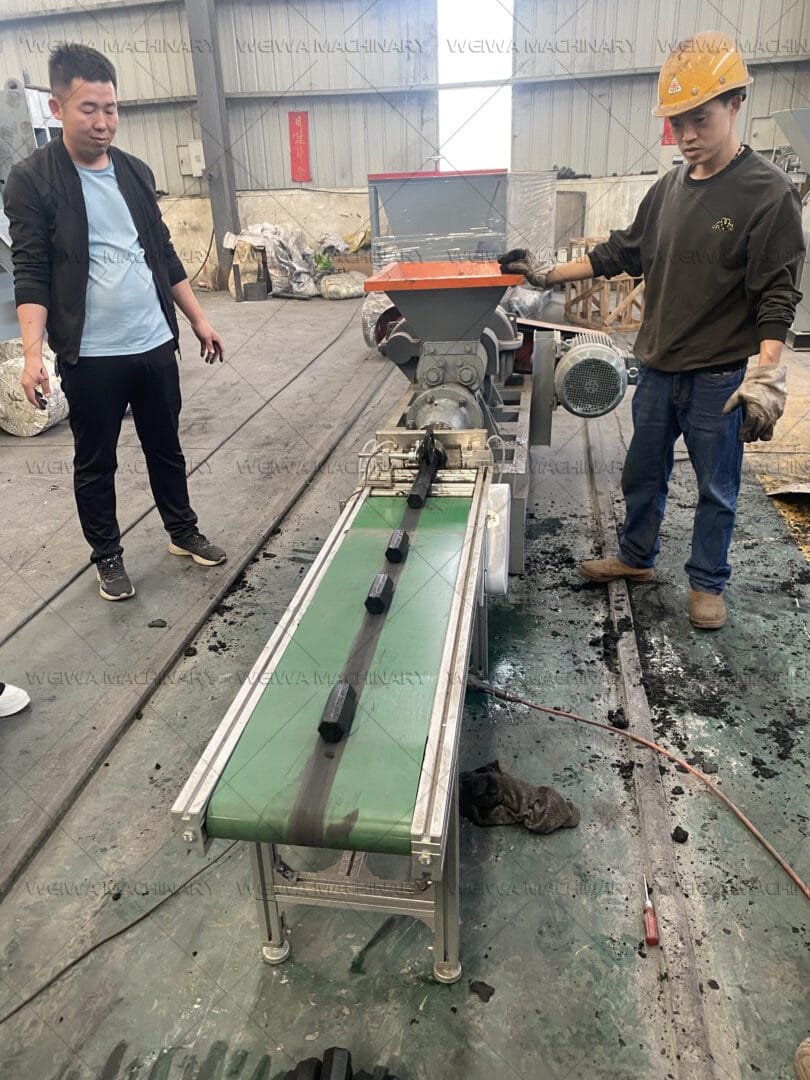
The trial was organized in our workshop before shipment. The Kenya client sent two material samples ahead of time: acacia wood charcoal dust with around 18 प्रतिशत नमी, and a blended anthracite coal powder with 10 percent charcoal fines. Our team reproduced both feeds, adjusted binder ratio, and ran the rod charcoal making machine for Kenya exactly as it would run on site.
Raw Material Preparation Before Extrusion
We started with the charcoal crusher. Input chunks were reduced to below 3 मिमी, which is the maximum size our extruder handles without pressure loss. The grinding wheel mixer then blended the powder with binder. For pure charcoal dust we used 5 percent cassava starch solution. For the coal-charcoal blend we used 3 percent mixed binder to compensate for lower natural cohesiveness.
Moisture control mattered. Too dry and the rod cracks. Too wet and the die head slips. The trial batch left the mixer at roughly 12 को 14 प्रतिशत नमी, which our engineers have found ideal for screw extrusion of charcoal and coal composites.
Live Extrusion Test and Rod Formation
The charcoal extruder machine was set to a 7.5 kW drive with a rated output shaft speed matched to a 40–50 stroke equivalent per minute. The motor transmitted power through a triangle belt to the gearbox, then through a floating coupling to the propulsion shaft. The high manganese propeller pushed material into a cylindrical die head with 33 mm outer diameter and a 6 mm central hole.
Within the first ten minutes, rod surface became smooth and glossy, a sign of correct temperature and pressure. No jamming occurred when we switched from pure charcoal to the coal-rich blend. The only observable change was a slight amperage rise on the coal blend, which is expected because anthracite has lower natural binding ability. The coal rod machine in Kenya held center alignment throughout, so rod diameter stayed within 0.5 mm tolerance.
Continuous running lasted 135 minutes. We weighed output every 15 minutes. Average wet rod output stayed at 320 को 360 kg per hour depending on cut length. The client requested 300 mm sticks, so we fixed the cutter accordingly. The same charcoal making machine setup can reach higher hourly volume with shorter cut length or larger die diameter.
Drying and Final Rod Inspection
After extrusion, rods were placed on a batch drying frame for 90 minutes at 80 को 90 डिग्री सेल्सियस. Final moisture dropped below 6 प्रतिशत. We then performed a drop test from 1.2 meters. Less than 2 percent of rods broke. Compressive check showed no deformation under 80 kg point load, which is more than enough for bagging, stacking, and informal transport in Kenyan towns.
Burn observation was done on a sample stove. The rods ignited within four minutes, burned with almost no visible smoke, and held glowing front for 48 minutes on a 300 mm stick. Ash was light grey, not black, confirming low volatiles and good carbon retention. For the client, this was the moment the charcoal briquette machine moved from specification sheet to bankable equipment.
Trial Run Data From the Charcoal Briquette Machine
The table below is a plain-text summary of the Kenya trial, not a styled list, to keep reading natural.
Machine model: WEIWA LJ-140 screw extruder. Motor: 7.5 किलोवाट, 100% copper coil. Gearbox: hardened helical type. Propeller: high manganese alloy, reversible wear side. Die: 33 mm cylinder with center hole. Feed moisture: 12 को 14 प्रतिशत. Binder: 5 percent starch for charcoal, 3 percent mixed for coal blend. Wet output: 320 को 360 kg/h. Dry cycle: 90 minutes batch drying. Final moisture: below 6 प्रतिशत. Breakage after drop test: under 2 प्रतिशत. Continuous run: 135 minutes without stop. Power behavior: stable on 220 V single feed simulation and 415 V three-phase simulation.
These numbers are not laboratory extremes. They reflect what a charcoal extruder machine in Kenya will face: variable powder, humid mornings, and operators still learning the line. The fact that the coal rod machine in Kenya stayed within tolerance for more than two hours is the result of gearbox cooling margin, propeller angle, and die polish rather than a one-time lucky batch.
How a Rod Charcoal Making Machine for Kenya Fits Local Fuel Demand?
Kenya’s charcoal chain is long. Rural areas produce irregular lumps, traders transport them to Nairobi or Kisumu, and end users pay for weight that includes dust and moisture. A rod charcoal making machine for Kenya shortens that chain. A workshop near the city edge can buy charcoal dust cheaply from wholesalers, extrude it into branded rods, and sell directly to restaurants, schools, and residential agents.
Coal blending is another advantage. Kenya imports some coal and also generates coal fines in small industrial zones. Mixing 20 को 30 percent coal powder with charcoal dust lowers raw material cost per bag while keeping burn quality acceptable for heating applications. The charcoal making machine line we tested handled 10 percent coal fines smoothly, and our engineers estimate 25 percent blend is safe with adjusted binder.
Environmental pressure also matters. Extruded rods burn longer than loose charcoal and emit less smoke than raw coal. For NGOs and county projects promoting clean cooking, a charcoal briquette machine is easier to approve than an open kiln. Weiwa Machinery has shipped similar lines to Tanzania, जाम्बिया, इथियोपिया, and South Africa, so the Kenya trial adds one more field reference to the same mechanical platform.
Common Questions About Charcoal Making Machine Investment
Buyers usually ask whether one machine is enough. The honest answer is no if you want finished market fuel. You need a crusher, a mixer, the charcoal extruder machine, and a dryer. You can start with a single coal rod machine in Kenya if you already have powder and sun drying space, but rainy seasons in Kenya make a mechanical dryer worthwhile after month two.
Another question is mold change time. On the WEIWA LJ series, switching from cylindrical to square die takes 15 को 20 minutes with basic tools. That flexibility lets one charcoal briquette machine serve BBQ clients on weekends and industrial rod clients on weekdays.
Spare parts worry many first-time importers. The propeller and die are wear parts. Under eight-hour daily use with charcoal dust below 3 मिमी, a high manganese propeller lasts around 400 को 600 घंटे. A #45 steel die lasts 300 को 450 घंटे. We stock these for all charcoal extruder machine in Kenya orders and ship them with the container.
Electricity is the last common concern. The trial simulated voltage drop to 200 V and spike to 430 V. The machine kept running because the gearbox ratio absorbs load variation and the copper coil motor tolerates moderate thermal swing. Still, we recommend a stabilizer for workshops with frequent outages.
के बारे में वेइवा मशीनरी
Weiwa Machinery is a Chinese manufacturer of charcoal and biomass densification equipment with installations in more than 130 देशों, इंडोनेशिया सहित, भारत, मलेशिया, पाकिस्तान, मिस्र, इथियोपिया, Tanzania, दक्षिण अफ्रीका, and Kenya. Our product range covers charcoal crushers, wheel mixers, charcoal extruder machine units, honeycomb briquette presses, जलकर कोयला भट्टियां, and drying systems. Every coal rod machine in Kenya order passes pre-shipment load testing, comes with an English manual, and includes remote installation guidance through video or WhatsApp.
We do not only sell a charcoal making machine. We plan the line around your raw material, your voltage, your daily target, and your bagging style. The Kenya trial described above is one example of how we de-risk an import decision before the container leaves the port.
If you want the same trial report with your own material, you can send 5 kg of charcoal dust or coal powder to our factory. We will run the charcoal briquette machine, record output, and return dried rods by courier. To discuss configuration, price, or delivery time, contact us directly:
Mobile / WhatsApp: +8613838093177
ईमेल: info@cjlmachinegroup.com
Weiwa Machinery welcomes Kenya partners to visit the workshop, watch a live run, and inspect the coal rod machine before payment. Seeing the rod come out of the die is still the fastest way to trust the engineering.


 WeChat

 +8615937143060
