


Weiwa Machinery recently completed the installation and commissioning of a honeycomb briquette charcoal machine for a client in Tanzania. The project gave us another chance to show how a honeycomb briquette charcoal machine in Tanzania can be set up quickly, run steadily with local raw materials, and produce dense honeycomb samples that match the client’s sales requirements.
Most African buyers do not need a complicated theory paper. They need proof that the honeycomb charcoal coal briquette forming machine can press local charcoal dust, coal dust, and binder into uniform blocks without cracking. Our Tanzania case answered that question on the client’s own floor.
Why Tanzania Clients Choose a Honeycomb Briquette Charcoal Machine?
Tanzania’s cooking fuel market still depends heavily on loose charcoal and firewood, but Dar es Salaam, Arusha, Mwanza, and Dodoma are seeing steady growth in briquette demand because briquettes burn longer, smoke less, and can be packed under a brand. A honeycomb briquette charcoal machine in Tanzania helps an investor convert cheap carbonized charcoal fines and coal powder into a higher value product. Instead of selling raw dust by the sack, the client sells stacked honeycomb blocks with consistent hole patterns and fixed weight.
The Tanzania client who contacted Weiwa already owned a small charcoal retail shop. His pain point was simple: he was buying charcoal fines at low cost but had no way to reshape them. After comparing a roller press, a screw extruder, and a honeycomb punching machine, he chose the punching model because the honeycomb shape is familiar to local users, ignites fast, and allows air to pass through the holes during combustion.
What Is a Honeycomb Punching Machine and How It Forms Coal Briquettes?
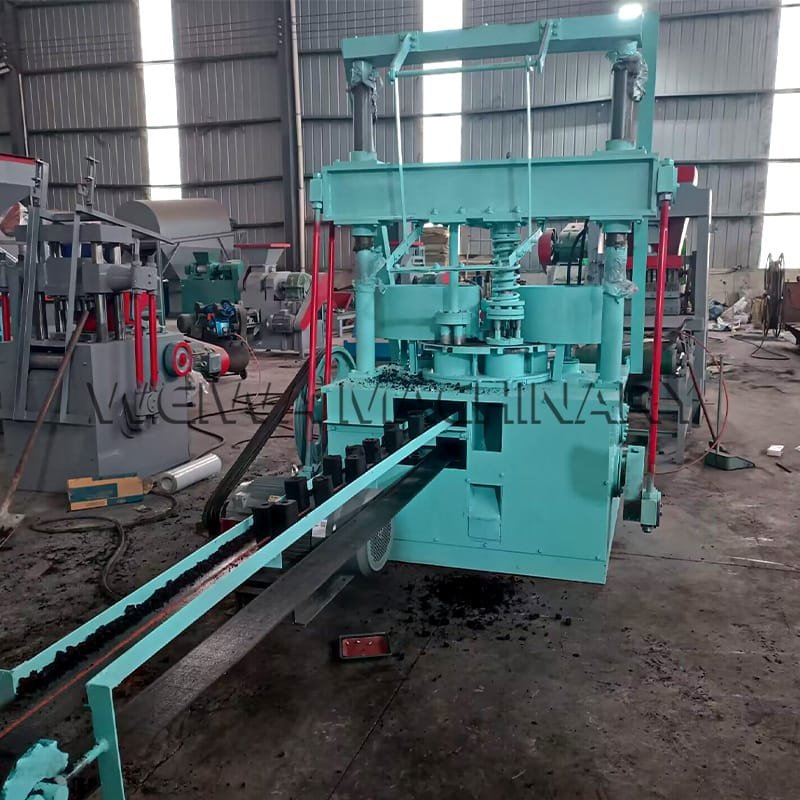
A honeycomb punching machine is a rotary table briquette press. Its core job is to take fine powder, compress it inside a cylindrical mold, and push out a block with several straight holes passing through the body. In East Africa the round honeycomb charcoal briquette is the most common, but the same coal briquettes making machine structure can also form square, हेक्सागोनल, or custom embossed faces.
Rotary Table and Punch Head Working Principle
The operator feeds mixed powder into a hopper. A screw conveyor moves the material to the filling position under the rotary table. As the table rotates, each mold cavity passes under the feeder, receives powder, moves to the compression station, and is struck by a punch head from the top. A bottom ejector then pushes the finished honeycomb briquette out of the mold. The cycle repeats several times per minute depending on motor power and mold diameter.
This mechanical logic is why the honeycomb charcoal coal briquette forming machine stays popular in countries where electricity is stable but skilled maintenance labor is limited. There are no fragile hydraulic seals to leak if the client forgets oil change intervals. The gear reducer, punch, and mold do the work.
Mold Options for Round Square and Hexagon Briquettes
Weiwa Machinery supplies molds with 12, 16, 19, 21, या 25 holes for round briquettes. For the Tanzania order we equipped the machine with a 19-hole round mold of 90 mm diameter and 60 mm height. The client also received a spare mold clamp for 100 mm blocks. Square and hexagon honeycomb molds are available if the buyer targets institutional kitchens or export pallets that stack better in boxes.
Mold change takes around 15 को 20 minutes. The punch tip and ejector pin are separate parts, so when wear appears after hundreds of thousands of strokes, the client does not replace the whole mold. He only changes the punch tip or sends the mold back for resurfacing.
Pre-Shipment Inspection and Sample Briquettes from Weiwa Workshop
Before the container left China, our quality team ran a pre-shipment inspection using a simulated Tanzania recipe: 70 percent carbonized charcoal dust, 25 percent coal dust, 5 percent cassava starch binder, moisture controlled at 12 प्रतिशत. The honeycomb briquette charcoal machine produced 90 mm samples with sharp edges, clean holes, and no central bulge. We weighed ten pieces; average weight was 385 grams with a deviation under 4 grams.
We recorded a short video of the trial and sent it to the Tanzania client together with the commercial invoice, पैकिंग सूची, certificate of origin, and foundation drawing. The main machine was coated with anti-rust oil, wrapped in stretch film, fixed on a steel pallet, and loaded into a 20 foot container together with two plywood cases containing molds, motor, V belts, ejector pins, and a spare punch.
The same honeycomb briquette charcoal machine model can also be quoted as a honeycomb charcoal coal briquette forming machine when the buyer intends to blend coal and charcoal in variable ratios. From the factory side the difference is mostly in mold pressure setting and binder suggestion, not in the base frame.
On-Site Installation and Commissioning in Tanzania
After the container arrived at Dar es Salaam port, the client arranged trucking to his workshop outside the city. Weiwa provided remote commissioning support by WhatsApp video. The whole mechanical setup took two days; electrical connection and trial run took one more day.
Foundation Anchoring and Three Phase Power Check
We sent a foundation layout showing anchor bolt positions, concrete pad thickness, and vibration clearance. The client poured a 150 mm reinforced concrete base. After the machine was placed, our engineer asked him to check four points: belt tension, gearbox oil level, mold alignment under the punch, and three phase voltage stability. Tanzania workshops often share power with welding machines, so we advised a separate breaker and proper grounding to avoid phase imbalance during punch stroke.
First Trial Run with Charcoal Coal Blend Powder
The first trial used the client’s own charcoal dust collected from his retail yard, mixed with imported coal dust and cassava starch. Moisture was slightly high at 14 प्रतिशत, so the first five briquettes showed minor surface hairline cracks. We instructed the operator to lower moisture to 11–12 percent and increase dwell time by reducing rotary speed from 10 को 8 strokes per minute. The next batch came out clean.
That moment is important for any honeycomb punching machine buyer: the machine is not automatic magic. Powder fineness, नमी, binder type, and stroke speed must match. Once those four variables are stable, the coal briquettes making machine will repeat the same block for months.
Sample Display and Physical Quality of Honeycomb Briquettes
After commissioning, we displayed the samples in three groups: fresh pressed, sun dried for one day, and sun dried for three days. The client invited two local charcoal shop owners to feel the products.
Density Burn Time and Hole Pattern Observation
The dried 90 mm honeycomb briquette had a firm surface, rang slightly when tapped, and did not crumble when dropped from waist height. Hole walls were smooth. We did not perform a laboratory calorific test on site, but based on similar Weiwa machines in Kenya and Uganda, charcoal-coal honeycomb blocks of this density typically burn 40 को 60 minutes longer than loose charcoal of the same weight and produce less startup smoke because the holes create draft.
The client preferred the 19-hole pattern because it looked familiar to his customers and balanced ignition speed with burn duration. He rejected the 25-hole option for the first batch because thinner walls can break during stacking if the binder ratio is not tuned. This is exactly the kind of practical feedback a honeycomb briquette charcoal machine in Tanzania project should generate before mass production.
Market Context for Honeycomb Briquette Charcoal Machine in Tanzania
Tanzania uses hundreds of thousands of charcoal bags every month in Dar es Salaam alone. Institutions such as schools, prisons, bakeries, and staff canteens are under growing pressure to reduce smoke and control fuel cost. Honeycomb briquettes fit that gap. They can be branded, shrink wrapped, and priced per pack. A honeycomb briquette charcoal machine in Tanzania is therefore not only a piece of equipment. It is the entry point to a packaged fuel business.
Local feedstock is not a problem. Charcoal dust is available from retail yards, coal dust comes from imports or Ruvuma region supply, sawdust and rice husk can be carbonized separately, and cassava starch binder is cheap in many East African towns. The real bottleneck is machine reliability and mold service life, which is why Weiwa uses alloy tool steel molds and hardened gear reducers instead of thin cast parts.
Many Tanzania entrepreneurs start with one honeycomb punching machine, then add a crusher, a double shaft mixer, a binder tank, and a mesh belt dryer in the second year. The same supplier relationship that begins with a coal briquettes making machine often grows into a full line discussion.
Why Choose Weiwa Machinery as Your Coal Briquettes Making Machine Supplier?
Weiwa Machinery has manufactured briquette and carbonization equipment for more than 15 years and exported to over 130 देशों. For the Tanzania client, our value was not only the honeycomb charcoal coal briquette forming machine itself, but the package around it: factory test video, English manual, wiring diagram, foundation drawing, spare punch, mold clamps, and remote video commissioning.
Our frames are fabricated from thickened steel plate. Molds and punches are heat treated and ground. Electrical cabinets include overload protection and emergency stop. For clients who scale up, we offer larger rotary models such as BLMQ 160 and BLMQ 220 that share the same working principle but handle 160 mm and 220 mm diameter blocks for industrial users.
When you buy a honeycomb briquette charcoal machine from Weiwa, you are not buying a photo on a website. You receive a tested machine, a mold matched to your market, and an engineer who answers your WhatsApp call during startup week.
के बारे में वेइवा मशीनरी and Contact Information
Weiwa Machinery is a professional manufacturer of honeycomb briquette charcoal machine, coal briquettes making machine, honeycomb punching machine, चारकोल एक्सट्रूडर, crushers, mixers, और कार्बोनाइजेशन भट्टियां. Based in Zhengzhou, चीन, we serve charcoal traders, biomass energy investors, and industrial fuel suppliers in Tanzania, केन्या, युगांडा, इथियोपिया, Nigeria, इंडोनेशिया, वियतनाम, भारत, पाकिस्तान, फिलिपींस, टर्की, मेक्सिको, and more than 130 countries in total.
All machines are factory inspected before shipment. We provide installation drawings, English operation manuals, spare parts kits, and remote video guidance. OEM branding and mold customization are available for clients who want their own briquette face logo.
If you plan to install a honeycomb briquette charcoal machine in Tanzania or any nearby market, we can help you choose mold holes, calculate binder ratio, and design a starter production line from 150 kg per hour upward.
वेवा मशीनरी से संपर्क करें:
भीड़ / WhatsApp: +8613838093177
ई-मेल: info@cjlmachinegroup.com
उत्पाद संदर्भ: honeycomb charcoal briquettes machine
You are welcome to visit our factory in Zhengzhou, चीन, or request a pre-shipment trial video with your own powder recipe.


 WeChat

 +8615937143060
