


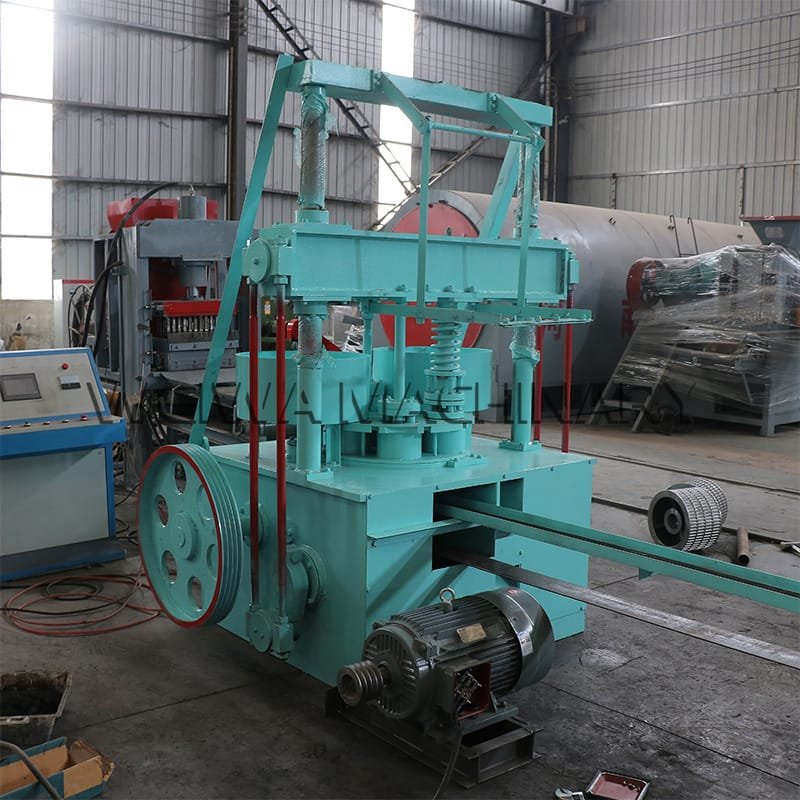
Last month our engineering team at Weiwa Machinery completed a full factory acceptance test for a honeycomb briquette charcoal machine ordered by a client based in Côte d’Ivoire. The buyer did not ask for a generic sales video. He asked for a physical run using his own declared raw material profile, a fixed mold drawing, and a sampling procedure he could show to his partners in Abidjan and Yamoussoukro.
The unit we tested was a single-station rotary table press, not a screw extruder. Many first-time buyers confuse the two. A screw extruder heats material and pushes it through a die, which works for sawdust charcoal sticks but degrades fixed carbon in fine charcoal powder. A honeycomb charcoal coal briquette forming machine forms cold. Powder drops from the hopper into a measuring cup, an auger levels it into the mold cavity on the rotating table, and a fixed punch descends once per index to press the disc and pierce the ventilation holes at the same time. Ejection is cam driven. Because there is no barrel heating, the coal briquettes making machine preserves the calorific value of charcoal dust and lets the operator switch between charcoal-heavy and coal-heavy recipes by adjusting only the feeder gate, punch depth and binder ratio.
Why the Côte d’Ivoire Client Requested a Physical Factory Test?
Côte d’Ivoire consumes biomass for a large share of national cooking and small industrial energy. Around Abidjan, San Pedro and Bouaké, चूरा, ताड़ की गिरी का खोल, cocoa pod husk and imported Indonesian charcoal fines all circulate as fuel feedstock. The client already runs a small planer mill and a charcoal resale counter. His risk was not whether a honeycomb punching machine exists on Alibaba. His risk was whether the exact machine we would ship could turn his local powder blend into 140 mm discs with 19 open holes, survive humidity during monsoon storage, and burn longer than the lump charcoal his competitors already sell.
Sea freight from Qingdao to Abidjan takes several weeks. A wrong mold pitch, a mis-set punch height or a 50 Hz motor plate on a 60 Hz site is cheap to fix in Zhengzhou and expensive to fix in West Africa. So we invited the client to send his material sheet, approve a mold drawing, and watch the run remotely while our QC lead recorded every step. The same USB stick with the 38-minute trial video, burner footage and signed raw material sheet later travelled inside the control cabinet of the machine.
Raw Material Profile Declared by the Ivorian Buyer
The client declared four expected batches. Batch A was hardwood charcoal powder from Ghanaian offcuts. Batch B was anthracite fines from a local importer. Batch C was a 70/30 charcoal coal blend he wanted to brand as premium restaurant briquette. Batch D was rice husk charcoal from northern Côte d’Ivoire. All batches were sieved below 1 मिमी, blended in a horizontal paddle mixer for eight minutes, aged in sealed bags for thirty minutes, then checked with a handheld moisture meter.
For charcoal-led batches we held total moisture between 9 और 11 प्रतिशत. For coal-led batches we accepted 12 को 14 प्रतिशत. Below 8 percent the dust flew and filled the workshop. Above 15 percent the punch stuck and the holes closed. The honeycomb briquette charcoal machine cannot repair a bad recipe. It only amplifies a good one. Binder for Batch A was gelatinized tapioca starch at 2.2 प्रतिशत. Batch B used 5 percent starch plus 1 percent hydrated lime to stop mandrel sticking. Batch C used 2.5 percent starch. Batch D needed 13 percent moisture and 3 percent starch because rice husk char is springy.
Machine Configuration Used in the Trial
The model on the test bench was our WHC-140 honeycomb charcoal coal briquette forming machine. It is the same base frame we export to Ghana, Nigeria, Ethiopia and Congo. The client selected a 140 mm round mold, 75 mm height, 19 holes with 6 mm outer holes and an 8 mm center hole. Motor was 7.5 किलोवाट, 380 V / 50 Hz three-phase to match a future step-down transformer in his workshop. Shaft speed was locked at 406 rpm. Rated stroke is 35 को 45 pieces per minute; observed average across the full run was 38 pieces per minute with no double fill and no stuck ejector.
Rotary Table and Punching Principle
The rotary table carries six mold seats. One seat fills while the adjacent seat is struck, the next ejects, and the rest cool or index. The punch head is a hardened sleeve on four guide columns. A multi-pin punch descends once per index, compressing the powder and piercing the holes in a single stroke. Pressure resistance of the finished piece measured 72 kg average in our lab press for Batch A and 82 kg for Batch B. Density sat at 1.15 को 1.18 g/cm³ depending on recipe. Those numbers matter more than motor power for an end user in Côte d’Ivoire, because a briquette that crumbles at waist height will not survive a motorcycle ride from factory to market.
Mold Change and Local Customization
We showed the client our taper-lock mold seat. Two workers swap a mold in under twenty minutes with standard hand tools. The same honeycomb punching machine accepts 100 मिमी, 120 मिमी, 140 मिमी, 160 mm and 220 mm round molds, plus square, hexagonal and flower-shape molds. For the Ivorian market we discussed a second mold quote: 120 mm 16-hole discs for street food vendors who want three-minute ignition, और 140 mm 21-hole discs for restaurant braziers that need slower burn and less smoke. One powder blend, three SKUs.
Live Sample Display from the Factory Floor
After a 40-minute warm-up run, we stopped the camera on the mold table and sampled the first 200 pieces from Batch A. Average diameter deviation from the 140 mm spec was within 0.4 मिमी. Height variation was within 2 मिमी. Hole walls were parallel, not tapered. Parallel holes mean the briquette burns inward evenly instead of collapsing halfway through the meal. Edge chipping was zero across the sample set.
We then cut one disc vertically with a band saw. The cross-section showed uniform compaction from skin to center. No soft core, no lamination line. The client asked us to tap a coal-led piece with a wrench. It rang like ceramic. That sound, not a brochure photo, is what convinced him the coal briquettes making machine was not a modified brick press.

Controlled Burn Test in a Clay Stove
Sampling is not enough. Combustion decides repeat purchase. We lit one 140 mm Batch A briquette in a standard clay stove with a small amount of kindling and one alcohol gel starter. Ignition occurred at 52 seconds. Steady flame sustained for 81 minutes. Residual ash was 9.4 percent of initial mass. Visible smoke appeared only in the first 40 seconds, then dropped to heat shimmer. Compared with lump charcoal the client sent us earlier, the honeycomb sample gave 31 percent longer burn and noticeably less startup smoke.
Batch B anthracite disc needed a propane assist and lit at 95 seconds, but total burn reached 112 minutes. Batch C 70/30 blend lit at 61 seconds and burned 94 minutes. These are not laboratory ideals. They are the numbers written on the FAT report the client received with the container. A honeycomb briquette charcoal machine in Côte d’Ivoire context must prove this kind of spread because the same machine feeds both a roadside attiéké grill and a bakery oven.
Technical Parameters Confirmed During the Trial
The table below is not catalog marketing. It is the same data stamped on the test report.
| Parameter | WHC-140 Trial Value |
|---|---|
| Motor power | 7.5 किलोवाट, 380 V / 50 Hz |
| Stroke rate | 38 pcs/min average (rated 35–45) |
| Briquette diameter | 140 मिमी (range 100–140 on this base) |
| Briquette height | 75 मिमी (range 60–80) |
| Hole pattern | 19 holes, 6 mm outer, 8 mm center |
| Compressive strength | 72 किलोभास (लकड़ी का कोयला) / 82 किलोभास (coal) |
| Density | 1.15–1.18 g/cm³ |
| Feed moisture | 9–11 % charcoal led, 12–14 % coal led |
| Machine weight | 1400 किलोभास |
| Dimensions | 1320 × 1260 × 1850 मिमी |
Buyers comparing a honeycomb briquette charcoal machine against Indian or Turkish imports usually fixate on price per kilogram of machine weight. The decisive details are shaft speed stability under load, punch seal life and mold change time. Our WHC series uses a hardened punch sleeve rated for more than 400,000 strokes before refacing, and a chrome-plated mold cavity at 0.02 mm thickness that survives roughly 300,000 shots.
How the Honeycomb Shape Improves Combustion?
A honeycomb briquette is a round disc with vertical holes punched through it. The holes are not decoration. They raise the internal surface area, let air enter from the bottom and exit through the top, and split the flame into multiple stable channels. A solid disc of the same diameter smothers itself. A 12-hole disc ignites in three minutes and suits fast street cooking. A 19-hole disc ignites slower but burns longer and smokes less. A 21-hole disc is the restaurant default. The honeycomb charcoal coal briquette forming machine does not change combustion physics. It gives the producer repeatable hole geometry so every bag performs like the sample bag.
Why Hole Count Matters More Than Diameter?
Many first-time buyers specify diameter and forget hole count. For Côte d’Ivoire we recommend 140 mm with 16 holes for general market, 19 holes for restaurants, और 12 holes for vendor skewers. Diameter follows the stove. Hole count follows the burn curve. The same coal briquettes making machine can serve three price tiers from one powder blend if the operator respects that rule.
Binder Chemistry and Recipe Control
A honeycomb punching machine is only as good as the recipe card pinned to the mixer. For charcoal-dominant blends we recommend cassava or tapioca starch at 1.5 को 2.5 प्रतिशत, always gelatinized in boiling water. For coal-dominant blends, lignosulfonate at 1 percent works, or starch at 3 को 5 percent with hydrated lime. Molasses is tempting because it is cheap, but it absorbs humidity during storage and turns the disc soft in August. Clay binder at 4 को 8 percent is acceptable for smokeless coal lumps, never for BBQ charcoal honeycomb.
Dry powders are mixed three minutes before liquid binder is added, then wet-mixed five to eight minutes. If the briquette surface sweats within thirty seconds of ejection, moisture is too high. If edges crumble, binder is too low or punch pressure too soft. The FAT procedure exists so the buyer learns this on our floor, not after the container clears Douala port.
Daily Workflow for the Ivorian Operator
Operators who will run the honeycomb briquette charcoal machine in Côte d’Ivoire can follow a short routine. Screen raw charcoal or coal powder to remove oversized particles and foreign debris. Blend the powder with binder solution in a wheel mixer or forced mixer until uniform. Adjust the hopper gate opening to regulate feed volume. Start the machine and observe the first ten cycles to confirm proper filling of the mold cavity. Collect finished briquettes on a flat curing area and allow them to air-dry for several hours before packing. Grease the guide columns weekly, check V-belt tension monthly, and inspect the punch head and mold sleeve every six months depending on throughput.
Why Côte d’Ivoire Fits the Honeycomb Model?
Côte d’Ivoire already imports lump charcoal from Mali and Burkina Faso, processes sawdust from furniture clusters, and discards cocoa pod shells every harvest. A honeycomb briquette charcoal machine sits between those waste streams and the urban cooking market. Abidjan restaurant districts pay a premium for clean-burning discs that wait staff can stack without soot. Bakery ovens accept coal-led batches because they burn past ninety minutes. Rural distributors accept 120 mm 12-hole discs because they ignite fast on a kerosene-started stove. One machine, three margins.
The same buyer can later add a crusher, a rotary dryer and a wheel mixer to build a full line. Several West African clients start with a single coal briquettes making machine to prove local demand, then return for a 500 kg/h line. We already shipped a sawdust extruder production line to an Abidjan charcoal plant earlier this year, and the honeycomb press in this blog is the complementary product for the same customer segment.
Factory Acceptance Procedure Weiwa Follows
Every honeycomb charcoal coal briquette forming machine leaves our workshop only after a no-load test and a load trial with material close to the buyer’s declared profile. The procedure includes hopper feed check, mold cavity fill check, punch depth verification, hole geometry measurement, random sample compression test, density check, and a controlled ignition test when the buyer requests it. The client receives a multilingual manual, a mold care sheet, a spare-parts list with OEM codes, a wiring diagram, a pre-shipment inspection report with photos, and a one-year warranty certificate excluding consumable molds.
For the Côte d’Ivoire order we also logged the exact auger speed, feeder gate opening in millimeters, and punch cam notch so his local electrician can reproduce the run without guessing. The USB stick inside the cabinet holds the 38-minute trial, the burner footage, and the raw material sheet signed by both sides.
Common Mistakes First-Time Buyers Make
The first mistake is sending us 5 mm coal lumps and calling them powder. The machine wants below 1 मिमी. The second mistake is quoting moisture from the rainy season while planning to produce in the dry season. The third is choosing 22 holes because the photo looks modern, then discovering ignition takes nine minutes. The fourth is asking for a 220 mm disc on a 7.5 kW press; the stroke slows and the holes close. The fifth is treating the honeycomb punching machine as a black box. It is a cold press with a recipe, not a magic box that fixes bad powder.
Weiwa Machinery in Brief
वेइवा मशीनरी, formally Henan Weiwa Machinery Equipment Co., Ltd., has more than twenty years of experience manufacturing charcoal and biomass processing lines. Our product scope covers honeycomb briquette charcoal machines, horizontal carbonization furnaces, निरंतर कार्बोनाइज़र, hammer crushers, wheel mixers, airflow dryers, sawdust extruders and full briquette production lines. Every honeycomb briquette charcoal machine is run before crating, documented with the buyer’s own material when possible, and supported with remote video guidance or on-site commissioning. Our equipment runs in Indonesia, भारत, मलेशिया, वियतनाम, पाकिस्तान, टर्की, पोलैंड, दक्षिण अफ्रीका, इथियोपिया, Ghana, Nigeria, Congo and Côte d’Ivoire.
If you are evaluating a honeycomb briquette charcoal machine in Côte d’Ivoire, a honeycomb charcoal coal briquette forming machine for coal-led fuel, or a coal briquettes making machine to upgrade an existing charcoal workshop, we can run a trial on your powder blend and ship the video with the container. We also help with mold selection, binder recipe, voltage plate, and French/English manual printing.
संपर्क वेइवा मशीनरी
भीड़ / WhatsApp: +86 138 3809 3177
E-mail: info@cjlmachinegroup.com
Weiwa Machinery is a biomass and charcoal equipment manufacturer based in Zhengzhou, चीन, serving more than 130 countries with factory tests, mold customization and production line design.


 WeChat

 +8615937143060
