


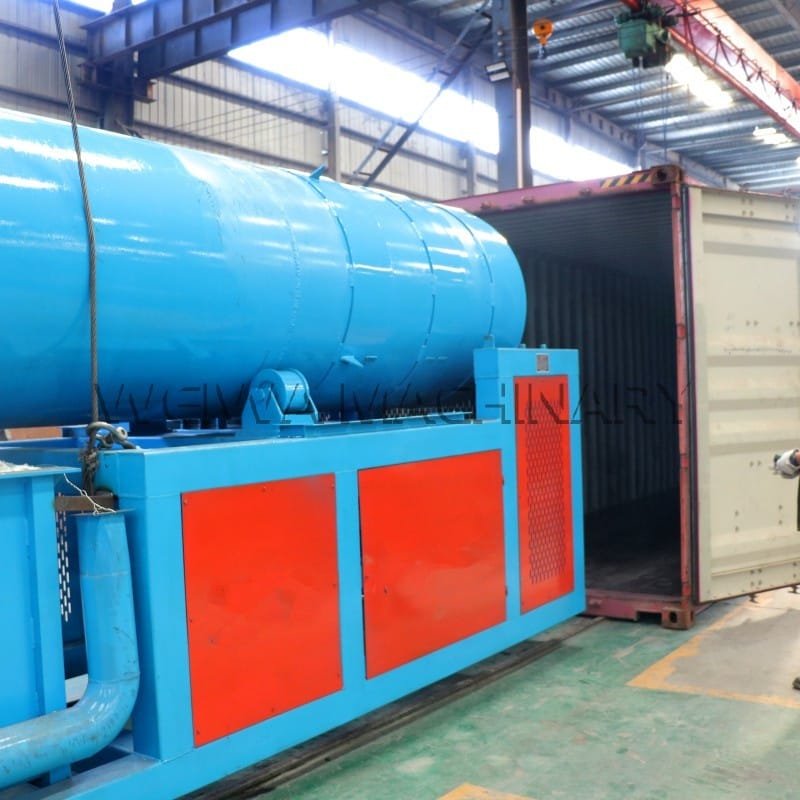
Dispatch Day at the Weiwa Machinery Factory
The morning began before dawn. Our production supervisors conducted a final walkthrough of the continuous carbonization furnace, checking every weld, every sensor, and every conveyor interface. This particular unit had been in fabrication for eleven weeks, moving through our workshop where thirty-plus years of manufacturing experience shaped every stage of the build. The furnace body, with its multi-layer refractory lining and precision-calibrated auger system, was the centerpiece. Around it, our technicians secured the gas recycling pipes, the cooling discharge screw, and the PLC control cabinet that allows operators to monitor the entire carbonization process from a single touchscreen.
As the crane operator lifted the main reactor chamber onto the flatbed truck, a sense of pride was visible across the crew. Many of these workers have been with Weiwa Machinery since the 1990s. Their hands have built hundreds of carbonization systems that now operate across Asia, अफ़्रीका, Europe, and the Americas. This shipment to Canada carried their accumulated knowledge and the reputation of a company that has grown into an industry leader over more than three decades.
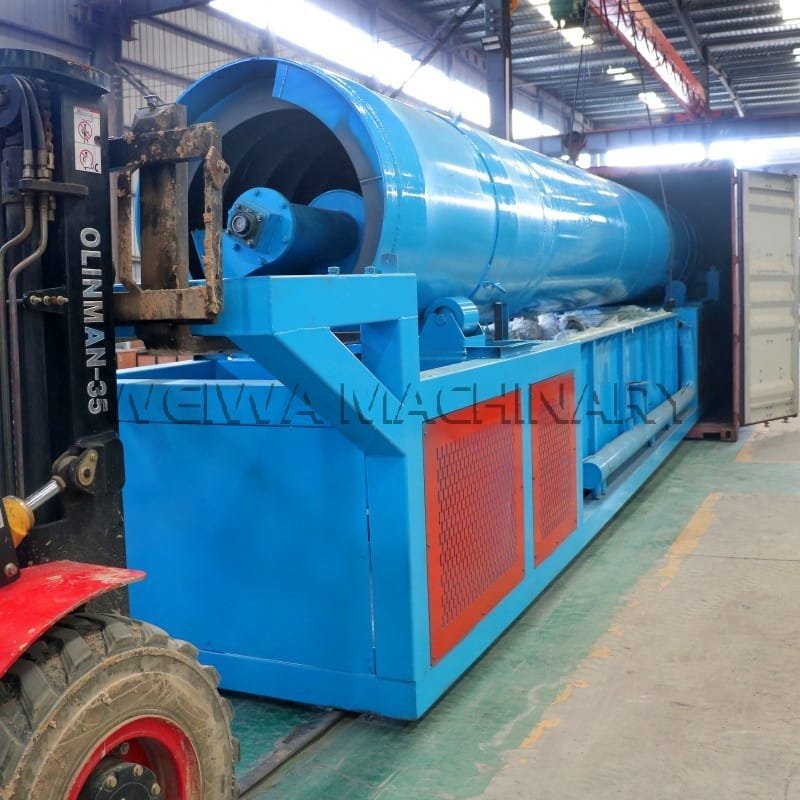
The logistics coordination for exporting a continuous carbonization furnace to Canada involves far more than simply booking freight. Our export team spent two full weeks preparing the documentation, from the bill of lading and commercial invoice to the certificate of origin and the detailed packing list that customs brokers in Vancouver would require. We also pre-arranged the marine insurance and confirmed that the container specifications matched the port handling capabilities at the destination. Every detail mattered because our Canadian client was on a tight project timeline and needed the equipment to arrive ready for installation.
What sets this shipment apart from many others is the destination market itself. Canada is not just buying a machine. Canada is investing in a biochar future, and the continuous carbonization furnace is the engine that will make that future real.
Why Canada Is Turning to Biochar at Scale?
To understand why a continuous carbonization furnace in Indonesia or Nigeria might serve a different purpose than one in Canada, it helps to look at what is happening with biomass policy north of the forty-ninth parallel. Canada holds approximately nine percent of the world’s forests. That is nearly three hundred and seventy million hectares of managed woodland. Every year, forestry operations generate millions of tons of slash, bark, चूरा, और लकड़ी के चिप्स. Traditionally, much of this residue was either burned in the open or left to decompose, releasing carbon dioxide and methane into the atmosphere. आज, that same residue is increasingly viewed as a valuable feedstock for biochar production.
The Canadian government has set an ambitious target of net-zero emissions by twenty fifty. Within that framework, biochar has emerged as one of the few carbon-negative technologies available at commercial scale. When biomass is heated in the oxygen-limited environment of a continuous carbonization furnace, the carbon that the trees pulled from the atmosphere becomes locked into a stable, solid form. That solid biochar can remain in the soil for hundreds or even thousands of years. Research from the University of British Columbia and the University of Saskatchewan has demonstrated that applying biochar to agricultural soils across the Canadian prairies can improve water retention, reduce fertilizer runoff, and increase crop yields, all while sequestering carbon.
Beyond agriculture, Canadian environmental regulations are beginning to recognize biochar as a tool for mine reclamation, wetland restoration, and stormwater filtration. Provinces such as British Columbia and Alberta have introduced grant programs that support biochar pilot projects, and the federal government’s Clean Fuel Regulations create a market signal that favors low-carbon fuels and carbon removal technologies. For entrepreneurs and established forestry companies alike, investing in a continuous carbonization furnace is no longer just an environmental gesture. It is becoming a sound business decision.
The challenge, however, has always been finding equipment that can handle Canadian biomass varieties reliably and at the scale that makes economic sense. Softwood sawdust, pine bark, and mixed hardwood chips each behave differently inside a carbonization reactor. The moisture content in Canadian feedstock can swing dramatically between summer and winter. This is precisely where the engineering behind our continuous carbonization furnace for Canada becomes critical.
Engineering Features That Matter for the Canadian Market
When our Canadian client first contacted Weiwa Machinery through our website inquiry form, their primary concern was consistency. They needed a continuous carbonization furnace that could process between eight hundred and twelve hundred kilograms of biomass per hour, day after day, without the temperature fluctuations that plague lower-quality systems. Our response was to walk them through the design details that have been refined across more than thirty years of continuous improvement.
Precision Temperature Control Across Four Independent Zones
The furnace features four independently controlled heating zones, each monitored by K-type thermocouples linked to the PLC system. This allows the operator to set different temperature profiles depending on the feedstock. For Canadian softwood sawdust, which carbonizes efficiently at around four hundred and fifty degrees Celsius, the first zone acts as a pre-drying chamber while the subsequent zones reach the optimal pyrolysis temperature. The result is a stable output of high-quality biochar with a fixed carbon content that typically exceeds sixty-five percent.
Closed-Loop Combustion Gas Recycling
One of the standout features of our continuous carbonization furnace for sale is the closed-loop gas recycling system. During carbonization, the process releases combustible syngas. In our design, this gas is drawn through a purification system, then fed back into the combustion chamber as fuel. This dramatically reduces external energy requirements. In many operating scenarios, once the furnace reaches its operating temperature, the additional fuel needed from outside sources drops close to zero. For Canadian operators facing high energy costs, this self-sustaining cycle translates directly into lower operating expenses.
Heavy-Duty Construction for Harsh Climates
Canada’s climate demands robust engineering. The continuous carbonization furnace shipped this week includes upgraded insulation rated for continuous operation in ambient temperatures as low as minus thirty degrees Celsius. The control cabinet is equipped with a positive-pressure heating and ventilation unit to ensure the electronics remain within their specified operating range even when the equipment is installed in an unheated industrial building. These may seem like small details, but for a Canadian buyer, they determine whether the machine runs reliably through a prairie winter.
Dust Collection and Emission Compliance
Environmental compliance is non-negotiable for any continuous carbonization furnace in Canada. Our system integrates a multi-stage dust removal and wet scrubbing system that brings particulate emissions well within the limits set by Environment and Climate Change Canada. The scrubber uses a closed-loop water system with minimal discharge, addressing the water conservation concerns that are particularly relevant in western Canadian provinces.
Each of these features contributed to the client’s decision to move forward with Weiwa Machinery. But the equipment itself was only part of the equation. The other part was the human element, the technical support that our company has built its reputation on since 1990.
Installation and After-Sales Support Across Borders
Buying a continuous carbonization furnace is a significant capital investment. For our Canadian client, knowing that Weiwa Machinery has a mature technical team capable of traveling overseas for on-site installation and training was a decisive factor. Our engineers have installed equipment in more than thirty countries, from Southeast Asia to South America, from the Middle East to Eastern Europe. We understand the complexities of working across different electrical standards, different languages, and different regulatory environments.
For this Canadian project, our technical team will arrive on-site approximately three weeks after the furnace clears customs. They will oversee the unloading, positioning, and mechanical assembly of the system. Then comes the electrical connection, the calibration of sensors, and the critical first test run using locally sourced biomass. During this phase, our engineers work side by side with the client’s operators, transferring the knowledge needed to run the continuous carbonization furnace safely and efficiently. This hands-on training typically lasts between seven and ten days, depending on the complexity of the client’s production goals.
Beyond the initial installation, our after-sales protocol includes a three-month remote monitoring period. Using the PLC’s remote access capability, our engineers in China can log into the system, review operating data, and provide optimization recommendations. This level of ongoing support ensures that the continuous carbonization furnace in Canada continues to perform at peak efficiency long after our team has returned home.
The combination of battle-tested equipment and responsive technical support is why Weiwa Machinery has maintained long-term relationships with clients around the world. It is also why we continue to receive inquiries about continuous carbonization furnace price from buyers who have seen our machines operating in the field and want the same reliability for their own projects.
Understanding निरंतर कार्बनकरण भट्ठी Price in the Canadian Context
No discussion of purchasing industrial equipment would be complete without addressing cost. The continuous carbonization furnace price depends on several variables, including capacity, the level of automation, the specific emission control equipment required for the destination country, and the choice of refractory materials. For the Canadian market, we typically recommend configurations that include the full wet scrubbing system and the cold-climate insulation package, which adds to the base price but ensures compliance and reliability.
When evaluating continuous carbonization furnace price, Canadian buyers should also consider the total cost of ownership. A lower-priced furnace from an inexperienced manufacturer may seem attractive on a pro forma, but the costs of frequent downtime, premature refractory failure, and non-compliance with environmental regulations can quickly exceed any initial savings. वेइवा मशीनरी में, we price our equipment competitively, but we never cut corners on the components that determine long-term performance. Our clients are investing in a system designed to operate for ten to fifteen years with proper maintenance, not a disposable machine that will need replacement in three.
We also recognize that access to capital can be a barrier for smaller operators. That is why we work with our Canadian clients to provide detailed equipment specifications and performance data that they can present to lenders or grant programs. Several of our clients have successfully secured financing by demonstrating the revenue potential from biochar sales combined with the carbon credit opportunities that biochar projects can generate under emerging Canadian carbon pricing mechanisms.
If you are currently comparing continuous carbonization furnace price quotes from different suppliers, we encourage you to look beyond the number on the first page of the proposal. Ask about the refractory material grade, the thickness of the reactor shell, the brand of the PLC components, and the track record of the manufacturer. These details tell you far more about the real value of the equipment than the price alone.
Market Outlook: The Future of Continuous Carbonization in Canada
Looking ahead, the prospects for continuous carbonization furnace adoption in Canada appear exceptionally strong. The convergence of several factors is creating a perfect environment for growth. पहला, the volume of available biomass is increasing as forestry companies seek higher-value uses for residual fiber. दूसरा, carbon pricing mechanisms are making biochar production economically attractive. तीसरा, the agricultural sector’s interest in soil health and carbon sequestration is driving demand for biochar as a soil amendment. And fourth, public and private investment in clean technology is at an all-time high.
We are already in discussions with additional Canadian clients about projects ranging from small-scale mobile units designed for sawmill residues to large fixed installations capable of processing several tons per hour. The interest is not limited to British Columbia and Alberta. We have received serious inquiries from Ontario, Quebec, and the Atlantic provinces. Each region has its own biomass profile and its own regulatory landscape, but the underlying need is the same: a reliable, कुशल, and environmentally compliant continuous carbonization furnace.
For companies evaluating a continuous carbonization furnace for sale, the Canadian market offers a compelling combination of feedstock availability, policy support, and end-market demand. Those who move early will be best positioned to capture the value as the biochar sector matures over the next decade.
क्यों चुनें? वेइवा मशीनरी?
Weiwa Machinery was founded in 1990. Over the past thirty-plus years, we have grown into a recognized industry leader in the design and manufacturing of carbonization equipment. Our company operates a large-scale manufacturing facility with advanced machining centers, welding workshops, and a dedicated quality control laboratory. We employ a mature technical team that includes mechanical engineers, electrical engineers, and field service technicians, many of whom have been with the company for more than twenty years. This depth of experience allows us to handle complex, customized projects that newer manufacturers simply cannot manage.
Our commitment to quality is reflected in every continuous carbonization furnace that leaves our factory. From the selection of raw materials to the final factory acceptance test, we maintain rigorous quality standards at every step. We have supplied equipment to clients in more than forty countries, and our machines are known for their durability, efficiency, और संचालन में आसानी.
Most importantly, we stand behind our products. When you purchase a continuous carbonization furnace from Weiwa Machinery, you are not just buying a piece of equipment. You are gaining a long-term partner. Our technical team is available to travel to your site anywhere in the world for installation guidance, operator training, and ongoing technical support. We understand that your success is our success, and we are committed to helping you achieve your production goals.
If you are exploring a continuous carbonization furnace for Canada or any other market, we invite you to reach out to our team. Whether you need a detailed quotation, a customized equipment proposal, or simply want to learn more about how continuous carbonization technology can work for your specific biomass and production requirements, we are here to help.
Contact Weiwa Machinery today:
Mobile / WhatsApp: +8613838093177
ईमेल: info@cjlmachinegroup.com
Let us put more than thirty years of carbonization expertise to work for your project. The future of biochar in Canada is bright, and we are ready to help you be part of it.


 WeChat

 +8615937143060
