


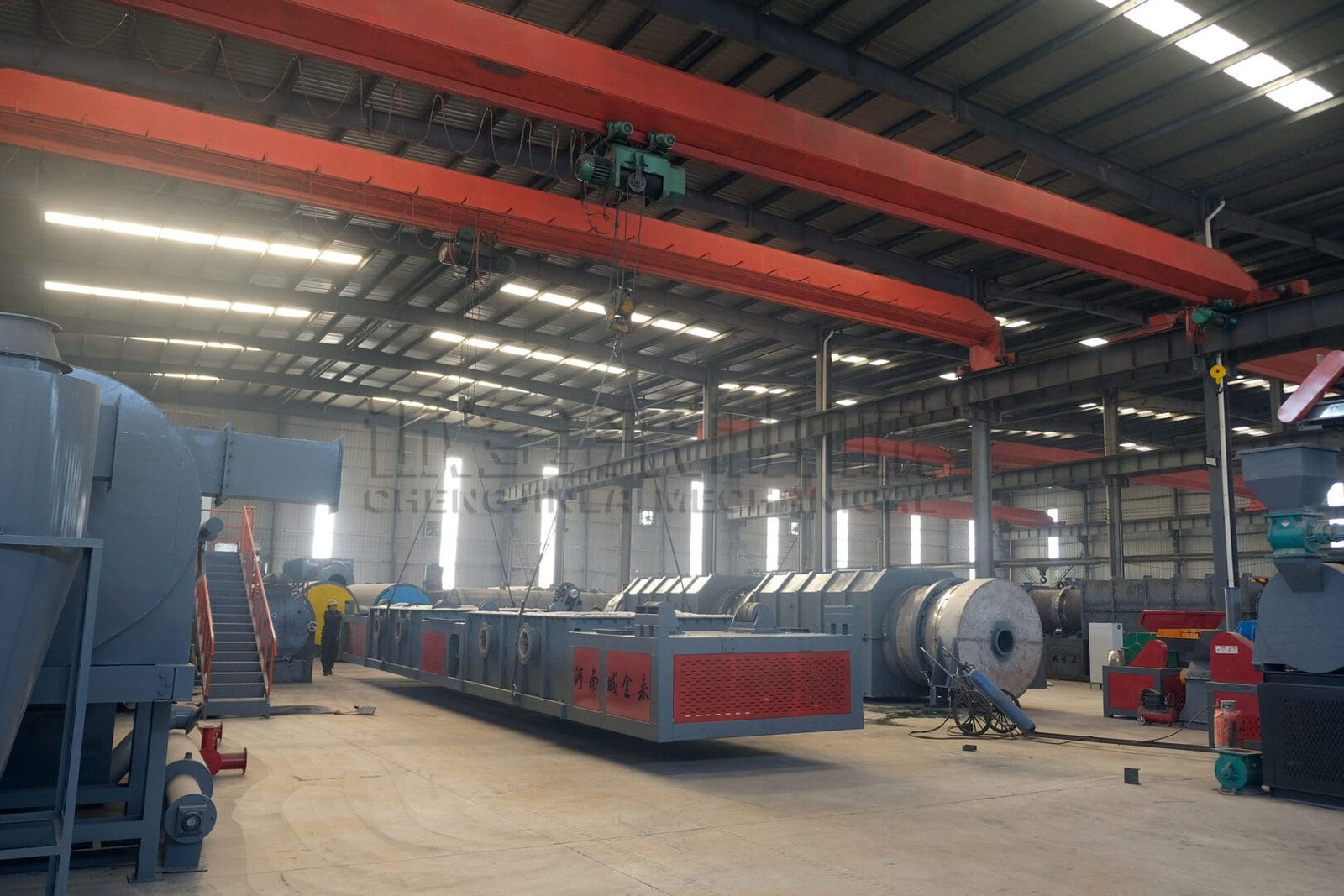
Indonesia has become one of the most dynamic markets for biomass utilization in Southeast Asia. As a professional manufacturer of charcoal production equipment, Weiwa Machinery recently completed an on-site trial of our continuous carbonization furnace at a client’s palm kernel shell processing site in Sumatra.
Understanding the निरंतर कार्बनकरण भट्ठी
A continuous carbonization furnace is designed to convert biomass feedstocks into high-quality biochar through a controlled pyrolysis process without interrupting operation. Unlike batch-type kilns, this system allows raw materials such as palm kernel shells, नारियल के गोले, लकड़ी के टुकड़े, and rice husks to enter the furnace continuously while carbonized output is discharged steadily. For large-scale operations, especially in tropical regions with abundant agricultural residues, this technology offers consistent productivity and predictable quality.
The core advantage of a continuous carbonization furnace lies in its ability to maintain stable internal temperatures and gas flow. By optimizing residence time and heating rates, operators can control fixed carbon content, volatile matter, and ash levels. In Indonesia, where palm kernel shells are widely available, a continuous carbonization furnace for PKS enables factories to transform low-value waste into dense, energy-rich biochar suitable for fuel, भूमि संशोधन, and industrial applications.
Key Components of the System
During the trial in Indonesia, our engineers installed a complete production line consisting of a feeding conveyor, pre-drying unit, मुख्य कार्बोनाइजेशन कक्ष, cooling screw, and gas recycling system. The feeding section regulates material input speed to match furnace capacity. The pre-drying unit reduces moisture content before pyrolysis, which improves thermal efficiency. Inside the main chamber, biomass undergoes oxygen-limited decomposition, releasing syngas that is recycled to supply heat. The cooling screw stabilizes biochar temperature before storage, preventing spontaneous combustion.
This integrated design ensures that a continuous carbonization furnace operates safely and efficiently under tropical conditions. Indonesian clients often emphasize reliability, since high humidity and seasonal rainfall can disrupt traditional charcoal production methods. Our equipment addresses these challenges through sealed construction and automated controls.
On-Site Trial of Continuous Carbonization Furnace for PKS in Indonesia
The field test took place at a palm oil mill located near Jambi, Sumatra. The client had previously relied on simple earth kilns but faced inconsistent charcoal quality and excessive smoke emissions. After evaluating several suppliers, they selected Weiwa Machinery’s continuous carbonization furnace due to its proven track record in Southeast Asia and transparent continuous carbonization furnace price structure.
During the first day of commissioning, our technical team calibrated the feeding rate and monitored furnace temperature profiles. Palm kernel shells were fed continuously at approximately 800 kilograms per hour. Within two hours, the system reached optimal carbonization temperature between 450 और 550 डिग्री सेल्सियस. Smoke generated during pyrolysis was captured and redirected into the combustion chamber, eliminating visible emissions and complying with environmental requirements.
By the third day, the client began collecting finished biochar samples for laboratory analysis. Results showed fixed carbon content above 70 प्रतिशत, moisture below 5 प्रतिशत, and ash content within acceptable limits for export-grade charcoal. The client noted that the continuous carbonization furnace produced uniform particles with minimal fines, which simplified downstream handling and packaging.
Operational Observations from the Trial
One important observation involved energy consumption. Thanks to the gas recycling system, the continuous carbonization furnace reduced external fuel demand by more than 40 percent compared to conventional kilns. Operators also appreciated the automated control panel, which allowed real-time adjustment of temperature and feeding speed. Even during short power interruptions, the system maintained stable internal pressure, avoiding safety risks.
Another notable outcome was the reduction of labor intensity. Previously, workers manually loaded and unloaded charcoal batches, exposing themselves to heat and dust. With the continuous carbonization furnace in Indonesia, the process became enclosed and mechanized, improving workplace safety and reducing manpower requirements by nearly half.
Performance Evaluation of Charcoal Making Machine in Indonesia
From a technical perspective, the trial confirmed that a modern charcoal making machine in Indonesia must meet three criteria: high throughput, environmental compliance, and ease of maintenance. Our continuous carbonization furnace satisfied all three. Daily output exceeded 18 tons of biochar, aligning with the client’s production targets. Emission levels remained well below local regulatory thresholds, and routine maintenance required only basic cleaning and periodic inspection of refractory linings.
Product quality also met international standards. Buyers in Japan and South Korea have increasingly demanded biochar derived from PKS due to its high calorific value and low sulfur content. The continuous carbonization furnace enabled the Indonesian client to access these premium markets without investing in costly post-processing equipment.
Economic Impact on Local Operations
Beyond technical performance, the project delivered measurable economic benefits. By converting palm kernel shells into biochar, the client reduced waste disposal costs and generated new revenue streams. At current market prices, high-grade PKS charcoal commands a significant premium over raw shells. When calculating return on investment, the continuous carbonization furnace price proved competitive when amortized over a five-year operational horizon.
Local employment also improved. Although automation reduced manual loading tasks, the facility hired additional staff for quality control, logistics, and equipment monitoring. This balanced approach aligns with Indonesia’s emphasis on sustainable industrial development and community-oriented growth.
Market Outlook for Continuous Carbonization Furnace in Indonesia
Indonesia produces millions of tons of palm kernel shells annually, yet a large portion remains underutilized. As global demand for renewable energy and carbon-negative materials rises, continuous carbonization furnace in Indonesia will play a pivotal role in transforming agricultural residues into valuable commodities. Government incentives for clean energy projects further support adoption of advanced charcoal making machines.
Export potential remains strong. Countries across East Asia and Europe seek reliable supplies of biochar for metallurgical processes, activated carbon production, and soil enhancement. A continuous carbonization furnace provides the consistency required for long-term trade relationships. Moreover, as carbon credit markets mature, producers using efficient carbonization technologies may qualify for additional financial incentives.
Trends Shaping Future Demand
Several trends indicate sustained growth for continuous carbonization furnace for PKS. पहला, tightening environmental regulations discourage open burning and inefficient kilns. दूसरा, rising energy costs encourage factories to adopt self-sufficient systems that recycle syngas. तीसरा, increasing awareness of biochar’s agronomic benefits drives demand from plantation operators seeking to improve soil fertility while sequestering carbon.
Weiwa Machinery anticipates that charcoal making machine in Indonesia will evolve toward higher automation, smarter process controls, and modular designs that allow easy capacity expansion. Our ongoing research focuses on integrating IoT sensors for predictive maintenance and optimizing furnace geometry to handle diverse feedstocks beyond PKS, including empty fruit bunches and municipal green waste.
Why Choose Weiwa Machinery for Continuous Carbonization Furnace Projects?
Selecting the right equipment partner is critical for long-term success. Weiwa Machinery combines engineering expertise with practical field experience across Asia, अफ़्रीका, and Latin America. Our continuous carbonization furnace designs reflect years of refinement based on customer feedback and real-world operating data. We provide comprehensive after-sales support, including remote troubleshooting, spare parts supply, and operator training.
Pricing transparency is another differentiator. We offer detailed quotations that break down continuous carbonization furnace price components, helping clients plan capital expenditure accurately. Rather than promoting generic solutions, we tailor configurations to specific feedstocks, climate conditions, and production goals. This approach minimizes operational risks and accelerates project payback.
For businesses exploring a charcoal making machine in Indonesia, Weiwa Machinery offers end-to-end services—from feasibility studies and factory layout design to installation supervision and performance optimization. Our commitment extends beyond equipment delivery; we aim to build lasting partnerships that contribute to sustainable industrial development.
निष्कर्ष
The successful field test of our continuous carbonization furnace in Indonesia demonstrates the viability of large-scale biochar production using palm kernel shells. Stable operation, excellent product quality, and positive economic outcomes validate the suitability of this technology for Indonesian conditions. As market demand grows, continuous carbonization furnace for PKS will remain central to biomass valorization strategies.
Weiwa Machinery stands ready to support investors, plantation owners, and energy companies seeking reliable charcoal making machines in Indonesia. By combining advanced engineering with practical know-how, we help clients turn abundant biomass resources into profitable, environmentally responsible products.
संपर्क वेइवा मशीनरी
भीड़: +8613838093177
Whatsapp: +8613838093177
ई-मेल: info@cjlmachinegroup.com


 WeChat

 +8615937143060
